Department of Chemistry, University of Wisconsin-Madison, Madison, WI 53706, USA.
Science. 2011 Jul 8;333(6039):209-13. doi: 10.1126/science.1204183. Epub 2011 Jun 9.
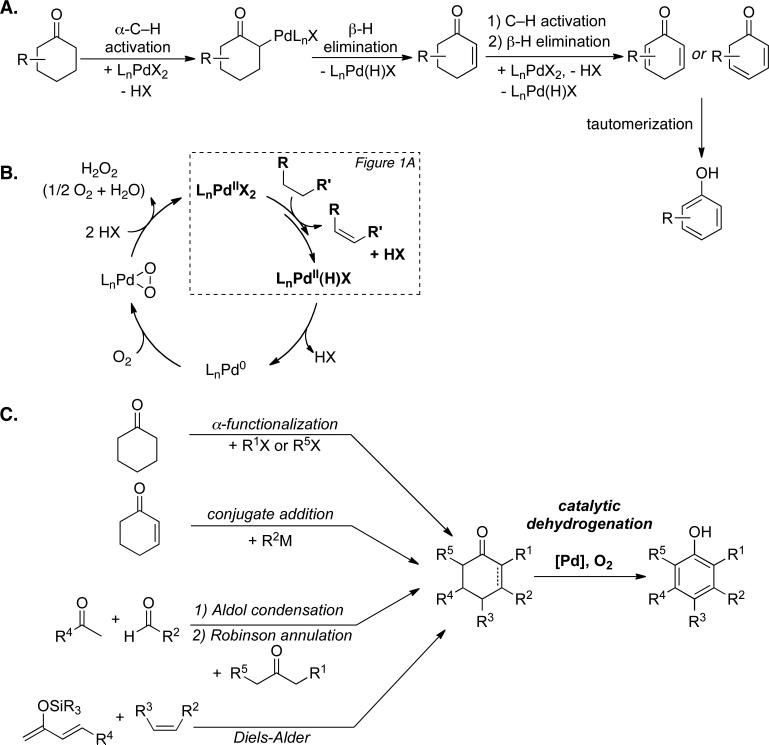
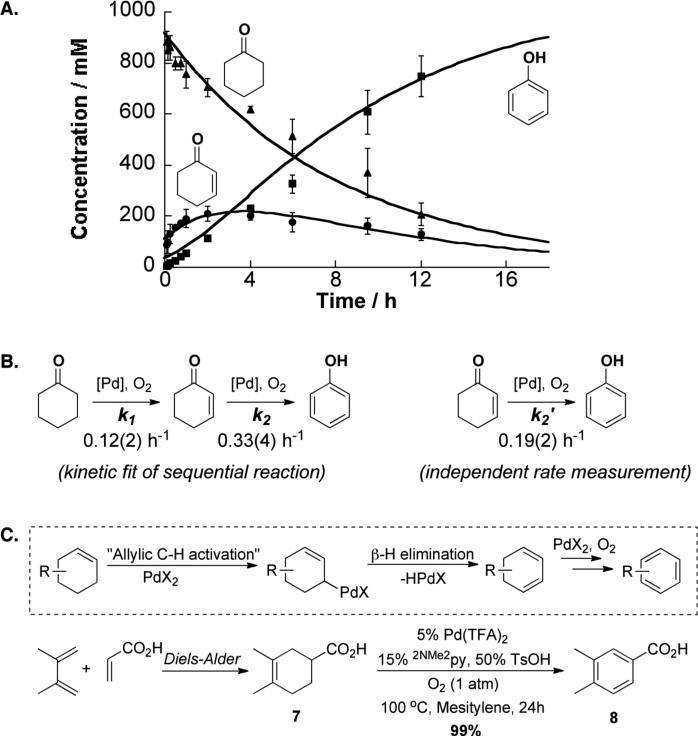
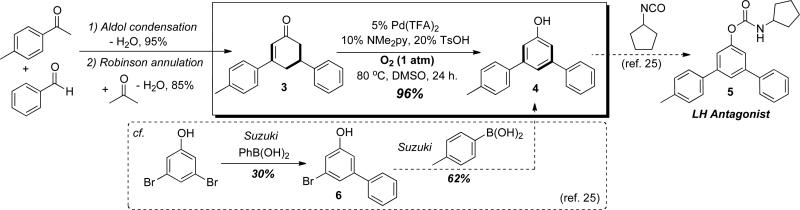
Aromatic molecules are key constituents of many pharmaceuticals, electronic materials, and commodity plastics. The utility of these molecules directly reflects the identity and pattern of substituents on the aromatic ring. Here, we report a palladium(II) catalyst system, incorporating an unconventional ortho-dimethylaminopyridine ligand, for the conversion of substituted cyclohexanones to the corresponding phenols. The reaction proceeds via successive dehydrogenation of two saturated carbon-carbon bonds of the six-membered ring and uses molecular oxygen as the hydrogen acceptor. This reactivity demonstrates a versatile and efficient strategy for the synthesis of substituted aromatic molecules with fundamentally different selectivity constraints from the numerous known synthetic methods that rely on substitution of a preexisting aromatic ring.
芳香族分子是许多药物、电子材料和大宗商品塑料的关键组成部分。这些分子的用途直接反映了芳香环上取代基的特征和模式。在这里,我们报告了一种钯(II)催化剂体系,它包含一种非传统的邻二甲氨基吡啶配体,可将取代的环己酮转化为相应的苯酚。该反应通过六元环中两个饱和碳-碳键的连续脱氢进行,并且使用分子氧作为氢受体。这种反应性展示了一种多功能且有效的策略,用于合成具有与众多依赖于取代预先存在的芳香环的已知合成方法根本不同的选择性约束的取代芳香族分子。