Colder Brian
Colder Scientific McLean, VA, USA.
Front Hum Neurosci. 2011 May 27;5:54. doi: 10.3389/fnhum.2011.00054. eCollection 2011.
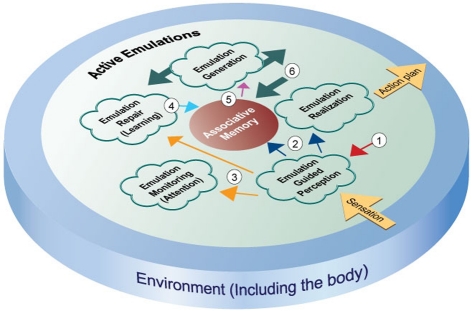
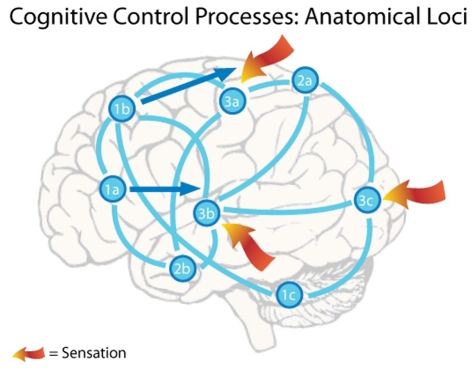
Emulations, defined as ongoing internal representations of potential actions and the futures those actions are expected to produce, play a critical role in directing human bodily activities. Studies of gross motor behavior, perception, allocation of attention, response to errors, interoception, and homeostatic activities, and higher cognitive reasoning suggest that the proper execution of all these functions relies on emulations. Further evidence supports the notion that reinforcement learning in humans is aimed at updating emulations, and that action selection occurs via the advancement of preferred emulations toward realization of their action and environmental prediction. Emulations are hypothesized to exist as distributed active networks of neurons in cortical and sub-cortical structures. This manuscript ties together previously unrelated theories of the role of prediction in different aspects of human information processing to create an integrated framework for cognition.
模拟被定义为对潜在行动以及这些行动预期产生的未来的持续内部表征,在指导人类身体活动中起着关键作用。对粗大运动行为、感知、注意力分配、错误反应、内感受和稳态活动以及高级认知推理的研究表明,所有这些功能的正确执行都依赖于模拟。进一步的证据支持这样一种观点,即人类的强化学习旨在更新模拟,并且行动选择是通过将偏好的模拟推进到其行动和环境预测的实现来发生的。据推测,模拟作为皮质和皮质下结构中神经元的分布式活跃网络而存在。本手稿将先前在人类信息处理不同方面预测作用的不相关理论联系在一起,以创建一个综合的认知框架。