Vaccine Research Center, National Institute of Allergy and Infectious Diseases, National Institutes of Health, Bethesda, MD 20892-3027, USA.
J Biomol NMR. 2011 Jul;50(3):197-207. doi: 10.1007/s10858-011-9506-4. Epub 2011 Jun 12.
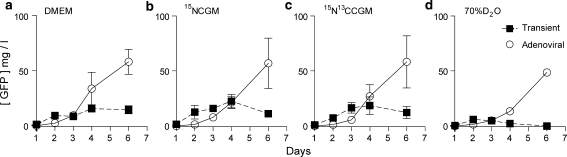
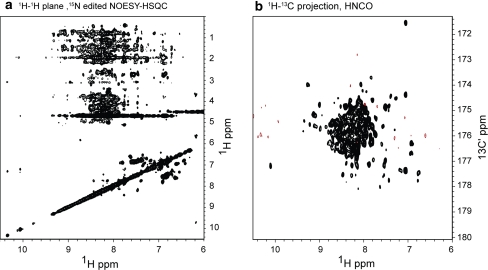
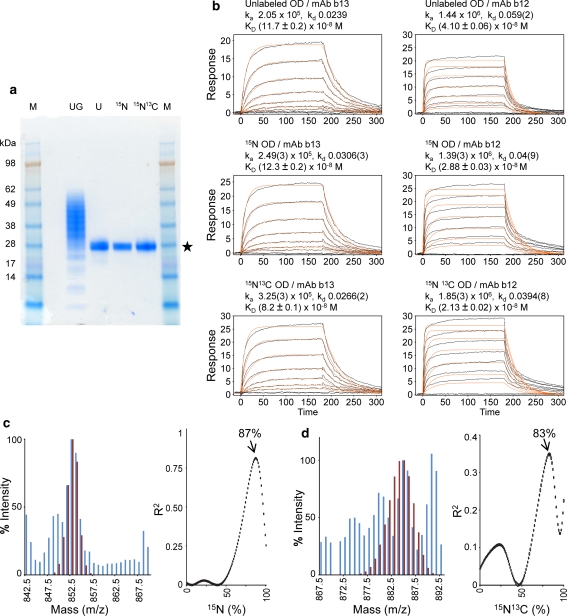
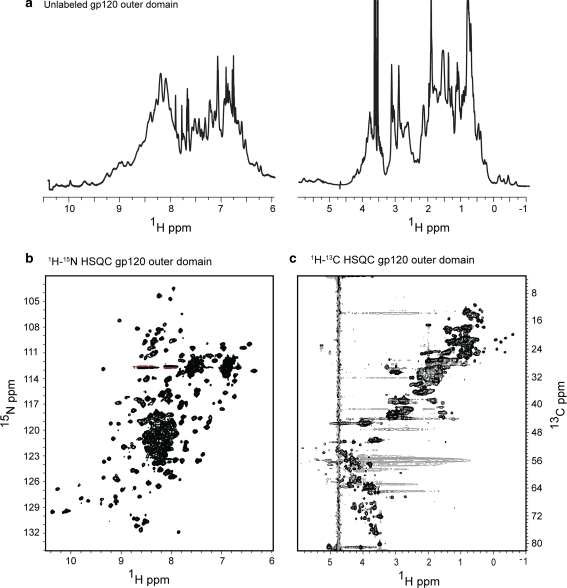
NMR spectroscopic characterization of the structure or the dynamics of proteins generally requires the production of samples isotopically enriched in (15)N, (13)C, or (2)H. The bacterial expression systems currently in use to obtain isotopic enrichment, however, cannot produce a number of eukaryotic proteins, especially those that require post-translational modifications such as N-linked glycosylation for proper folding or activity. Here, we report the use of an adenovirus vector-based mammalian expression system to produce isotopically enriched (15)N or (15)N/(13)C samples of an outer domain variant of the HIV-1 gp120 envelope glycoprotein with 15 sites of N-linked glycosylation. Yields for the (15)N- and (15)N/(13)C-labeled gp120s after affinity chromatography were 45 and 44 mg/l, respectively, with an average of over 80% isotope incorporation. Recognition of the labeled gp120 by cognate antibodies that recognize complex epitopes showed affinities comparable to the unlabeled protein. NMR spectra, including (1)H-(15)N and (1)H-(13)C HSQCs, (15)N-edited NOESY-HSQC, and 3D HNCO, were of high quality, with signal-to-noise consistent with an efficient level of isotope incorporation, and with chemical shift dispersion indicative of a well-folded protein. The exceptional protein yields, good isotope incorporation, and ability to obtain well-folded post-translationally modified proteins make this mammalian system attractive for the production of isotopically enriched eukaryotic proteins for NMR spectroscopy.
NMR 光谱学对蛋白质结构或动力学的研究通常需要制备同位素(15)N、(13)C 或(2)H 标记的样品。然而,目前用于获得同位素富集的细菌表达系统无法生产出许多真核蛋白质,特别是那些需要翻译后修饰(如 N 连接糖基化)以正确折叠或发挥活性的蛋白质。在这里,我们报告了使用基于腺病毒载体的哺乳动物表达系统来生产具有 15 个 N 连接糖基化位点的 HIV-1 gp120 包膜糖蛋白外域变体的同位素(15)N 或(15)N/(13)C 标记样品。亲和层析后(15)N-和(15)N/(13)C 标记 gp120 的产量分别为 45 和 44mg/L,平均同位素掺入率超过 80%。与未标记蛋白相比,对识别复杂表位的同源抗体的标记 gp120 的识别具有相当的亲和力。NMR 谱,包括(1)H-(15)N 和(1)H-(13)C HSQCs、(15)N 编辑的 NOESY-HSQC 和 3D HNCO,具有高质量,信噪比与高效的同位素掺入一致,并且化学位移分散表明蛋白质折叠良好。这种哺乳动物系统在生产用于 NMR 光谱学的同位素标记真核蛋白质方面具有出色的蛋白质产量、良好的同位素掺入率和获得翻译后修饰的折叠良好的蛋白质的能力,因此非常有吸引力。