Service d'Anesthésie-Réanimation 1, Hôpital Pontchaillou, 2 rue Henri Le Guilloux, 35000 Rennes, France.
Crit Care. 2011;15(3):222. doi: 10.1186/cc10097. Epub 2011 Jun 7.
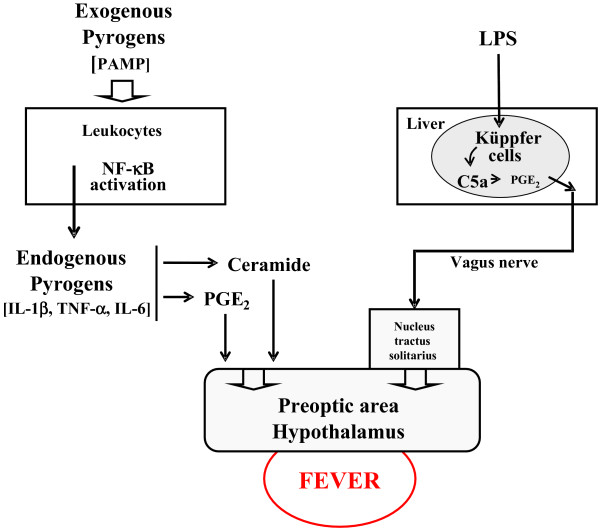
In recent years, fever control in critically ill patients by medications and/or external cooling has gained widespread use, notably in patients suffering from neurological injuries. Nevertheless, such a strategy in septic patients is not supported by relevant data. Indeed, in response to sepsis, experimental and clinical studies argue that fever plays a key role in increasing the clearance of microorganisms, the immune response and the heat shock response. Moreover, fever is a cornerstone diagnostic sign in clinical practice, which aids in early and appropriate therapy, and allows physicians to follow the infection course. After discussing the physiological aspects of fever production, the present review aims to delineate the advantages and drawbacks of fever in septic patients. Finally, the treatment of fever by pharmacological and/or physical means is discussed with regards to their drawbacks, which argues for their careful use in septic patients in the absence of clinical relevance.
近年来,通过药物和/或外部冷却来控制危重病患者的发热已经得到广泛应用,尤其是在患有神经损伤的患者中。然而,这种策略在脓毒症患者中并没有相关数据支持。事实上,针对脓毒症,实验和临床研究表明,发热在增加微生物清除、免疫反应和热休克反应方面起着关键作用。此外,发热是临床实践中的一个重要诊断标志,有助于早期和适当的治疗,并使医生能够跟踪感染过程。在讨论了发热产生的生理方面之后,本综述旨在阐述发热对脓毒症患者的利弊。最后,讨论了通过药理学和/或物理手段治疗发热的优缺点,鉴于其在缺乏临床相关性的情况下对脓毒症患者的使用应谨慎。