Psychology Department, McGill University, Montreal, Canada.
PLoS One. 2011;6(6):e20304. doi: 10.1371/journal.pone.0020304. Epub 2011 Jun 1.
Animal and human adult studies reveal a contribution of serotonin to behavior regulation. Whether these findings apply to children is unclear. The present study investigated serotonergic functioning in boys with a history of behavior regulation difficulties through a double-blind, acute tryptophan supplementation procedure.
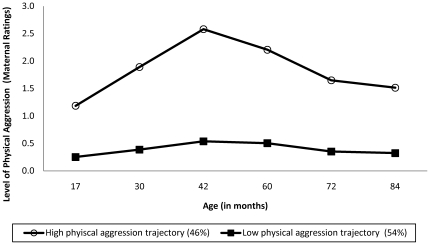
Participants were 23 boys (age 10 years) with a history of elevated physical aggression, recruited from a community sample. Eleven were given a chocolate milkshake supplemented with 500 mg tryptophan, and 12 received a chocolate milkshake without tryptophan. Boys engaged in a competitive reaction time game against a fictitious opponent, which assessed response to provocation, impulsivity, perspective taking, and sharing. Impulsivity was further assessed through a Go/No-Go paradigm. A computerized emotion recognition task and a staged instrumental help incident were also administered.
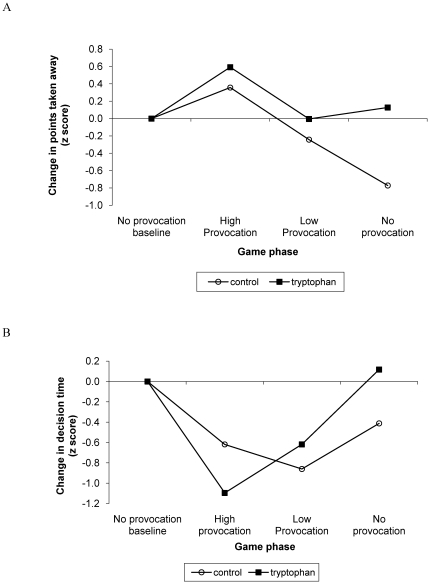
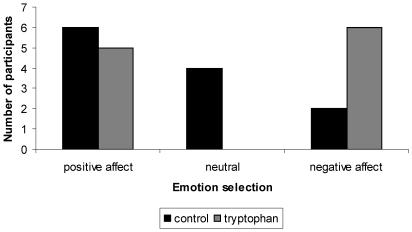
Boys, regardless of group, responded similarly to high provocation by the fictitious opponent. However, boys in the tryptophan group adjusted their level of responding optimally as a function of the level of provocation, whereas boys in the control group significantly decreased their level of responding towards the end of the competition. Boys in the tryptophan group tended to show greater perspective taking, tended to better distinguish facial expressions of fear and happiness, and tended to provide greater instrumental help to the experimenter.
The present study provides initial evidence for the feasibility of acute tryptophan supplementation in children and some effect of tryptophan supplementation on children's behaviors. Further studies are warranted to explore the potential impact of increased serotonergic functioning on boys' dominant and affiliative behaviors.
动物和人类的成人研究表明,血清素对行为调节有一定作用。这些发现是否适用于儿童尚不清楚。本研究通过双盲、急性色氨酸补充程序,调查了有行为调节困难史的男孩的血清素功能。
参与者为 23 名(年龄 10 岁)有过升高的身体攻击史的男孩,来自社区样本。其中 11 名被给予含有 500mg 色氨酸的巧克力奶昔,而 12 名则被给予不含色氨酸的巧克力奶昔。男孩们与一个虚构的对手进行竞争性反应时间游戏,该游戏评估了对挑衅的反应、冲动、换位思考和分享能力。冲动性还通过 Go/No-Go 范式进行评估。还进行了计算机化情绪识别任务和阶段性仪器帮助事件。
无论组内如何,男孩们对虚构对手的高挑衅反应相似。然而,色氨酸组的男孩会根据挑衅的程度优化调整自己的反应水平,而对照组的男孩在比赛接近尾声时则明显降低了反应水平。色氨酸组的男孩往往表现出更好的换位思考能力,更能准确区分恐惧和幸福的面部表情,并且更倾向于为实验者提供更多的仪器帮助。
本研究初步证明了急性色氨酸补充在儿童中的可行性,以及色氨酸补充对儿童行为的一些影响。需要进一步的研究来探索增加血清素功能对男孩主导和亲和行为的潜在影响。