Buchman C, Skroch P, Dixon W, Tullius T D, Karin M
Department of Pharmacology, School of Medicine, University of California, San Diego, La Jolla 92093.
Mol Cell Biol. 1990 Sep;10(9):4778-87. doi: 10.1128/mcb.10.9.4778-4787.1990.
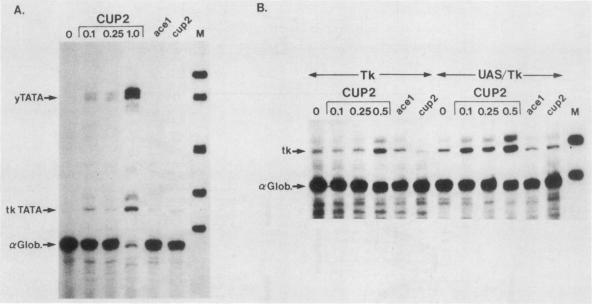
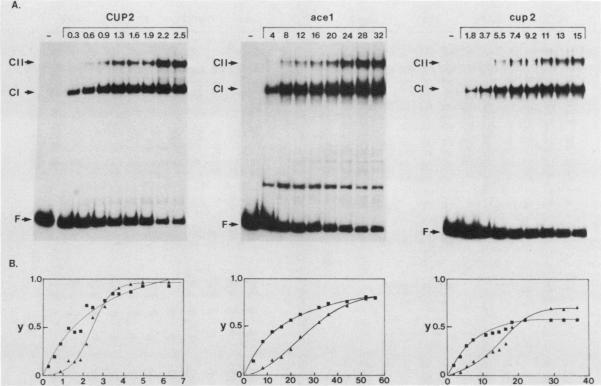
CUP2 is a copper-dependent transcriptional activator of the yeast CUP1 metallothionein gene. In the presence of Cu+ and Ag+) ions its DNA-binding domain is thought to fold as a cysteine-coordinated Cu cluster which recognizes the palindromic CUP1 upstream activation sequence (UASc). Using mobility shift, methylation interference, and DNase I and hydroxyl radical footprinting assays, we examined the interaction of wild-type and variant CUP2 proteins produced in Escherichia coli with the UASc. Our results suggest that CUP2 has a complex Cu-coordinated DNA-binding domain containing different parts that function as DNA-binding elements recognizing distinct sequence motifs embedded within the UASc. A single-amino-acid substitution of cysteine 11 with a tyrosine results in decreased Cu binding, apparent inactivation of one of the DNA-binding elements and a dramatic change in the recognition properties of CUP2. This variant protein interacts with only one part of the wild-type site and prefers to bind to a different half-site from the wild-type protein. Although the variant has about 10% of wild-type DNA-binding activity, it appears to be completely incapable of activating transcription.
CUP2是酵母CUP1金属硫蛋白基因的一种铜依赖性转录激活因子。在Cu⁺和Ag⁺离子存在的情况下,其DNA结合结构域被认为折叠成一个由半胱氨酸配位的铜簇,该铜簇可识别回文的CUP1上游激活序列(UASc)。我们使用迁移率变动分析、甲基化干扰分析以及DNase I和羟自由基足迹分析,研究了在大肠杆菌中产生的野生型和变体CUP2蛋白与UASc的相互作用。我们的结果表明,CUP2具有一个复杂的铜配位DNA结合结构域,该结构域包含不同的部分,这些部分作为识别嵌入在UASc内不同序列基序的DNA结合元件发挥作用。将半胱氨酸11单氨基酸替换为酪氨酸会导致铜结合减少、其中一个DNA结合元件明显失活以及CUP2识别特性的显著变化。这种变体蛋白仅与野生型位点的一部分相互作用,并且更倾向于与与野生型蛋白不同的半位点结合。尽管该变体具有约10%的野生型DNA结合活性,但它似乎完全无法激活转录。