Department of Geography, University of North Carolina, Chapel Hill, NC, USA.
Int J Health Geogr. 2011 Jun 15;10:41. doi: 10.1186/1476-072X-10-41.
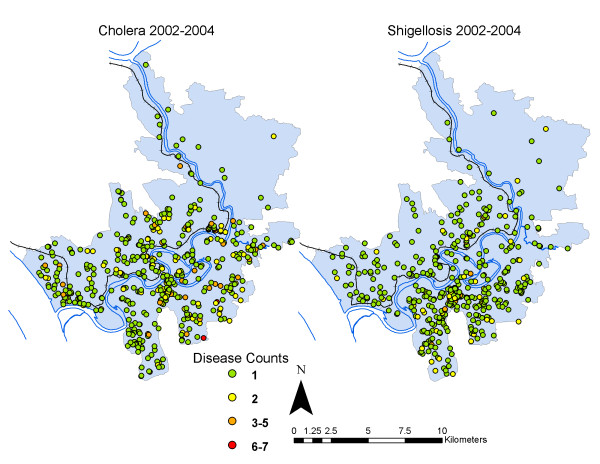
This study investigates the impact of tubewell user density on cholera and shigellosis events in Matlab, Bangladesh between 2002 and 2004. Household-level demographic, health, and water infrastructure data were incorporated into a local geographic information systems (GIS) database. Geographically-weighted regression (GWR) models were constructed to identify spatial variation of relationships across the study area. Zero-inflated negative binomial regression models were run to simultaneously measure the likelihood of increased magnitude of disease events and the likelihood of zero cholera or shigellosis events. The aim of this study was to examine the effect of tubewell density on both the occurrence of diarrheal disease and the magnitude of diarrheal disease incidence.
In Matlab, households with greater tubewell density were more likely to report zero cholera or shigellosis events. Results for both cholera and shigellosis GWR models suggest that tubewell density effects are spatially stationary and the use of non-spatial statistical methods is appropriate.
Increasing the amount of drinking water available to households through increased density of tubewells contributed to lower reports of cholera and shigellosis events in rural Bangladesh. Our findings demonstrate the importance of tubewell installation and access to groundwater in reducing diarrheal disease events in the developing world.
本研究调查了 2002 年至 2004 年期间孟加拉国 Matlab 地区水井用户密度对霍乱和痢疾事件的影响。家庭层面的人口统计学、健康和水基础设施数据被纳入当地地理信息系统(GIS)数据库。构建了地理加权回归(GWR)模型,以识别研究区域内关系的空间变化。零膨胀负二项回归模型被用来同时衡量疾病事件发生率增加的可能性和霍乱或痢疾零事件的可能性。本研究的目的是检验水井密度对腹泻病发生和腹泻病发病率的影响。
在 Matlab,水井密度较高的家庭更有可能报告霍乱或痢疾零事件。霍乱和痢疾 GWR 模型的结果表明,水井密度的影响在空间上是稳定的,因此使用非空间统计方法是合适的。
通过增加水井密度增加家庭可获得的饮用水量,有助于减少孟加拉国农村地区霍乱和痢疾事件的报告。我们的研究结果表明,水井的安装和地下水的获取对于减少发展中国家的腹泻病事件非常重要。