Seo Sungchul, Kim Dohyeong, Min Soojin, Paul Christopher, Yoo Young, Choung Ji Tae
The Environmental Health Center for Asthma, Korea University, Seoul, Korea.
School of Economic, Political and Policy Sciences, the University of Texas at Dallas, Richardson, TX, United States.
Allergy Asthma Immunol Res. 2016 Jan;8(1):32-40. doi: 10.4168/aair.2016.8.1.32. Epub 2015 Jul 25.
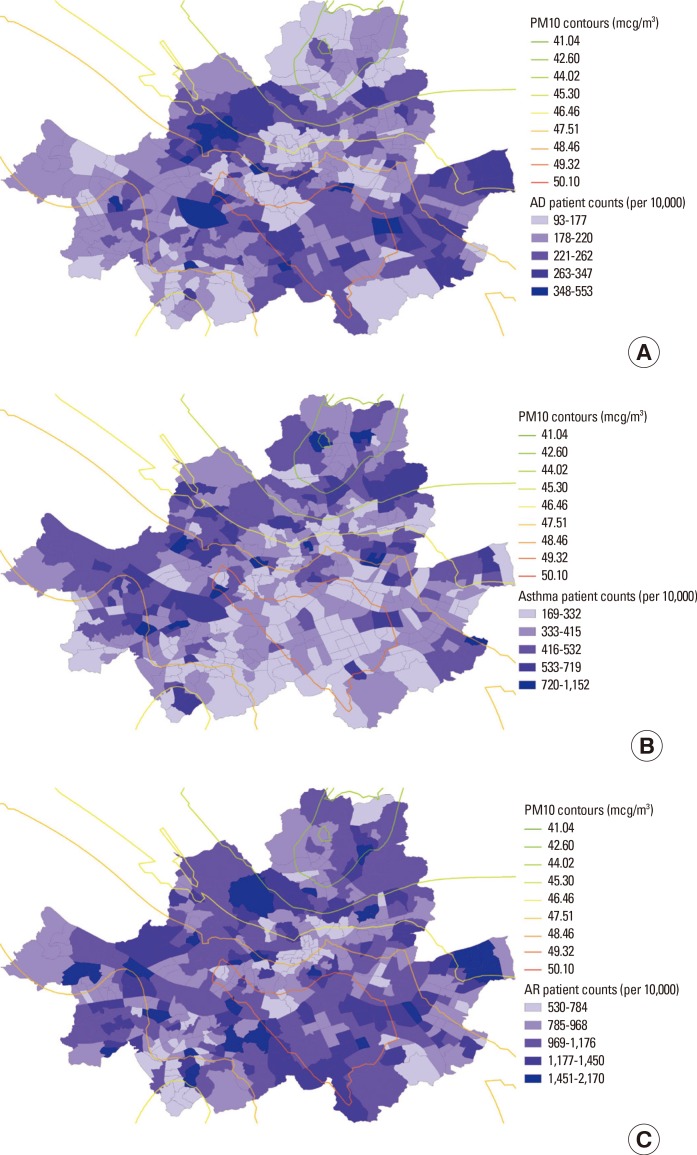
The role of PM10 in the development of allergic diseases remains controversial among epidemiological studies, partly due to the inability to control for spatial variations in large-scale risk factors. This study aims to investigate spatial correspondence between the level of PM10 and allergic diseases at the sub-district level in Seoul, Korea, in order to evaluate whether the impact of PM10 is observable and spatially varies across the subdistricts.
PM10 measurements at 25 monitoring stations in the city were interpolated to 424 sub-districts where annual inpatient and outpatient count data for 3 types of allergic diseases (atopic dermatitis, asthma, and allergic rhinitis) were collected. We estimated multiple ordinary least square regression models to examine the association of the PM10 level with each of the allergic diseases, controlling for various sub-district level covariates. Geographically weighted regression (GWR) models were conducted to evaluate how the impact of PM10 varies across the sub-districts.
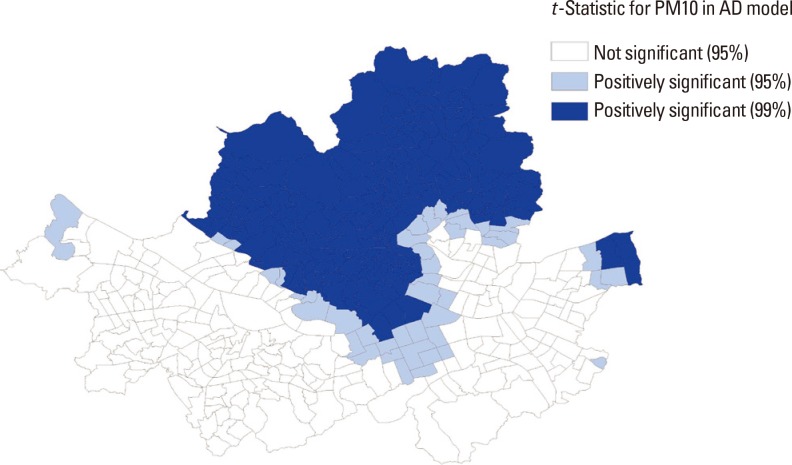
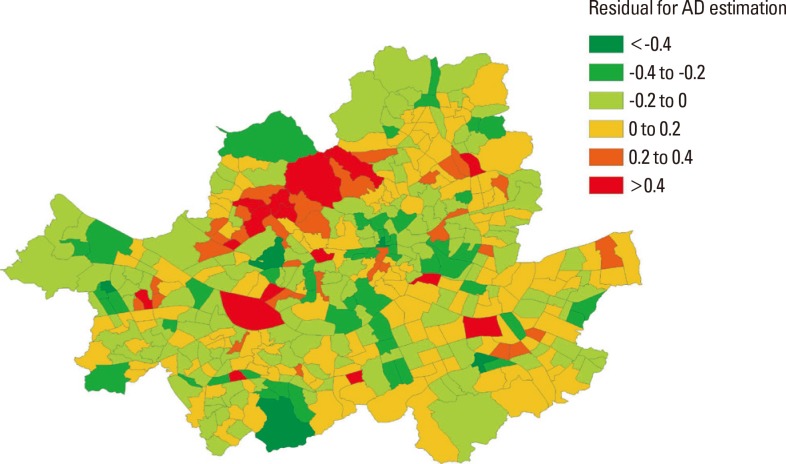
PM10 was found to be a significant predictor of atopic dermatitis patient count (P<0.01), with greater association when spatially interpolated at the sub-district level. No significant effect of PM10 was observed on allergic rhinitis and asthma when socioeconomic factors were controlled for. GWR models revealed spatial variation of PM10 effects on atopic dermatitis across the sub-districts in Seoul. The relationship of PM10 levels to atopic dermatitis patient counts is found to be significant only in the Gangbuk region (P<0.01), along with other covariates including average land value, poverty rate, level of education and apartment rate (P<0.01).
Our findings imply that PM10 effects on allergic diseases might not be consistent throughout Seoul. GIS-based spatial modeling techniques could play a role in evaluating spatial variation of air pollution impacts on allergic diseases at the sub-district level, which could provide valuable guidelines for environmental and public health policymakers.
在流行病学研究中,PM10在过敏性疾病发展中的作用仍存在争议,部分原因是无法控制大规模风险因素的空间变化。本研究旨在调查韩国首尔市辖区层面PM10水平与过敏性疾病之间的空间对应关系,以评估PM10的影响是否可观察到以及在各辖区之间是否存在空间差异。
将该市25个监测站的PM10测量值内插到424个辖区,收集了3种过敏性疾病(特应性皮炎、哮喘和过敏性鼻炎)的年度住院和门诊计数数据。我们估计了多个普通最小二乘回归模型,以检验PM10水平与每种过敏性疾病之间的关联,并控制各种辖区层面的协变量。进行地理加权回归(GWR)模型以评估PM10的影响在各辖区之间如何变化。
发现PM10是特应性皮炎患者计数的显著预测因子(P<0.01),在辖区层面进行空间内插时关联更强。在控制社会经济因素后,未观察到PM10对过敏性鼻炎和哮喘有显著影响。GWR模型揭示了首尔各辖区内PM10对特应性皮炎影响的空间差异。发现PM10水平与特应性皮炎患者计数之间的关系仅在江北地区显著(P<0.01),其他协变量包括平均土地价值、贫困率、教育水平和公寓率也显著(P<0.01)。
我们的研究结果表明,PM10对过敏性疾病的影响在整个首尔可能不一致。基于地理信息系统的空间建模技术可在评估空气污染对辖区层面过敏性疾病影响的空间差异方面发挥作用,这可为环境和公共卫生政策制定者提供有价值的指导。