Ontario Cancer Institute and Campbell Family Institute for Breast Cancer Research, Princess Margaret Hospital, University Health Network, 610 University Avenue, Toronto, Ontario, M5G 2M9, Canada.
BMC Cancer. 2011 Jun 16;11:253:1-13. doi: 10.1186/1471-2407-11-253.
The ability of gene profiling to predict treatment response and prognosis in breast cancers has been demonstrated in many studies using DNA microarray analyses on RNA from fresh frozen tumor specimens. In certain clinical and research situations, performing such analyses on archival formalin fixed paraffin-embedded (FFPE) surgical specimens would be advantageous as large libraries of such specimens with long-term follow-up data are widely available. However, FFPE tissue processing can cause fragmentation and chemical modifications of the RNA. A number of recent technical advances have been reported to overcome these issues. Our current study evaluates whether or not the technology is ready for clinical applications.
A modified RNA extraction method and a recent DNA microarray technique, cDNA-mediated annealing, selection, extension and ligation (DASL, Illumina Inc) were evaluated. The gene profiles generated from FFPE specimens were compared to those obtained from paired fresh fine needle aspiration biopsies (FNAB) of 25 breast cancers of different clinical subtypes (based on ER and Her2/neu status). Selected RNA levels were validated using RT-qPCR, and two public databases were used to demonstrate the prognostic significance of the gene profiles generated from FFPE specimens.
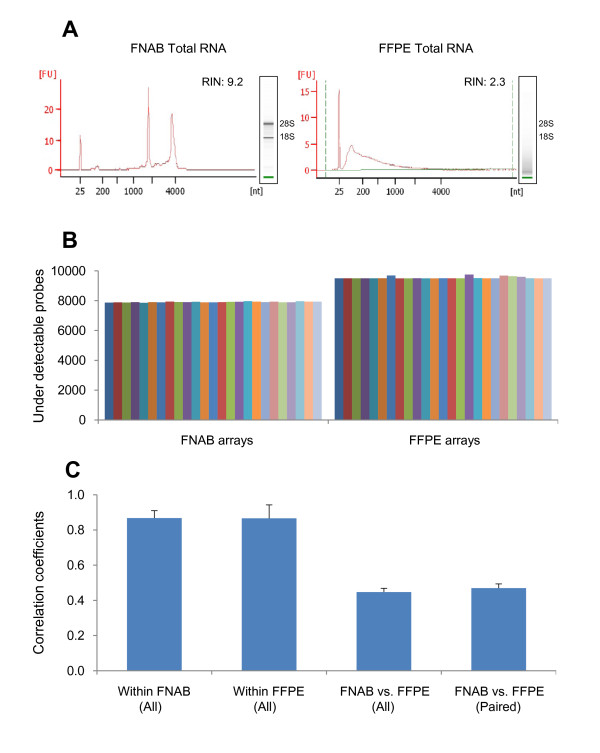
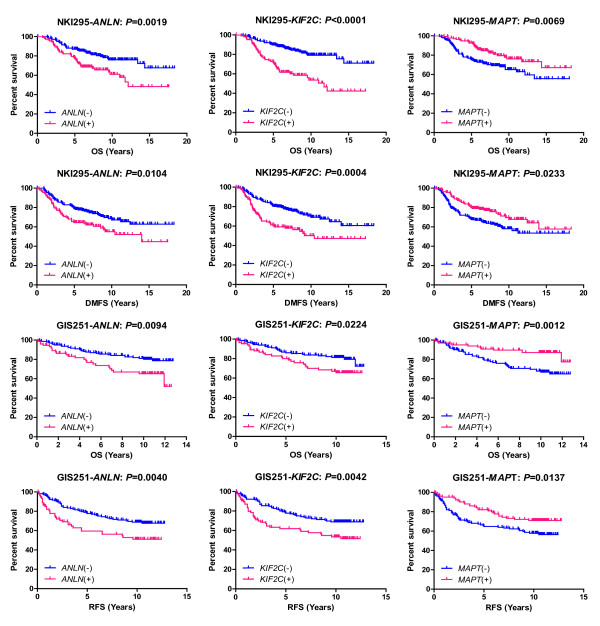
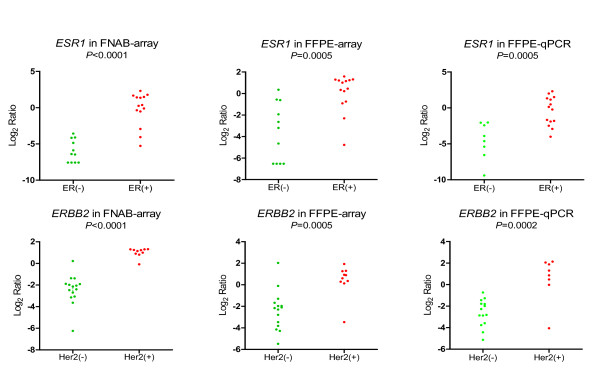
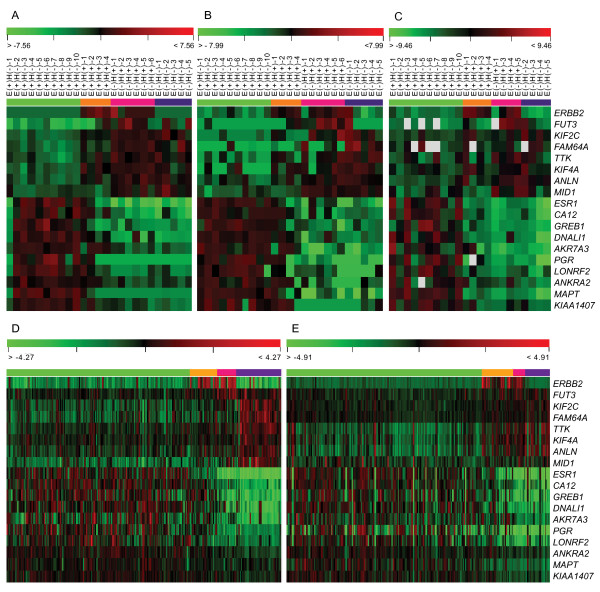
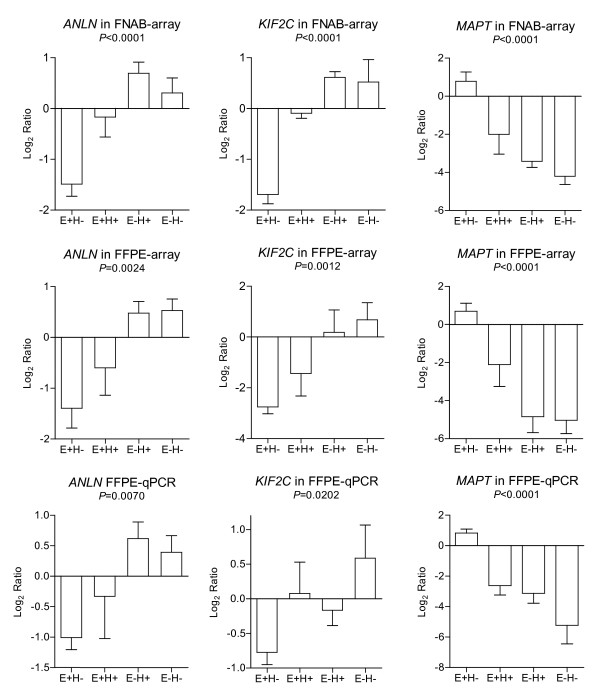
Compared to FNAB, RNA isolated from FFPE samples was relatively more degraded, nonetheless, over 80% of the RNA samples were deemed suitable for subsequent DASL assay. Despite a higher noise level, a set of genes from FFPE specimens correlated very well with the gene profiles obtained from FNAB, and could differentiate breast cancer subtypes. Expression levels of these genes were validated using RT-qPCR. Finally, for the first time we correlated gene expression profiles from FFPE samples to survival using two independent microarray databases. Specifically, over-expression of ANLN and KIF2C, and under-expression of MAPT strongly correlated with poor outcomes in breast cancer patients.
We demonstrated that FFPE specimens retained important prognostic information that could be identified using a recent gene profiling technology. Our study supports the use of FFPE specimens for the development and refinement of prognostic gene signatures for breast cancer. Clinical applications of such prognostic gene profiles await future large-scale validation studies.
基因谱分析已在许多研究中通过对新鲜冷冻肿瘤标本的 RNA 进行 DNA 微阵列分析证明了其在预测乳腺癌治疗反应和预后方面的能力。在某些临床和研究情况下,对存档的福尔马林固定石蜡包埋(FFPE)手术标本进行此类分析将是有利的,因为有广泛的具有长期随访数据的此类标本库。然而,FFPE 组织处理会导致 RNA 的片段化和化学修饰。最近已经报道了许多技术进步来克服这些问题。我们目前的研究评估该技术是否已准备好进行临床应用。
评估了改良的 RNA 提取方法和最近的 DNA 微阵列技术,cDNA 介导的退火、选择、延伸和连接(DASL,Illumina Inc)。将从 FFPE 标本中生成的基因谱与 25 例不同临床亚型(基于 ER 和 Her2/neu 状态)的乳腺癌的配对新鲜细针抽吸活检(FNAB)获得的基因谱进行比较。使用 RT-qPCR 验证了选定的 RNA 水平,并使用两个公共数据库证明了从 FFPE 标本中生成的基因谱的预后意义。
与 FNAB 相比,从 FFPE 样本中分离的 RNA 相对降解更多,但是,超过 80%的 RNA 样本适合随后的 DASL 测定。尽管噪声水平较高,但从 FFPE 标本中获得的一组基因与从 FNAB 获得的基因谱非常吻合,并且可以区分乳腺癌亚型。使用 RT-qPCR 验证了这些基因的表达水平。最后,我们首次使用两个独立的微阵列数据库将 FFPE 样本的基因表达谱与生存相关联。具体而言,ANLN 和 KIF2C 的过表达以及 MAPT 的低表达与乳腺癌患者的不良预后密切相关。
我们证明了 FFPE 标本保留了重要的预后信息,可通过最近的基因谱分析技术识别。我们的研究支持使用 FFPE 标本开发和完善乳腺癌的预后基因特征。此类预后基因谱的临床应用需要等待未来的大规模验证研究。