Deng Yujie, Chen Xiaohui, Huang Chuanzhong, Song Jun, Feng Sisi, Chen Xuzheng, Zhou Ruixiang
School of Basic Medical Sciences, Fujian Medical University, Fuzhou 350108, Fujian, China.
Key Laboratory of Gastrointestinal Cancer, Ministry of Education, Fujian Medical University, Fuzhou 350108, Fujian, China.
J Oncol. 2022 Apr 11;2022:3794021. doi: 10.1155/2022/3794021. eCollection 2022.
Although more pathologic stage-I lung adenocarcinoma (LUAD) was diagnosed recently, some relapsed or distantly metastasized shortly after radical resection. The study aimed to identify biomarkers predicting prognosis in the pathologic stage-I LUAD and improve the understanding of the mechanisms involved in tumorigenesis.
We obtained the expression profiling data for non-small cell lung cancer (NSCLC) patients from the NCBI-GEO database. Differentially expressed genes (DEGs) between early-stage NSCLC and normal lung tissue were determined. After function enrichment analyses on DEGs, the protein-protein interaction (PPI) network was built and analyzed with the Search Tool for the Retrieval of Interacting Genes (STRING) and Cytoscape. Overall survival (OS) and mRNA levels of genes were performed with Kaplan-Meier analysis and Gene Expression Profiling Interactive Analysis (GEPIA). qPCR and western blot analysis of hub genes in stage-I LUAD patients validated the significant genes with poor prognosis.
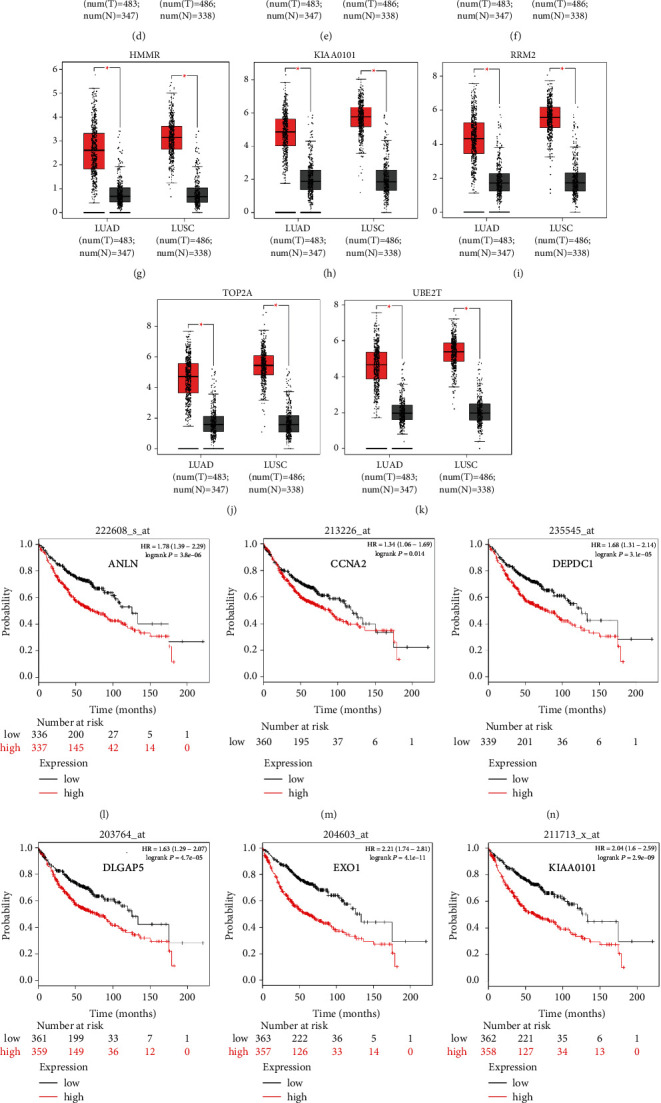
A total of 172 DEGs were identified, which were mainly enriched in terms related to management of extracellular matrix (ECM), receptor signaling pathway, cell adhesion, activity of endopeptidase, and receptor. The PPI network identified 11 upregulated hub genes that were significantly associated with OS in NSCLC and highly expressed in NSCLC tissues compared with normal tissues by GEPIA. Elevated expression of ANLN, EXO1, KIAA0101, RRM2, TOP2A, and UBE2T were identified as potential risk factors in pathologic stage-I LUAD. Except for ANLN and KIAA0101, the hub genes mRNA levels were higher in tumors compared with adjacent non-cancerous samples in the qPCR analysis. The hub genes protein levels were also overexpressed in tumors. In vitro experiments showed that knockdown of UBE2T in LUAD cell lines could inhibit cell proliferation and cycle progression.
The DEGs can probably be used as potential predictors for stage-I LUAD worse prognosis and UBE2T may be a potential tumor promoter and target for treatment.
尽管近年来病理I期肺腺癌(LUAD)的诊断数量有所增加,但仍有部分患者在根治性切除后不久复发或远处转移。本研究旨在寻找预测病理I期LUAD预后的生物标志物,并加深对肿瘤发生机制的理解。
我们从NCBI-GEO数据库中获取了非小细胞肺癌(NSCLC)患者的表达谱数据。确定了早期NSCLC与正常肺组织之间的差异表达基因(DEG)。对DEG进行功能富集分析后,使用搜索互作基因工具(STRING)和Cytoscape构建并分析蛋白质-蛋白质相互作用(PPI)网络。通过Kaplan-Meier分析和基因表达谱交互式分析(GEPIA)对基因的总生存期(OS)和mRNA水平进行评估。对I期LUAD患者的枢纽基因进行qPCR和蛋白质印迹分析,验证了预后不良的显著基因。
共鉴定出172个DEG,主要富集于细胞外基质(ECM)管理、受体信号通路、细胞粘附、内肽酶活性和受体相关的术语。PPI网络确定了11个上调的枢纽基因,这些基因与NSCLC的OS显著相关,并且通过GEPIA分析发现与正常组织相比,在NSCLC组织中高表达。ANLN、EXO1、KIAA0101、RRM2、TOP2A和UBE2T的表达升高被确定为病理I期LUAD的潜在危险因素。qPCR分析显示,除ANLN和KIAA0101外,肿瘤中枢纽基因的mRNA水平高于相邻非癌样本。肿瘤中枢纽基因的蛋白质水平也过表达。体外实验表明,敲低LUAD细胞系中的UBE2T可抑制细胞增殖和细胞周期进程。
DEG可能作为I期LUAD预后不良的潜在预测指标,UBE2T可能是潜在的肿瘤促进因子和治疗靶点。