Entomology Unit, Faculty of Agriculture and Natural Resources, University of Kassala, New Halfa, Sudan.
Parasit Vectors. 2011 Jun 16;4:109. doi: 10.1186/1756-3305-4-109.
Understanding malaria vector mosquitoes and their infectivity dynamics is of importance in setting up intervention and control programmes. Patterns of malaria transmission have been shown to differ between non-irrigated and irrigated semi-arid areas of eastern Sudan. However, very little information is available regarding malaria transmission dynamics along the seasonal river's basin. Such information is required for the design of effective vector control strategies.
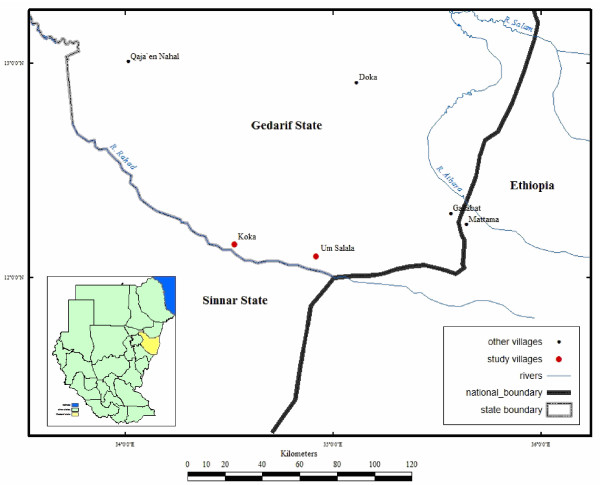
A longitudinal study for mosquito sampling using pyrethrum spray catch (PSC) was conducted in two villages (Koka & Um Salala) along the Rahad River basin from December 2005 to October 2006. The Plasmodium falciparum circumsporozoite (CSP) and human blood index (HBI) were detected by ELISA. Three seasons were considered and the surveys represented cool dry, hot dry and rainy seasons were November - February, March - June, July - October, respectively. The CSP was compared between the seasons and populations using Chi-square test. The differences between the seasons and the populations in the other entomological indices, including Entomological Inoculation Rates (EIR), were measured using Tukey-Kramer HSD and Student T-test, respectively. The association between An. arabiensis density and monthly total rainfall was examined using regression analysis.
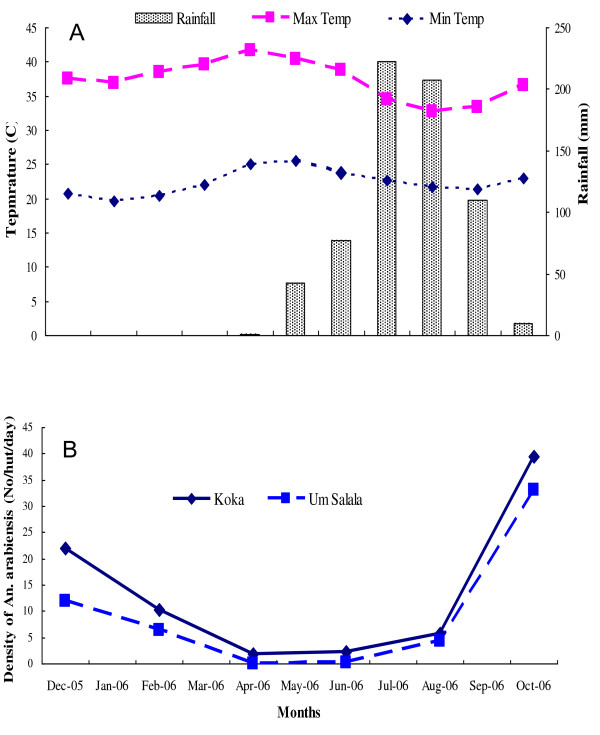
A total of 1,402 adult female anopheline mosquitoes were sampled, of which 98% were An. gambiae complex; the rest were An. rufipes. All specimens of An. gambiae complex identified by the PCR were An. arabiensis. Bimodal annual peaks of An. arabiensis densities were observed following the peak of rainfall and recess of the Rahad River after a time- lag of two months (Koka r = 0.79, d.f. = 1, P = 0.05; Um Salala, r = 0.88, d.f. = 1, P = 0.02). The CSP differed significantly among the seasons only in Koka (P = 0.0009) where the mean was nine times higher than in Um Salala (P = 0.0014). Active transmission was observed in Koka during the hot, dry season (CSP = 6.25%) and the EIR was observed to be 0.01 ib/p/n during this time. The EIR peaked to 0.71 ib/p/n during the rainy season and decreased to 0.18 ib/p/n during the minor peak of the cool dry season (P = 0.54). The combined annual average of the EIR for both populations was 55.48 ib/p/y and, typically, it would take approximately 192.7 days for an individual to receive an infective bite from An. arabiensis.
The bimodal annual peaks and the active transmission observed during the hot dry season suggested low to moderate perennial malaria transmission pattern. Infectivity and transmission rates increased with proximity to the river following the peak of rainfall and the subsequent recession in the flow of the Rahad River. Current vector interventions can be integrated with larval control and should be formatted in accordance with targeted according to the time and space.
了解疟疾病媒蚊及其感染动力学对于制定干预和控制计划非常重要。已经表明,在苏丹东部的非灌溉和灌溉半干旱地区,疟疾传播模式存在差异。然而,关于沿季节性河流流域的疟疾传播动态,几乎没有信息。为了设计有效的媒介控制策略,需要这种信息。
2005 年 12 月至 2006 年 10 月,在 Rahad 河流域的两个村庄(Koka 和 Um Salala)使用除虫菊酯喷雾捕获(PSC)进行了纵向蚊虫采样研究。使用 ELISA 检测恶性疟原虫环子孢子蛋白(CSP)和人血指数(HBI)。考虑了三个季节,调查分别代表凉爽干燥、炎热干燥和雨季,时间分别为 11 月至 2 月、3 月至 6 月、7 月至 10 月。使用卡方检验比较了季节和人群之间的 CSP。使用 Tukey-Kramer HSD 和学生 T 检验分别测量了季节和人群之间其他昆虫学指标(包括昆虫接种率(EIR))之间的差异。使用回归分析检查了按蚊密度与每月总降雨量之间的关系。
共采集了 1402 只成年雌性按蚊,其中 98%为冈比亚按蚊复合体;其余为丽蝇。通过 PCR 鉴定的冈比亚按蚊复合体的所有标本均为阿拉伯按蚊。在 Rahad 河水位下降后两个月(Koka r = 0.79,d.f. = 1,P = 0.05;Um Salala,r = 0.88,d.f. = 1,P = 0.02),按蚊密度出现双峰年度高峰。仅在 Koka 观察到 CSP 季节之间有显著差异(P = 0.0009),其平均值是 Um Salala 的九倍(P = 0.0014)。在炎热干燥的季节,Koka 观察到了活跃的传播(CSP = 6.25%),并且在此期间 EIR 观察到为 0.01 ib/p/n。在雨季,EIR 达到峰值 0.71 ib/p/n,在凉爽干燥季节的小高峰时降至 0.18 ib/p/n(P = 0.54)。两个种群的年平均 EIR 为 55.48 ib/p/y,通常情况下,个体需要大约 192.7 天才能受到阿拉伯按蚊的感染性叮咬。
观察到的双峰年度高峰和炎热干燥季节的活跃传播表明存在低至中度的常年疟疾传播模式。感染性和传播率随着靠近河流而增加,这是由于降雨高峰后 Rahad 河水位下降和随后的河流水位下降所致。目前的媒介干预措施可以与幼虫控制相结合,并应根据时间和空间进行有针对性的格式化。