Department of Chemical Engineering, University of Michigan, Ann Arbor, MI 48109, USA.
BMC Bioinformatics. 2011 Jun 17;12:243. doi: 10.1186/1471-2105-12-243.
A central question in cancer biology is what changes cause a healthy cell to form a tumor. Gene expression data could provide insight into this question, but it is difficult to distinguish between a gene that causes a change in gene expression from a gene that is affected by this change. Furthermore, the proteins that regulate gene expression are often themselves not regulated at the transcriptional level. Here we propose a Bayesian modeling framework we term RegNetB that uses mechanistic information about the gene regulatory network to distinguish between factors that cause a change in expression and genes that are affected by the change. We test this framework using human gene expression data describing localized prostate cancer progression.
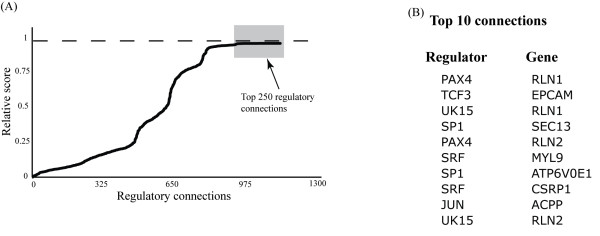
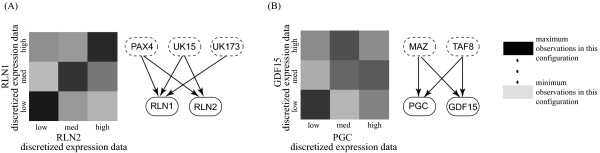
The top regulatory relationships identified by RegNetB include the regulation of RLN1, RLN2, by PAX4, the regulation of ACPP (PAP) by JUN, BACH1 and BACH2, and the co-regulation of PGC and GDF15 by MAZ and TAF8. These target genes are known to participate in tumor progression, but the suggested regulatory roles of PAX4, BACH1, BACH2, MAZ and TAF8 in the process is new.
Integrating gene expression data and regulatory topologies can aid in identifying potentially causal mechanisms for observed changes in gene expression.
癌症生物学中的一个核心问题是,是什么样的变化导致健康细胞形成肿瘤。基因表达数据可以为此问题提供一些见解,但很难区分导致基因表达变化的基因和受这种变化影响的基因。此外,调节基因表达的蛋白质通常本身不受转录水平的调节。在这里,我们提出了一个贝叶斯建模框架,我们称之为 RegNetB,该框架利用基因调控网络的机制信息来区分导致表达变化的因素和受变化影响的基因。我们使用描述局部前列腺癌进展的人类基因表达数据来测试这个框架。
RegNetB 识别的顶级调控关系包括 PAX4 对 RLN1 和 RLN2 的调控、JUN、BACH1 和 BACH2 对 ACPP(PAP)的调控以及 MAZ 和 TAF8 对 PGC 和 GDF15 的共调控。这些靶基因已知参与肿瘤进展,但 PAX4、BACH1、BACH2、MAZ 和 TAF8 在该过程中的调节作用是新的。
整合基因表达数据和调控拓扑结构可以帮助识别观察到的基因表达变化的潜在因果机制。