Ocular Surface Center, Cullen Eye Institute, Department of Ophthalmology, Baylor College of Medicine, Houston, TX 77030, USA.
Int J Biochem Cell Biol. 2011 Sep;43(9):1383-91. doi: 10.1016/j.biocel.2011.06.003. Epub 2011 Jun 12.
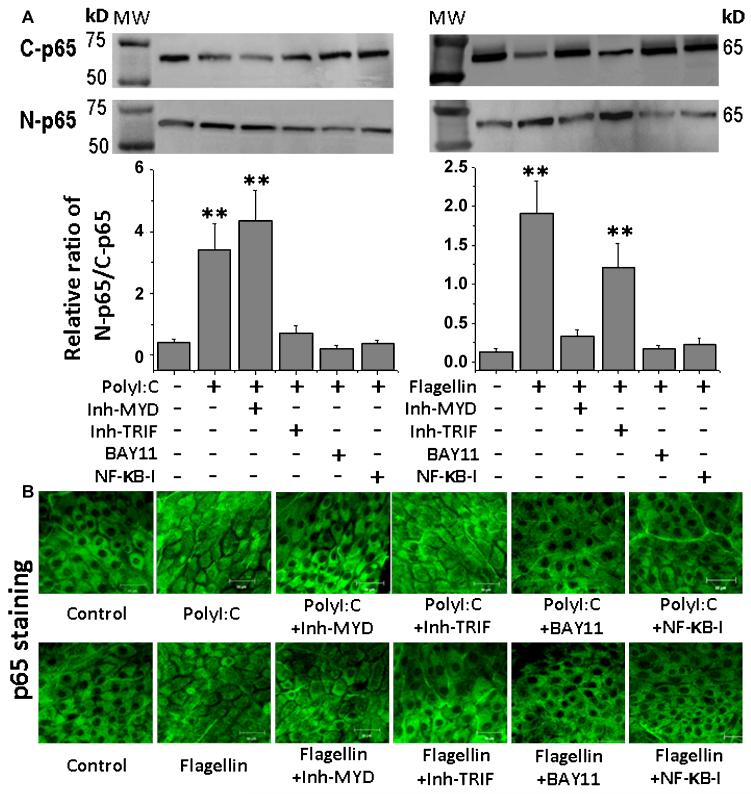
Interleukin (IL) 33 has been recently identified as a ligand to the ST2 receptor that mediates Th2-dominant allergic inflammation. The purpose of this study was to explore the role of toll-like receptor (TLR)-mediated innate immunity in IL-33 induction by mucosal epithelium. Human corneal tissues and cultured primary human corneal epithelial cells (HCECs) were treated with a variety of viral or bacterial components without or with different inhibitors to evaluate the IL-33 regulation and signaling pathways. The level of mRNA expression was determined by reverse transcription and real time PCR, and protein was measured by ELISA, immunostaining and Western blotting. IL-33 mRNA and protein were largely induced by various microbial components, mainly by polyI:C and flagellin, the ligands to TLR3 and TLR5, respectively in human corneal epithelium ex vivo and in vitro cultures. Pro-IL-33 protein was normally restricted inside cells, and could be secreted outside when activated by ATP. The PolyI:C induced IL-33 production was blocked by TLR3 antibody or TRIF Inhibitory peptide, while flagellin stimulated IL-33 was blocked by TLR5 antibody or MyD88 Inhibitory peptide. Interestingly, IκB-α inhibitor (BAY11-7082) or NF-κB inhibitor (quinazoline) blocked NF-κB p65 protein nuclear translocation, and suppressed IL-33 production induced by PolyI:C and flagellin. These findings demonstrate that IL-33, an epithelium-derived pro-allergic cytokine, is induced by microbial ligands through TLR-mediated innate signaling pathways, suggesting a possible role of mucosal epithelium in Th2-dominant allergic inflammation.
白细胞介素 (IL) 33 最近被鉴定为 ST2 受体的配体,介导 Th2 优势过敏炎症。本研究旨在探讨 Toll 样受体 (TLR) 介导的先天免疫在黏膜上皮细胞诱导 IL-33 中的作用。用各种病毒或细菌成分处理人角膜组织和培养的原代人角膜上皮细胞 (HCEC),无或用不同的抑制剂来评估 IL-33 调节和信号通路。通过逆转录和实时 PCR 测定 mRNA 表达水平,通过 ELISA、免疫染色和 Western blot 测定蛋白。IL-33 mRNA 和蛋白主要由各种微生物成分诱导,主要是 polyI:C 和鞭毛蛋白,分别是 TLR3 和 TLR5 的配体,在人角膜上皮细胞外和体外培养中。Pro-IL-33 蛋白通常局限于细胞内,当被 ATP 激活时可分泌到细胞外。PolyI:C 诱导的 IL-33 产生被 TLR3 抗体或 TRIF 抑制肽阻断,而鞭毛蛋白刺激的 IL-33 被 TLR5 抗体或 MyD88 抑制肽阻断。有趣的是,IκB-α 抑制剂 (BAY11-7082) 或 NF-κB 抑制剂 (喹唑啉) 阻断 NF-κB p65 蛋白核易位,并抑制 PolyI:C 和鞭毛蛋白诱导的 IL-33 产生。这些发现表明,上皮细胞衍生的 pro-过敏细胞因子 IL-33 是由微生物配体通过 TLR 介导的先天信号通路诱导的,这表明黏膜上皮在 Th2 优势过敏炎症中可能发挥作用。