Brunetti Giacomina, Barile Barbara, Nicchia Grazia Paola, Onorati Francesco, Luciani Giovanni Battista, Galeone Antonella
Department of Biosciences, Biotechnologies and Environment, University of Bari Aldo Moro, 70125 Bari, Italy.
Department of Surgery, Dentistry, Pediatrics and Gynecology, Division of Cardiac Surgery, University of Verona, 37129 Verona, Italy.
Biomedicines. 2023 Jun 9;11(6):1676. doi: 10.3390/biomedicines11061676.
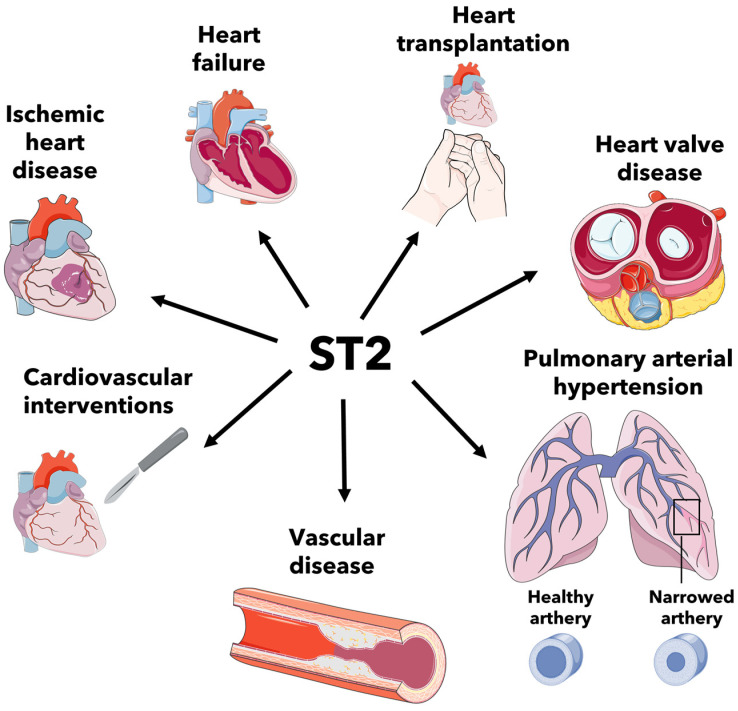
ST2 is a member of interleukin 1 receptor family with soluble sST2 and transmembrane ST2L isoforms. The ligand of ST2 is IL-33, which determines the activation of numerous intracytoplasmic mediators following the binding with ST2L and IL-1RAcP, leading to nuclear signal and cardiovascular effect. Differently, sST2 is released in the blood and works as a decoy receptor, binding IL-33 and blocking IL-33/ST2L interaction. sST2 is mainly involved in maintaining homeostasis and/or alterations of different tissues, as counterbalance/activation of IL-33/ST2L axis is typically involved in the development of fibrosis, tissue damage, inflammation and remodeling. sST2 has been described in different clinical reports as a fundamental prognostic marker in patients with cardiovascular disease, as well as marker for the treatment monitoring of patients with heart failure; however, further studies are needed to better elucidate its role. In this review we reported the current knowledge about its role in coronary artery disease, heart failure, heart transplantation, heart valve disease, pulmonary arterial hypertension, and cardiovascular interventions.
ST2是白细胞介素1受体家族的成员,有可溶性sST2和跨膜ST2L两种亚型。ST2的配体是IL-33,IL-33与ST2L和IL-1RAcP结合后可激活多种胞质内介质,从而引发核信号和心血管效应。与之不同的是,sST2释放入血后作为诱饵受体发挥作用,它结合IL-33并阻断IL-33/ST2L的相互作用。sST2主要参与维持不同组织的稳态和/或改变,因为IL-33/ST2L轴的平衡/激活通常参与纤维化、组织损伤、炎症和重塑的发展过程。在不同的临床报告中,sST2已被描述为心血管疾病患者的重要预后标志物,也是心力衰竭患者治疗监测的标志物;然而,还需要进一步研究以更好地阐明其作用。在本综述中,我们报告了目前关于其在冠状动脉疾病、心力衰竭、心脏移植、心脏瓣膜病、肺动脉高压和心血管介入治疗中作用的相关知识。