Brink Tila Tabea, Urton Karolina, Held Dada, Kirilina Evgeniya, Hofmann Markus J, Klann-Delius Gisela, Jacobs Arthur M, Kuchinke Lars
The Cluster of Excellence "Languages of Emotion", Freie Universität Berlin Berlin, Germany.
Front Psychol. 2011 Apr 28;2:80. doi: 10.3389/fpsyg.2011.00080. eCollection 2011.
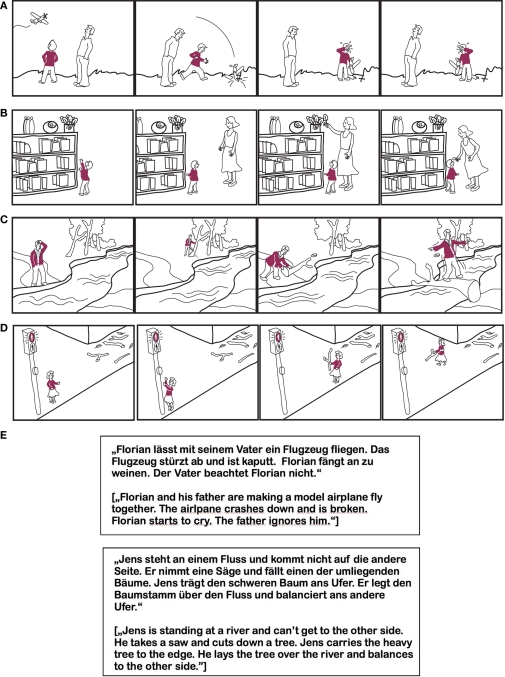
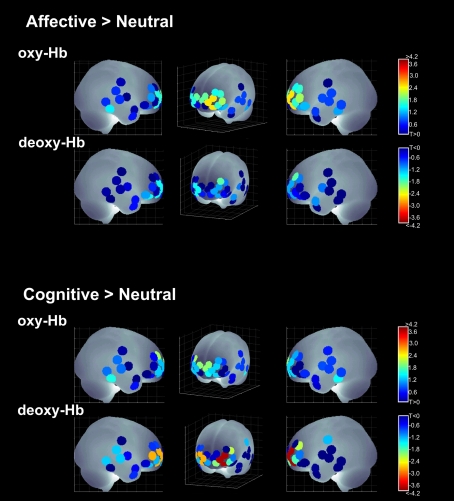
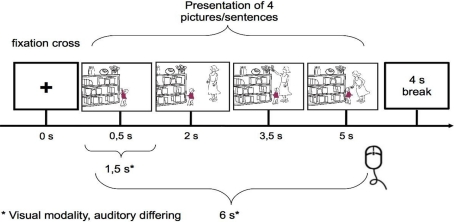
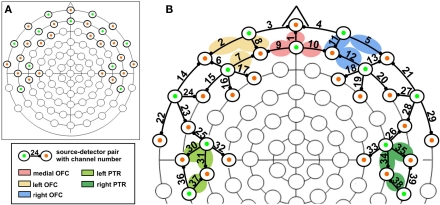
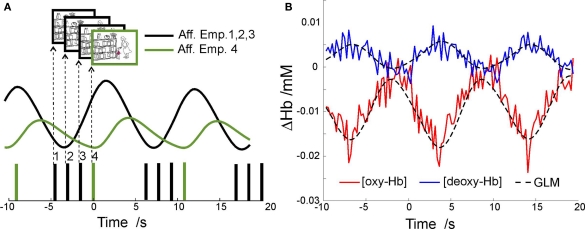
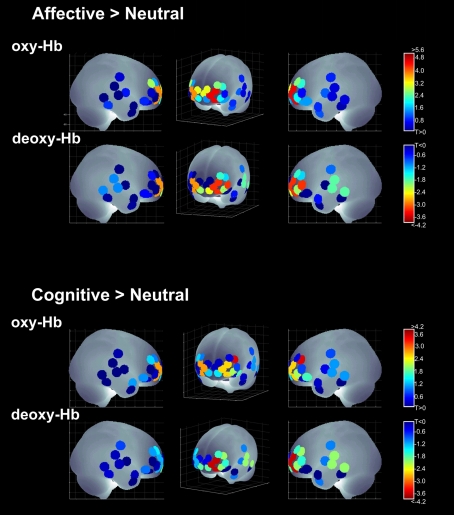
This study investigates the neuronal correlates of empathic processing in children aged 4-8 years, an age range discussed to be crucial for the development of empathy. Empathy, defined as the ability to understand and share another person's inner life, consists of two components: affective (emotion-sharing) and cognitive empathy (Theory of Mind). We examined the hemodynamic responses of preschool and school children (N = 48), while they processed verbal (auditory) and non-verbal (cartoons) empathy stories in a passive following paradigm, using functional Near-Infrared Spectroscopy. To control for the two types of empathy, children were presented blocks of stories eliciting either affective or cognitive empathy, or neutral scenes which relied on the understanding of physical causalities. By contrasting the activations of the younger and older children, we expected to observe developmental changes in brain activations when children process stories eliciting empathy in either stimulus modality toward a greater involvement of anterior frontal brain regions. Our results indicate that children's processing of stories eliciting affective and cognitive empathy is associated with medial and bilateral orbitofrontal cortex (OFC) activation. In contrast to what is known from studies using adult participants, no additional recruitment of posterior brain regions was observed, often associated with the processing of stories eliciting empathy. Developmental changes were found only for stories eliciting affective empathy with increased activation, in older children, in medial OFC, left inferior frontal gyrus, and the left dorsolateral prefrontal cortex. Activations for the two modalities differ only little, with non-verbal presentation of the stimuli having a greater impact on empathy processing in children, showing more similarities to adult processing than the verbal one. This might be caused by the fact that non-verbal processing develops earlier in life and is more familiar.
本研究调查了4至8岁儿童共情加工的神经关联,这个年龄范围被认为对共情发展至关重要。共情被定义为理解并分享他人内心生活的能力,由两个部分组成:情感共情(情绪分享)和认知共情(心理理论)。我们使用功能近红外光谱技术,在学龄前儿童和学龄儿童(N = 48)被动听故事的范式下,让他们处理语言(听觉)和非语言(卡通)共情故事时,检测其血液动力学反应。为了控制两种类型的共情,向儿童呈现引发情感或认知共情的故事块,或依赖于对物理因果关系理解的中性场景。通过对比年幼儿童和年长儿童的激活情况,我们期望观察到当儿童处理引发共情的故事时,大脑激活的发育变化,无论是哪种刺激方式,都会使前额叶脑区更多地参与其中。我们的结果表明,儿童对引发情感和认知共情的故事的处理与内侧和双侧眶额皮质(OFC)的激活有关。与使用成年参与者的研究结果不同,未观察到后脑区域的额外激活,而后脑区域的激活通常与处理引发共情的故事有关。仅在引发情感共情的故事中发现了发育变化,年长儿童的内侧OFC、左下额叶回和左背外侧前额叶皮质的激活增加。两种方式的激活差异很小,非语言呈现的刺激对儿童的共情加工影响更大,与成人加工的相似性比语言呈现的刺激更高。这可能是因为非语言加工在生命早期就发展起来且更为熟悉。