Developmental Biology Program, Sloan-Kettering Institute, 1275 York Avenue, New York, NY 10021, USA.
Neural Dev. 2011 Jun 20;6:29. doi: 10.1186/1749-8104-6-29.
The ventral midbrain contains a diverse array of neurons, including dopaminergic neurons of the ventral tegmental area (VTA) and substantia nigra (SN) and neurons of the red nucleus (RN). Dopaminergic and RN neurons have been shown to arise from ventral mesencephalic precursors that express Sonic Hedgehog (Shh). However, Shh expression, which is initially confined to the mesencephalic ventral midline, expands laterally and is then downregulated in the ventral midline. In contrast, expression of the Hedgehog target gene Gli1 initiates in the ventral midline prior to Shh expression, but after the onset of Shh expression it is expressed in precursors lateral to Shh-positive cells. Given these dynamic gene expression patterns, Shh and Gli1 expression could delineate different progenitor populations at distinct embryonic time points.
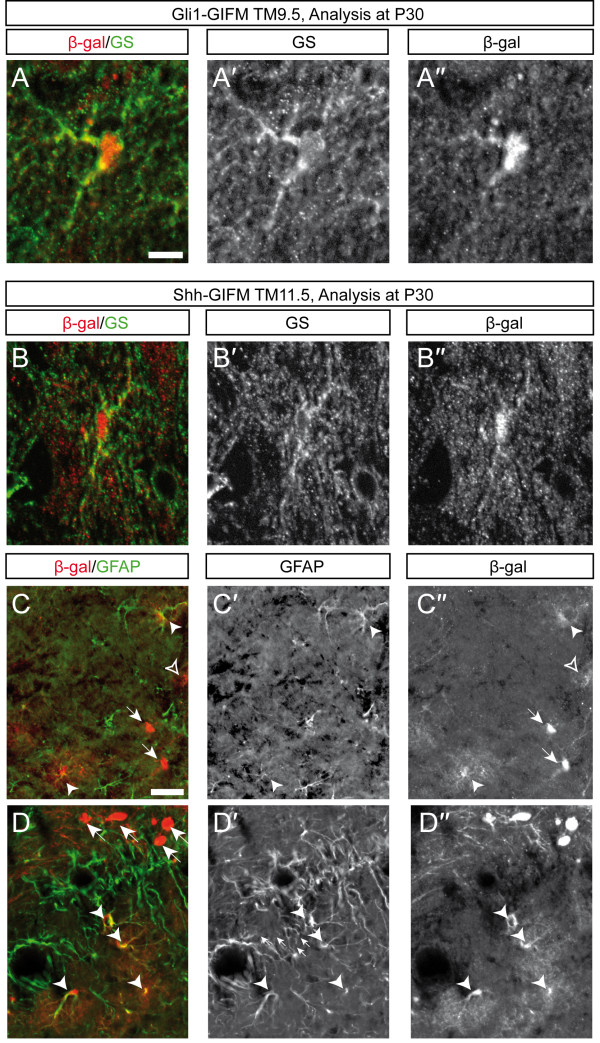
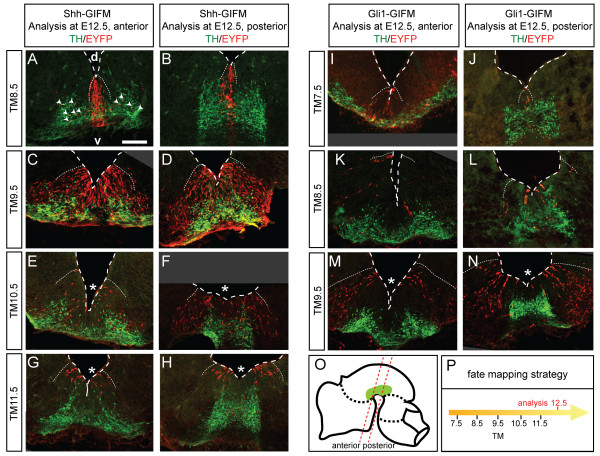
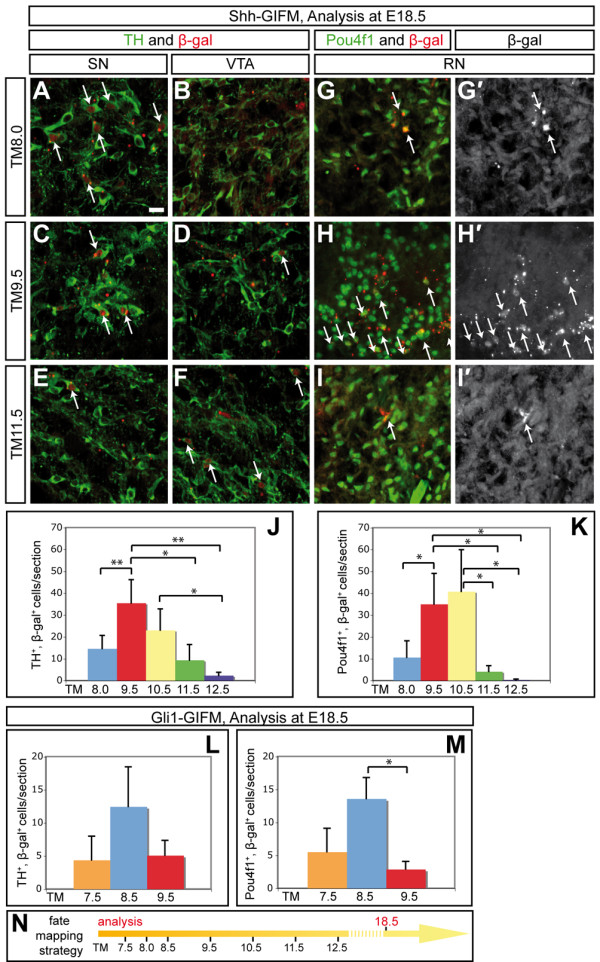
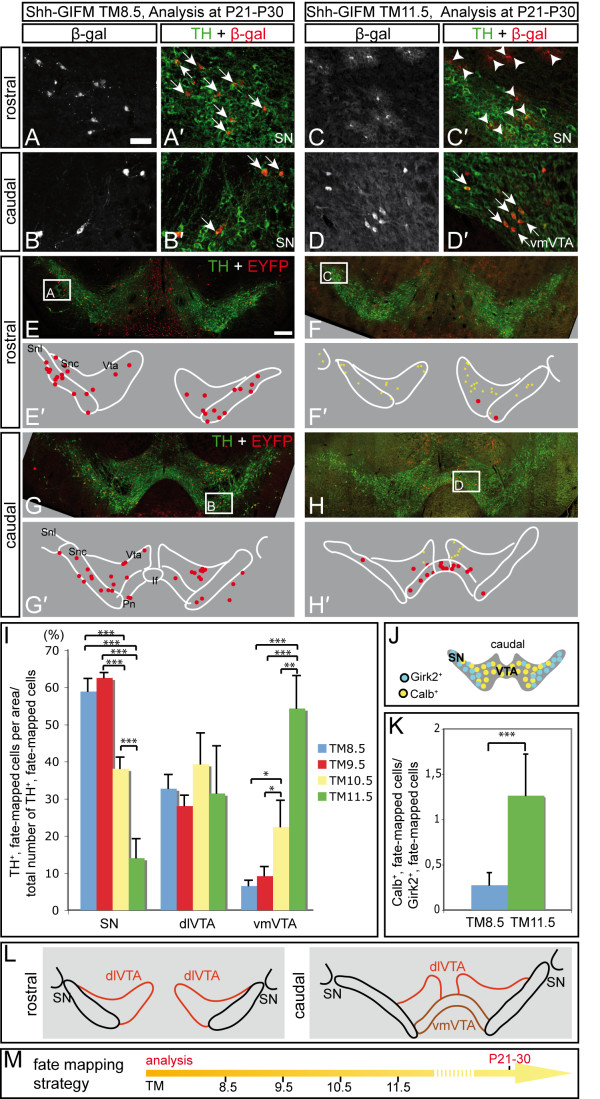
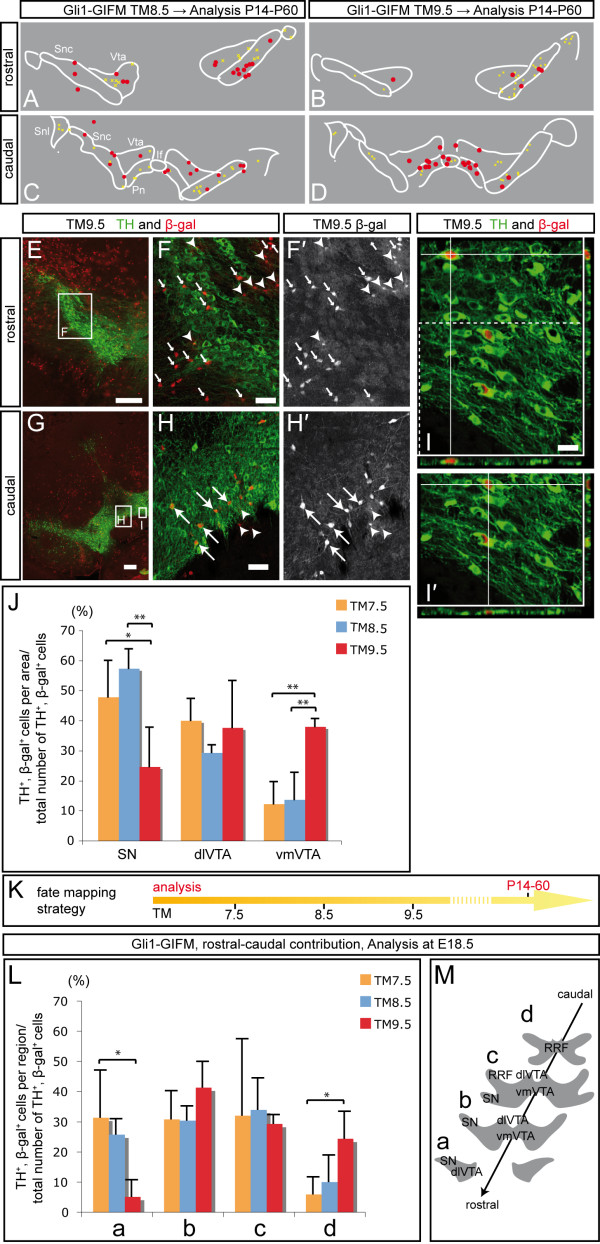
We employed genetic inducible fate mapping (GIFM) to investigate whether precursors that express Shh (Shh-GIFM) or transduce Shh signaling (Gli1-GIFM) at different time points give rise to different ventral midbrain cell types. We find that precursors restricted to the ventral midline are labeled at embryonic day (E)7.5 with Gli1-GIFM, and with Shh-GIFM at E8.5. These precursors give rise to all subtypes of midbrain dopaminergic neurons and the anterior RN. A broader domain of progenitors that includes the ventral midline is marked with Gli1-GIFM at E8.5 and with Shh-GIFM at E9.5; these fate-mapped cells also contribute to all midbrain dopaminergic subtypes and to the entire RN. In contrast, a lateral progenitor domain that is labeled with Gli1-GIFM at E9.5 and with Shh-GIFM at E11.5 has a markedly reduced potential to give rise to the RN and to SN dopaminergic neurons, and preferentially gives rise to the ventral-medial VTA. In addition, cells derived from Shh- and Gli1-expressing progenitors located outside of the ventral midline give rise to astrocytes.
We define a ventral midbrain precursor map based on the timing of Gli1 and Shh expression, and suggest that the diversity of midbrain dopaminergic neurons is at least partially determined during their precursor stage when their medial-lateral position, differential gene expression and the time when they leave the ventricular zone influence their fate decisions.
腹侧中脑包含多种神经元,包括腹侧被盖区(VTA)和黑质(SN)中的多巴胺能神经元和红核(RN)中的神经元。已表明多巴胺能神经元和 RN 神经元源自表达 Sonic Hedgehog(Shh)的腹侧中脑神经前体细胞。然而,Shh 的表达最初局限于中脑腹侧中线,随后向外侧扩展,然后在腹侧中线下调。相比之下,Hedgehog 靶基因 Gli1 的表达在 Shh 表达之前先于 Shh 在腹侧中线开始,但在 Shh 表达后,它在 Shh 阳性细胞的侧位表达。鉴于这些动态基因表达模式,Shh 和 Gli1 的表达可以在不同的胚胎时间点划定不同的祖细胞群体。
我们采用遗传诱导命运映射(GIFM)来研究在不同时间点表达 Shh(Shh-GIFM)或转导 Shh 信号(Gli1-GIFM)的前体细胞是否产生不同的腹侧中脑细胞类型。我们发现,在胚胎日(E)7.5 时,仅在腹侧中线上标记有 Gli1-GIFM 的前体细胞,并在 E8.5 时标记有 Shh-GIFM 的前体细胞。这些前体细胞产生所有中脑多巴胺能神经元亚型和前 RN。在 E8.5 时,用 Gli1-GIFM 标记包括腹侧中线在内的更广泛的祖细胞域,并在 E9.5 时用 Shh-GIFM 标记;这些命运映射的细胞也有助于所有中脑多巴胺能亚型和整个 RN。相比之下,在 E9.5 时用 Gli1-GIFM 标记而在 E11.5 时用 Shh-GIFM 标记的侧位祖细胞域,产生 RN 和 SN 多巴胺能神经元的潜力明显降低,并且优先产生腹侧中脑 VTA。此外,源自位于腹侧中线外的 Shh 和 Gli1 表达前体细胞的细胞产生星形胶质细胞。
我们根据 Gli1 和 Shh 表达的时间定义了腹侧中脑前体细胞图谱,并表明中脑多巴胺能神经元的多样性至少部分是在其前体细胞阶段确定的,当时它们的内侧-外侧位置、差异基因表达以及它们离开脑室区的时间影响它们的命运决定。