Institute for Social Research, Universityof Michigan, Ann Arbor, MI 48106, USA.
Psychoneuroendocrinology. 2012 Jan;37(1):107-18. doi: 10.1016/j.psyneuen.2011.05.011.
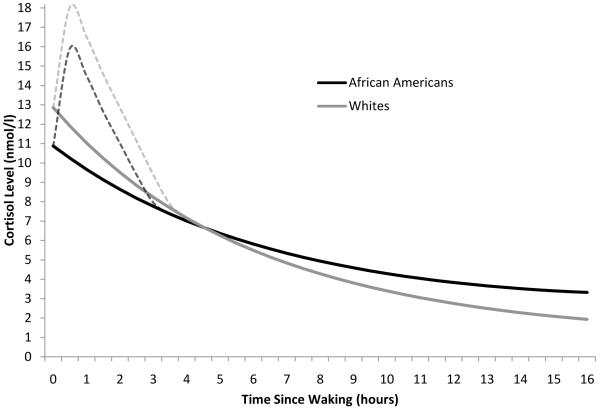
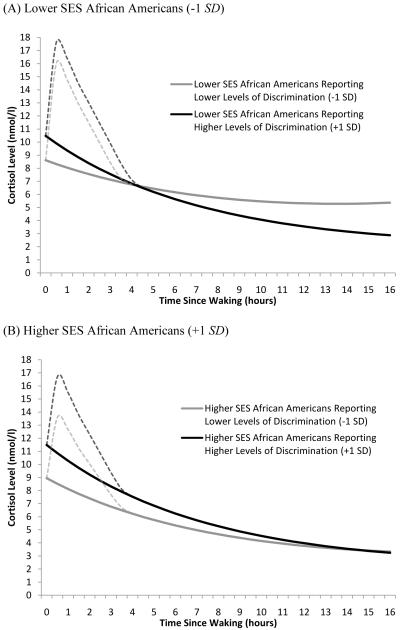
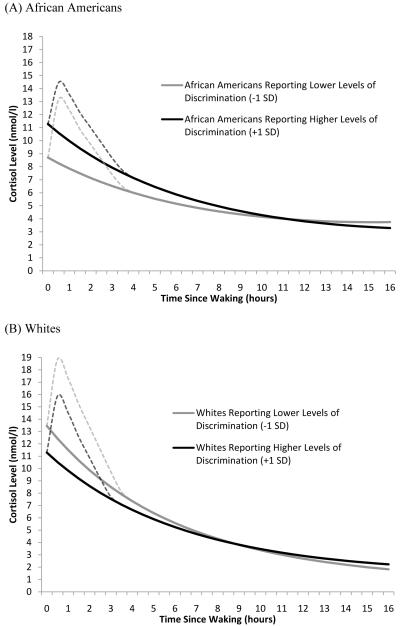
The current study considered the influence of perceived discrimination on the diurnal cortisol rhythm of 50 African American older adults and a matched comparison groups of 100 Whites (M(age)=56.6; 58% female). The role of socioeconomic status (SES) as a moderator of the effects of discrimination on the diurnal decline was also considered for each group. In support of the idea that perceptions of unfair treatment take on a unique meaning for stigmatized minority groups, results suggest that perceived discrimination is associated with a flatter (less healthy) diurnal slope among Whites but a steeper (more healthy) diurnal slope among African Americans. Perceived discrimination was also found to be more strongly associated with a steepening of the diurnal slope among lower SES African Americans than higher SES African Americans.
本研究考察了感知歧视对 50 名非裔美国老年人和 100 名白人(平均年龄=56.6;58%为女性)日间皮质醇节律的影响。还考虑了社会经济地位(SES)作为歧视对日间下降影响的调节剂的作用。支持这样一种观点,即不公平待遇的看法对受污名化的少数群体具有独特的意义,结果表明,感知歧视与白人的日间斜率更平坦(不太健康)相关,但与非裔美国人的日间斜率更陡峭(更健康)相关。还发现,感知歧视与较低 SES 的非裔美国人日间斜率的陡峭程度比较高 SES 的非裔美国人更强相关。