Departamento de Saúde Pública, Universidade Federal do Maranhão, São Luís, MA, Brasil.
BMC Public Health. 2011 Jun 21;11:486. doi: 10.1186/1471-2458-11-486.
Few cohort studies have been conducted in low and middle-income countries to investigate non-communicable diseases among school-aged children. This article aims to describe the methodology of two birth cohorts, started in 1994 in Ribeirão Preto (RP), a more developed city, and in 1997/98 in São Luís (SL), a less developed town.
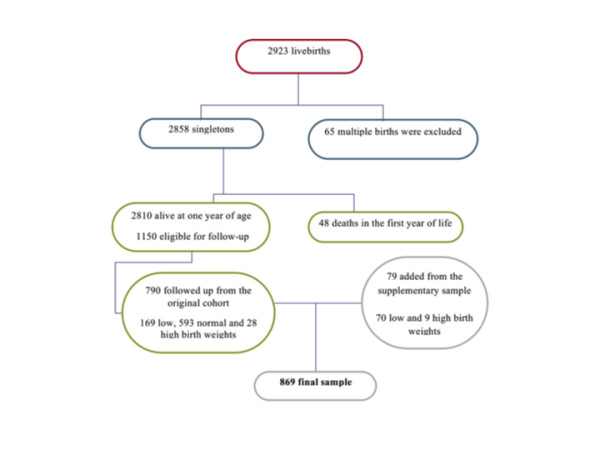
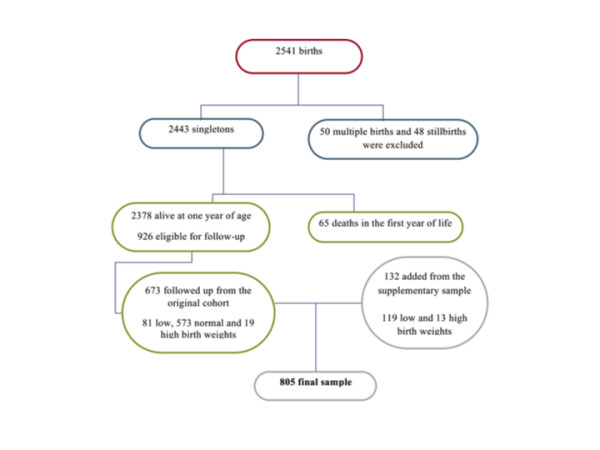
Prevalences of some non-communicable diseases during the first follow-up of these cohorts were estimated and compared. Data on singleton live births were obtained at birth (2858 in RP and 2443 in SL). The follow-up at school age was conducted in RP in 2004/05, when the children were 9-11 years old and in SL in 2005/06, when the children were 7-9 years old. Follow-up rates were 68.7% in RP (790 included) and 72.7% in SL (673 participants). The groups of low (<2500 g) and high (≥ 4250 g) birthweight were oversampled and estimates were corrected by weighting.
In the more developed city there was a higher percentage of non-nutritive sucking habits (69.1% vs 47.9%), lifetime bottle use (89.6% vs 68.3%), higher prevalence of primary headache in the last 15 days (27.9% vs 13.0%), higher positive skin tests for allergens (44.3% vs 25.3%) and higher prevalence of overweight (18.2% vs 3.6%), obesity (9.5% vs 1.8%) and hypertension (10.9% vs 4.6%). In the less developed city there was a larger percentage of children with below average cognitive function (28.9% vs 12.2%), mental health problems (47.4% vs 38.4%), depression (21.6% vs 6.0%) and underweight (5.8% vs 3.6%). There was no difference in the prevalence of bruxism, recurrent abdominal pain, asthma and bronchial hyperresponsiveness between cities.
Some non-communicable diseases were highly prevalent, especially in the more developed city. Some high rates suggest that the burden of non-communicable diseases will be high in the future, especially mental health problems.
在中低收入国家,很少有队列研究调查学龄儿童的非传染性疾病。本文旨在描述始于 1994 年的两个队列研究的方法,一个队列研究在 Ribeirão Preto(RP)开展,这是一个较发达的城市,另一个队列研究于 1997/98 年在 São Luís(SL)开展,这是一个欠发达的城镇。
在这些队列的第一次随访中,估计并比较了一些非传染性疾病的患病率。在出生时(RP 组 2858 例,SL 组 2443 例)获得了单胎活产数据。在 2004/05 年,当孩子们 9-11 岁时,在 RP 进行了学龄期随访,在 2005/06 年,当孩子们 7-9 岁时,在 SL 进行了学龄期随访。RP 组的随访率为 68.7%(790 例纳入),SL 组为 72.7%(673 例参与者)。低出生体重(<2500 克)和高出生体重(≥4250 克)组被过度抽样,通过加权对估计值进行了校正。
在较发达的城市,非营养性吸吮习惯(69.1% vs 47.9%)、终生奶瓶使用(89.6% vs 68.3%)、最近 15 天原发性头痛的患病率(27.9% vs 13.0%)、过敏原皮肤试验阳性率(44.3% vs 25.3%)和超重(18.2% vs 3.6%)、肥胖(9.5% vs 1.8%)和高血压(10.9% vs 4.6%)的比例更高。在欠发达的城市,认知功能低于平均水平的儿童比例更大(28.9% vs 12.2%)、心理健康问题(47.4% vs 38.4%)、抑郁(21.6% vs 6.0%)和体重不足(5.8% vs 3.6%)。两个城市的磨牙症、复发性腹痛、哮喘和支气管高反应性的患病率没有差异。
一些非传染性疾病的患病率很高,尤其是在较发达的城市。一些高比率表明,未来非传染性疾病的负担将会很高,尤其是心理健康问题。