Department of Microbiology and Immunology, New York Medical College, Valhalla, New York, United States of America.
PLoS One. 2011;6(6):e20823. doi: 10.1371/journal.pone.0020823. Epub 2011 Jun 13.
Influenza A virus vaccines undergo yearly reformulations due to the antigenic variability of the virus caused by antigenic drift and shift. It is critical to the vaccine manufacturing process to obtain influenza A seed virus that is antigenically identical to circulating wild type (wt) virus and grows to high titers in embryonated chicken eggs. Inactivated influenza A seasonal vaccines are generated by classical reassortment. The classical method takes advantage of the ability of the influenza virus to reassort based on the segmented nature of its genome. In ovo co-inoculation of a high growth or yield (hy) donor virus and a low yield wt virus with antibody selection against the donor surface antigens results in progeny viruses that grow to high titers in ovo with wt origin hemagglutinin (HA) and neuraminidase (NA) glycoproteins. In this report we determined the parental origin of the remaining six genes encoding the internal proteins that contribute to the hy phenotype in ovo.
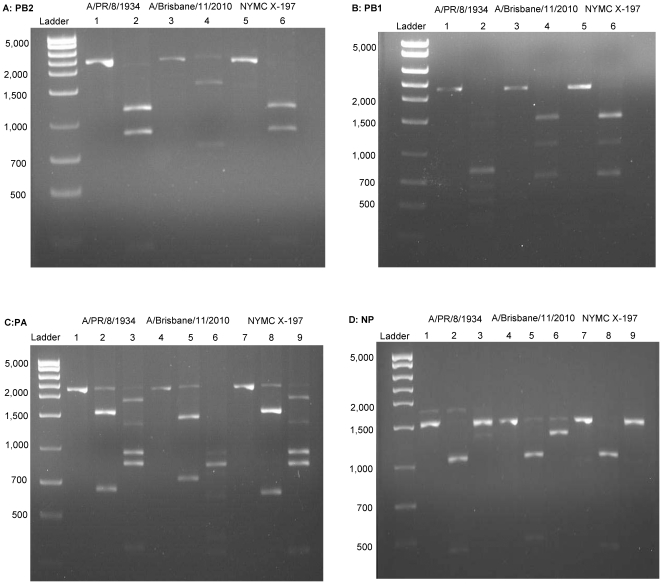
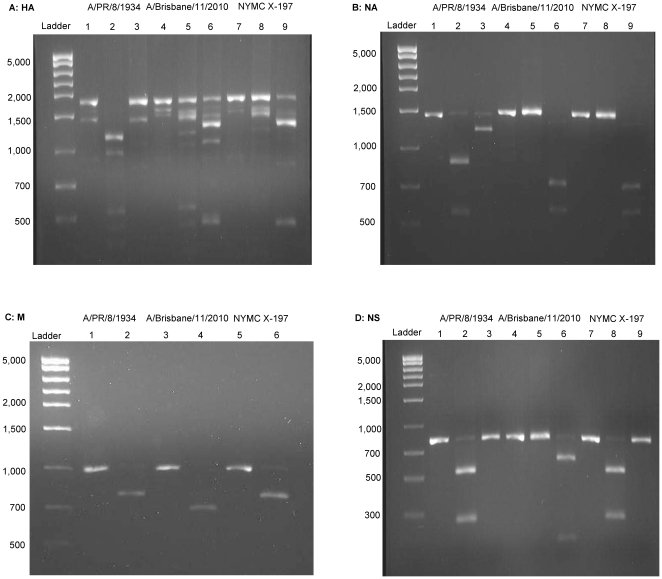
The genetic analysis was conducted using reverse transcription-polymerase chain reaction (RT-PCR) and restriction fragment length polymorphism (RFLP). The characterization was conducted to determine the parental origin of the gene segments (hy donor virus or wt virus), gene segment ratios and constellations. Fold increase in growth of reassortant viruses compared to respective parent wt viruses was determined by hemagglutination assay titers.
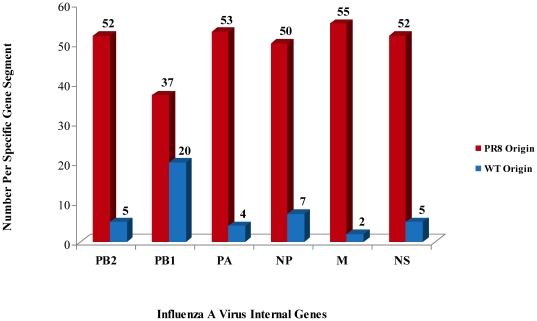
In this study fifty-seven influenza A vaccine candidate reassortants were analyzed for the presence or absence of correlations between specific gene segment ratios, gene constellations and hy reassortant phenotype. We found two gene ratios, 6:2 and 5:3, to be the most prevalent among the hy reassortants analyzed, although other gene ratios also conferred hy in certain reassortants.
由于病毒的抗原漂移和转变导致抗原变异,甲型流感病毒疫苗每年都需要进行配方改革。获得与流行野生型(wt)病毒具有相同抗原性且在鸡胚中高滴度生长的甲型流感种子病毒,对疫苗制造过程至关重要。灭活季节性流感 A 疫苗是通过经典重配生成的。经典方法利用流感病毒基于其基因组的分段性质进行重组的能力。在鸡胚中共同接种高生长或高产量(hy)供体病毒和低产量 wt 病毒,并对供体表面抗原进行抗体选择,可产生在鸡胚中高滴度生长的后代病毒,其 wt 来源血凝素(HA)和神经氨酸酶(NA)糖蛋白。在本报告中,我们确定了导致 hy 表型在鸡胚中出现的剩余六个编码内部蛋白的基因的亲本来源。
使用逆转录聚合酶链反应(RT-PCR)和限制性片段长度多态性(RFLP)进行遗传分析。通过特征分析确定基因片段(hy 供体病毒或 wt 病毒)、基因片段比例和基因组合的亲本来源。通过血凝试验滴度确定重组病毒与相应 wt 亲本病毒相比生长增加的倍数。
在这项研究中,分析了 57 种流感 A 疫苗候选重组体,以确定特定基因片段比例、基因组合和 hy 重组体表型之间是否存在相关性。我们发现,在分析的 hy 重组体中,6:2 和 5:3 这两个基因比例最为常见,尽管其他基因比例在某些重组体中也具有 hy 表型。