Plant Cell Biology Research Centre-School of Botany, University of Melbourne, Parkville, Victoria, Australia.
PLoS One. 2011;6(6):e20633. doi: 10.1371/journal.pone.0020633. Epub 2011 Jun 10.
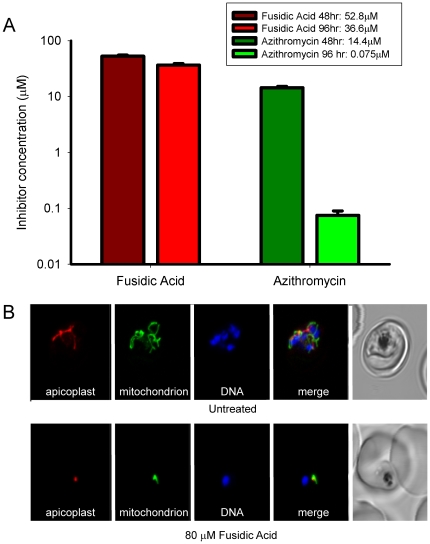
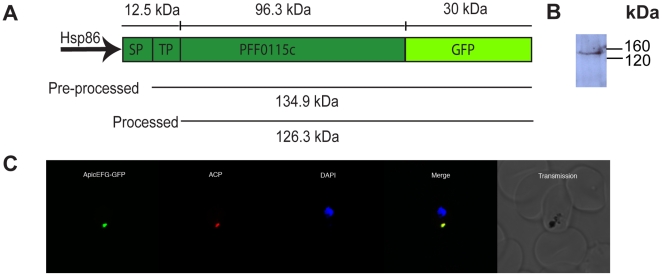
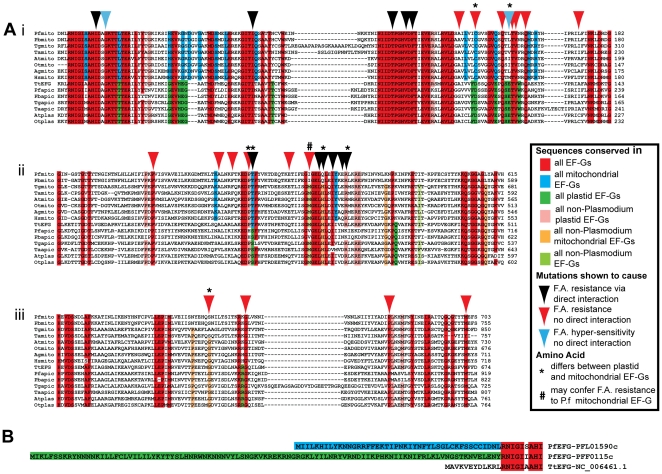
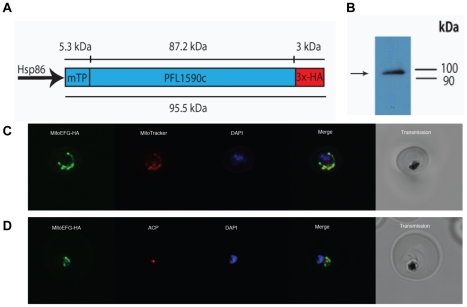
Malaria parasites harbour two organelles with bacteria-like metabolic processes that are the targets of many anti-bacterial drugs. One such drug is fusidic acid, which inhibits the translation component elongation factor G. The response of P. falciparum to fusidic acid was characterised using extended SYBR-Green based drug trials. This revealed that fusidic acid kills in vitro cultured P. falciparum parasites by immediately blocking parasite development. Two bacterial-type protein translation elongation factor G genes are identified as likely targets of fusidic acid. Sequence analysis suggests that these proteins function in the mitochondria and apicoplast and both should be sensitive to fusidic acid. Microscopic examination of protein-reporter fusions confirm the prediction that one elongation factor G is a component of parasite mitochondria whereas the second is a component of the relict plastid or apicoplast. The presence of two putative targets for a single inhibitory compound emphasizes the potential of elongation factor G as a drug target in malaria.
疟原虫有两个细胞器,它们具有类似细菌的代谢过程,是许多抗菌药物的作用靶点。其中一种药物是夫西地酸,它可以抑制翻译成分延伸因子 G。使用扩展的 SYBR-Green 基于药物试验来描述疟原虫对夫西地酸的反应。这表明夫西地酸通过立即阻止寄生虫发育而在体外培养的疟原虫寄生虫中杀死。鉴定出两种细菌型蛋白翻译延伸因子 G 基因可能是夫西地酸的作用靶点。序列分析表明这些蛋白质在线粒体和质体中发挥作用,两者都应该对夫西地酸敏感。对蛋白报告基因融合的显微镜检查证实了以下预测,即一个延伸因子 G 是寄生虫线粒体的组成部分,而第二个是遗迹质体或质体的组成部分。单一抑制化合物的两个假定靶标存在强调了延伸因子 G 作为疟疾药物靶点的潜力。