Gancheva Maria R, Mao Emma Y, Romeo Ornella, Vuong Daniel, O'Handley Ryan, Page Stephen W, Lacey Ernest, Wilson Danny W
Research Centre for Infectious Diseases, School of Biological Sciences, The University of Adelaide, Adelaide, 5005, South Australia, Australia; ARC Training Centre for Environmental and Agricultural Solutions to Antimicrobial Resistance (CEAStAR), St Lucia, 4072, Queensland, Australia; School of Animal and Veterinary Sciences, The University of Adelaide, Roseworthy, 5371, South Australia, Australia.
Research Centre for Infectious Diseases, School of Biological Sciences, The University of Adelaide, Adelaide, 5005, South Australia, Australia; ARC Training Centre for Environmental and Agricultural Solutions to Antimicrobial Resistance (CEAStAR), St Lucia, 4072, Queensland, Australia.
Int J Parasitol Drugs Drug Resist. 2025 Aug 5;29:100606. doi: 10.1016/j.ijpddr.2025.100606.
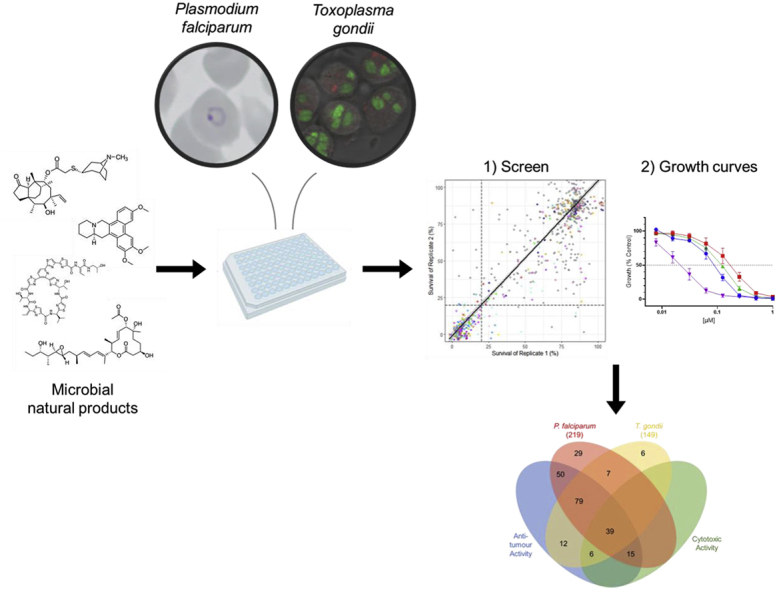
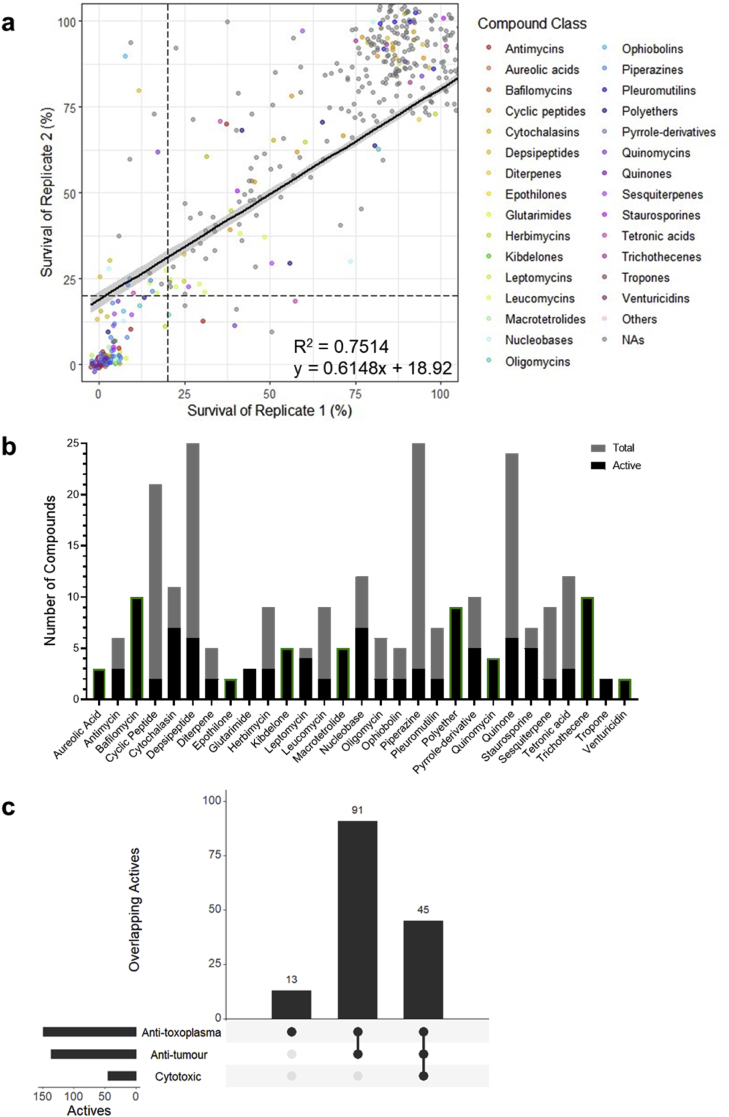
Frontline drug treatments for malaria are at risk of failing due to emerging resistance, meanwhile drugs used to treat toxoplasmosis have suboptimal efficacy and safety. As demonstrated by the success of clinically used antiparasitic drugs, the diverse structural complexity and biological activity of natural products holds great potential for drug discovery and development, to address the need for new compounds with novel mechanisms. Here we screened the BioAustralis Discovery Plates Series I library, a collection of 812 microbial natural product compounds including rare microbial metabolites, against Plasmodium falciparum erythrocytic stage and Toxoplasma gondii tachyzoite parasites. We identified 219 compounds that inhibited P. falciparum growth by at least 80 % at a concentration of 2 μg/mL (1-10 μM for >90 % of compounds), whilst 149 compounds demonstrated equivalent activity against T. gondii. The active compounds were assigned based on chemical structure to more than 50 compound classes. After triaging active compounds for those with low mammalian cytotoxicity, we defined the in vitro half maximal inhibitory concentration (IC) of a selection of compounds against the parasites, identifying four compound groups with activity in the low nanomolar range. The macrocyclic lactone pladienolide B and cryptopleurine were found to be very potent against the parasites but also mammalian cells, warranting further structure-activity relationship investigation. Two groups, the monocyclic thiazole peptides, including micrococcin P1 and the thiocillins, and the pleuromutilins, exhibited both low antiparasitic IC and low cytotoxicity, highlighting their potential for further analysis. This study defines the activity of the BioAustralis Discovery Plates Series I against two apicomplexan parasites of significant global importance, providing potential new tools to study parasite biology and possible starting points for novel antiparasitic development.
由于新出现的耐药性,疟疾的一线药物治疗面临失效风险,同时用于治疗弓形虫病的药物疗效和安全性欠佳。临床使用的抗寄生虫药物的成功表明,天然产物多样的结构复杂性和生物活性在药物发现和开发方面具有巨大潜力,以满足对具有新机制的新化合物的需求。在此,我们针对恶性疟原虫红细胞阶段和刚地弓形虫速殖子寄生虫,筛选了BioAustralis Discovery Plates Series I文库,该文库包含812种微生物天然产物化合物,包括稀有微生物代谢物。我们鉴定出219种化合物,在浓度为2μg/mL(超过90%的化合物为1 - 10μM)时对恶性疟原虫生长的抑制率至少为80%,同时有149种化合物对刚地弓形虫表现出同等活性。活性化合物根据化学结构被归为50多个化合物类别。在对低哺乳动物细胞毒性的活性化合物进行筛选后,我们确定了一系列化合物对寄生虫的体外半数最大抑制浓度(IC),鉴定出四个在低纳摩尔范围内具有活性的化合物组。发现大环内酯类普拉地诺醇B和隐丹参酮对寄生虫以及哺乳动物细胞都非常有效,需要进一步研究其构效关系。两组化合物,包括微球菌素P1和硫霉素的单环噻唑肽以及截短侧耳素类,表现出低抗寄生虫IC和低细胞毒性,突出了它们进一步分析的潜力。本研究确定了BioAustralis Discovery Plates Series I对两种具有重大全球意义的顶复门寄生虫的活性,为研究寄生虫生物学提供了潜在的新工具,并为新型抗寄生虫药物开发提供了可能的起点。