Center for Child and Adolescent Health Policy, Massachusetts General Hospital for Children, Department of Pediatrics, Harvard Medical School, Boston, Massachusetts 02114, USA.
J Adolesc Health. 2011 Jul;49(1):64-9. doi: 10.1016/j.jadohealth.2010.10.015. Epub 2011 Mar 12.
Little is known about the relationship between severe obesity and depressive symptoms, particularly in community as opposed to clinic-based samples. This study determined the relationship of severe obesity and depressive symptoms over 3 years in a community-based sample of non-Hispanic black and white adolescents in grades 7-12 at baseline.
The nested matched cohort study using data from a longitudinal school-based study of youth followed up for 3 years. A total of 51 severely obese participants (body mass index-for-age ≥99% and a body mass index ≥40 at one or more study visit) were identified and paired with an age-, gender-, and race-matched normal weight subject. Depressive symptoms (Center for Epidemiological Studies Depression [CES-D] scale) were assessed at baseline, 2 and 3 years later. High-depressive symptoms were defined by CES-D score above cut points predictive of major depressive disorder or use of antidepressant medication.
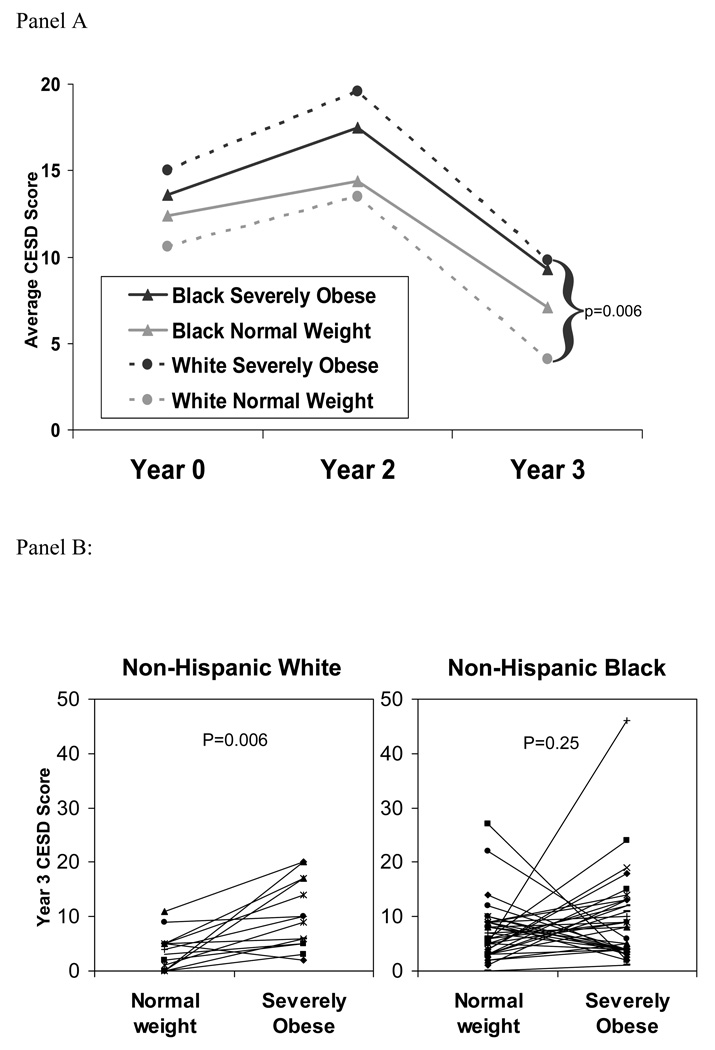
Pairs were 73% non-Hispanic black, 67% females. There was no relationship between weight status and high-depressive symptoms at any assessment point. However, a positive association between weight status and CES-D scores, while not present at baseline or at 2 years, emerged at 3 years (p = .02). This relationship was present only among non-Hispanic whites (p = .006 whites, p = .25 blacks) and did not differ by gender.
Severely obese youth in this community sample did not have increased likelihood of high levels of depressive symptoms. However, significantly increased depressive symptoms among non-Hispanic white youth at the end of the follow-up period suggests that this racial/ethnic group may be particularly vulnerable to the psychological effects of obesity in late adolescence and/or early adulthood.
对于严重肥胖与抑郁症状之间的关系,尤其是在社区而非诊所样本中,我们知之甚少。本研究旨在确定在非西班牙裔黑人和白人群体的 7-12 年级青少年中,以社区为基础的样本中,严重肥胖与抑郁症状在 3 年内的关系。
本嵌套匹配队列研究使用了一项纵向青少年学校研究的数据,该研究对参与者进行了为期 3 年的随访。共确定了 51 名严重肥胖者(体重指数-年龄≥99%,且在一次或多次研究就诊时体重指数≥40),并与年龄、性别和种族匹配的正常体重受试者进行配对。在基线、2 年和 3 年后评估抑郁症状(流行病学研究中心抑郁量表 [CES-D] 量表)。高抑郁症状的定义为 CES-D 评分高于预测重度抑郁症或使用抗抑郁药物的切点。
配对的参与者中 73%是非西班牙裔黑人,67%是女性。在任何评估点,体重状况与高抑郁症状之间均无关系。然而,体重状况与 CES-D 评分之间呈正相关,尽管在基线或 2 年时不存在,但在 3 年时出现(p =.02)。这种关系仅在非西班牙裔白人中存在(p =.006 白人,p =.25 黑人),且与性别无关。
在该社区样本中,严重肥胖的青少年发生高水平抑郁症状的可能性并未增加。然而,在随访期末,非西班牙裔白人青少年的抑郁症状显著增加,这表明这一种族/民族群体可能特别容易受到肥胖在青春期后期和/或成年早期对心理健康的影响。