Department of Zoology, Faculty of Science, University of Jaffna, Jaffna, Sri Lanka.
Parasit Vectors. 2011 Jun 24;4:117. doi: 10.1186/1756-3305-4-117.
Anopheles subpictus sensu lato, a widespread vector of malaria in Asia, is reportedly composed of four sibling species A-D based on distinct cytogenetic and morphological characteristics. However An. subpictus species B specimens in Sri Lanka are termed An. subpictus B/ An. sundaicus because of recent genetic data. Differences in salinity tolerance and coastal/inland prevalence of An. subpictus sibling species that were not previously established in Sri Lanka are presented here.
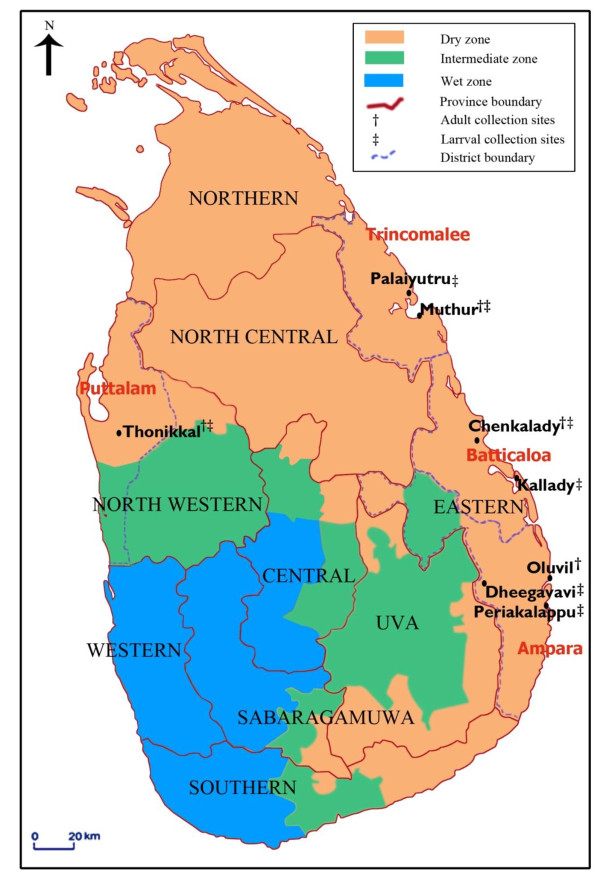
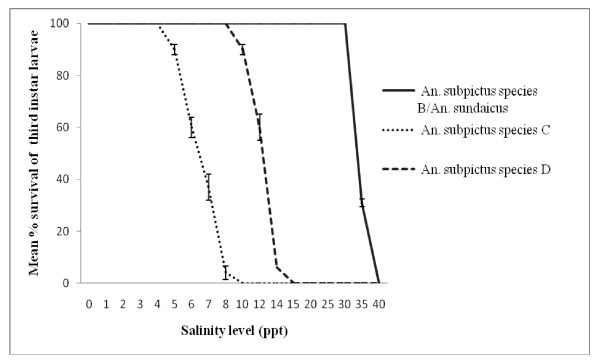
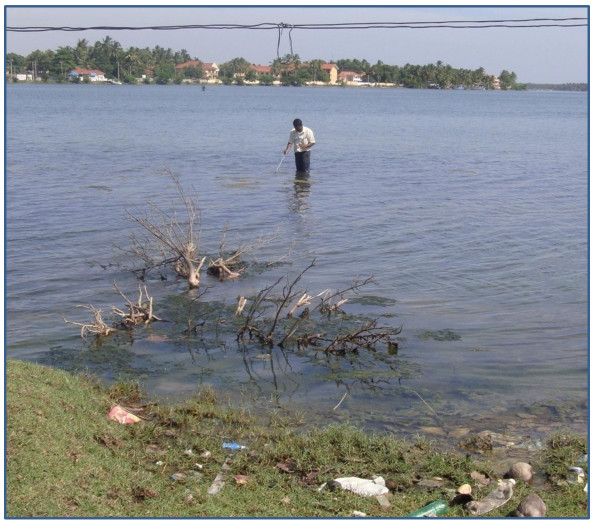
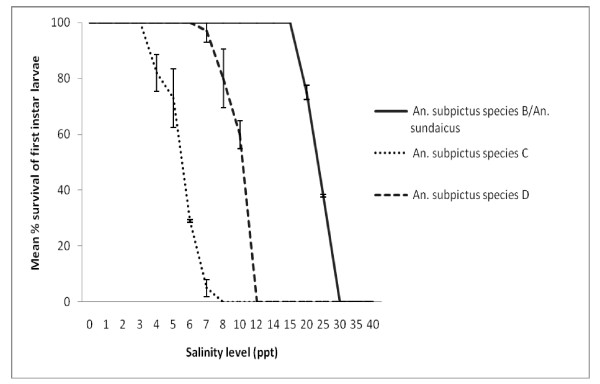
Specimens with morphological characteristics of all four Indian An. subpictus sibling species were found in Sri Lanka. Sibling species A, C and D tended to be predominant in inland, and An. subpictus species B/An. sundaicus, in coastal localities. Sibling species C was predominant in both adult and larval inland collections. Larvae of An. subpictus B/An. sundaicus were found in inland and coastal sites, including a lagoon, with salinity varying from 0 to 30 ppt. An. subpictus sibling species A, C and D larvae were present in water of salinity between 0 to 4 ppt. An. subpictus C, D and An. subpictus B/An. sundaicus larvae showed compatible differential salinity tolerance in laboratory tests. The first instar larvae of An. subpictus B/An. sundaicus showed 100% survival up to 15 ppt in comparison to species C and D where the corresponding values were 3 ppt and 6 ppt respectively. However all third instar larvae of An. subpictus B/An. sundaicus survived up to 30 ppt salinity whereas An. subpictus C and D tolerated up to 4 ppt and 8 ppt salinity respectively.
The results suggest that An. subpictus species B/An. sundaicus breed in fresh, brackish and nearly saline water while An. subpictus species C and D do so in fresh and less brackish waters in Sri Lanka, as in India. Because of the established role of An. sundaicus s.l. and An. subpictus s.l. as malaria vectors, the findings indicate a need for greater monitoring of brackish water breeding habitats in Asia. Tolerance to 15 ppt salinity may also constitute a simple method for differentiating An. subpictus B/An. sundaicus larvae from those of An. subpictus species C and D in field studies.
亚洲广泛传播疟疾的按蚊亚种 sensu lato 据报道由四个姊妹种 A-D 组成,基于明显的细胞遗传学和形态学特征。然而,由于最近的遗传数据,斯里兰卡的按蚊亚种 B 标本被称为按蚊亚种 B/按蚊巽他。本研究旨在介绍斯里兰卡此前未确定的按蚊亚种对盐度耐受性和沿海/内陆流行率的差异。
在斯里兰卡发现了具有所有四个印度按蚊亚种形态特征的标本。姊妹种 A、C 和 D 倾向于在内陆地区占优势,而按蚊亚种 B/按蚊巽他则在沿海地区占优势。在成年和幼虫内陆采集物中,姊妹种 C 占优势。按蚊亚种 B/按蚊巽他的幼虫在包括一个泻湖在内的内陆和沿海地点均有发现,盐度从 0 到 30 ppt 不等。按蚊亚种 A、C 和 D 的幼虫存在于盐度在 0 到 4 ppt 之间的水中。按蚊亚种 C、D 和按蚊亚种 B/按蚊巽他在实验室测试中表现出相容的不同盐度耐受性。与姊妹种 C 和 D 相比,按蚊亚种 B/按蚊巽他的第一龄幼虫在 15 ppt 盐度下存活率达到 100%,而相应值分别为 3 ppt 和 6 ppt。然而,所有按蚊亚种 B/按蚊巽他的第三龄幼虫在 30 ppt 盐度下均能存活,而按蚊亚种 C 和 D 则分别耐受 4 ppt 和 8 ppt 盐度。
结果表明,在斯里兰卡,按蚊亚种 B/按蚊巽他在淡水、微咸水和近咸水中繁殖,而按蚊亚种 C 和 D 在斯里兰卡的淡水中和微咸水中繁殖,与印度相同。由于按蚊巽他和按蚊亚种作为疟疾媒介的作用已确立,这些发现表明需要对亚洲的微咸水繁殖栖息地进行更广泛的监测。15 ppt 盐度的耐受性也可能构成一种简单的方法,用于在野外研究中区分按蚊亚种 B/按蚊巽他幼虫与按蚊亚种 C 和 D 的幼虫。