Hewavitharane Mihirini, Ranawaka Gaya, Saparamadu M D J S, Premaratne Risintha, Jayasooriya H T R
Anti Malaria Campaign Head Quarters, Ministry of Health, 555/5Public Health Complex, Colombo 5, Sri Lanka.
Department of Zoology, Faculty of Natural Sciences, The Open University of Sri Lanka, Nawala, Nugegoda, Sri Lanka.
Malar J. 2025 Aug 9;24(1):256. doi: 10.1186/s12936-025-05497-1.
Sri Lanka has been malaria-free since 2012, yet the risk of malaria re-introduction is high during the post-malaria elimination phase due to influx of infected individuals from endemic countries, the presence of competent Anopheles vectors, and suitable climatic conditions for vectors across Sri Lanka. This may lead to the re-emergence of autochthonous malaria in areas beyond the historically affected dry and intermediate zones. To sustain the malaria-free status, a better understanding of Anopheles species across Sri Lanka's climatic zones is essential. This information will support the existing receptivity monitoring system.
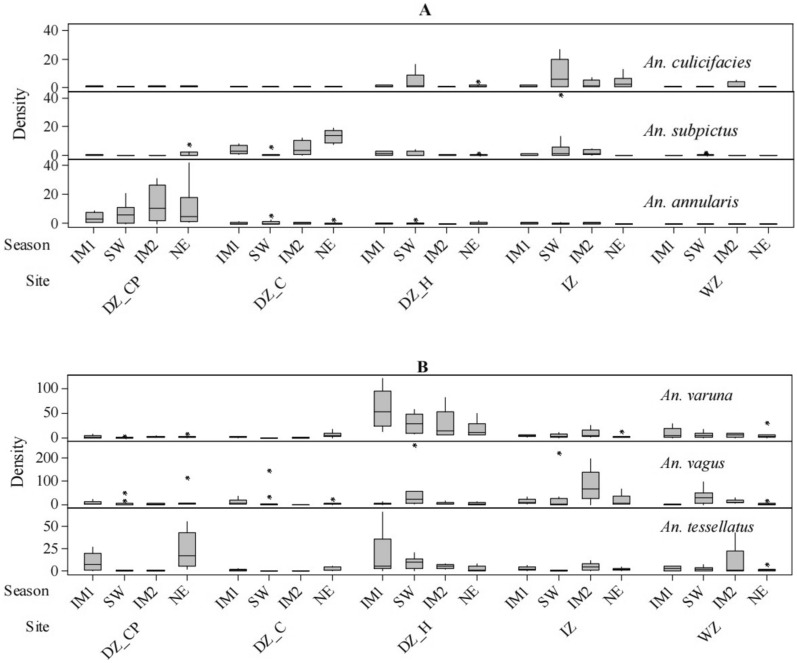
Female adults of Anopheles mosquitoes were sampled monthly for two years using cattle baited trap collections (CBTC), indoor and outdoor human landing catches (HLC) and indoor hand collections (IHC), from five districts covering the dry, intermediate, and wet zones. Rainfall, temperature, and relative humidity data for the sentinel sites were obtained from the Department of Meteorology in Colombo. The study assessed Anopheles species occurrence, distribution, abundance, and densities. Spatial distribution and seasonality were analyzed using box plots, while the effects of climatic factors and collection site on malaria vectors were evaluated using negative binomial regression.
Fifteen Anopheles mosquito species were identified, with varying abundance and densities across sites. The primary malaria vector mosquitoes were predominantly captured by HLC at all sites, except the dry zone coastal site, while secondary vectors were more common in CBTC. An. culicifacies exhibited the highest mean adult density at the intermediate zone site, with population peaks observed during the second inter-monsoon and southwest monsoon seasons at most sites, and during the northeast monsoon in the wet zone. Vector abundance was significantly influenced by climatic factors and collection site (p < 0.05); An. culicifacies densities increased with humidity, while secondary vectors showed species-specific responses to temperature, rainfall, and collection site conditions.
The spatial distribution and seasonality of Anopheles vectors provide insights on malaria vectorial efficiency in receptive areas. The intermediate zone of the island has the highest receptivity. Ongoing malaria entomological surveillance in the context of changing environmental conditions is critical for mitigating potential malaria reintroduction risks.
斯里兰卡自2012年起已消除疟疾,但在疟疾消除后的阶段,由于来自疟疾流行国家的感染个体涌入、存在易感按蚊媒介以及斯里兰卡各地适宜媒介生存的气候条件,疟疾重新传入的风险很高。这可能导致在历史上受影响的干旱和中间地带以外的地区出现本土疟疾的再次流行。为维持无疟疾状态,更好地了解斯里兰卡各气候区的按蚊种类至关重要。这些信息将支持现有的易感性监测系统。
在两年时间里,每月使用牛诱饵诱捕法(CBTC)、室内和室外人饵诱捕法(HLC)以及室内手工采集法(IHC),从覆盖干旱、中间和湿润地带的五个地区采集雌性按蚊成虫样本。哨兵站点的降雨、温度和相对湿度数据来自科伦坡的气象部门。该研究评估了按蚊种类的出现情况、分布、丰度和密度。使用箱线图分析空间分布和季节性,同时使用负二项回归评估气候因素和采集地点对疟疾媒介的影响。
共鉴定出15种按蚊,各站点的丰度和密度各不相同。除干旱区沿海站点外,主要疟疾媒介蚊子在所有站点主要通过人饵诱捕法捕获,而次要媒介在牛诱饵诱捕法中更为常见。在中间地带站点,库氏按蚊的成虫平均密度最高,大多数站点在第二个季风间期和西南季风季节出现种群高峰,在湿润地带则在东北季风季节出现高峰。媒介丰度受气候因素和采集地点的显著影响(p < 0.05);库氏按蚊的密度随湿度增加,而次要媒介对温度、降雨和采集地点条件表现出物种特异性反应。
按蚊媒介的空间分布和季节性为了解易感地区的疟疾媒介效率提供了见解。该岛的中间地带易感性最高。在环境条件不断变化的情况下,持续进行疟疾昆虫学监测对于降低潜在的疟疾重新传入风险至关重要。