Manitoba Institute of Cell Biology, Winnipeg, MB, Canada.
BMC Cancer. 2011 Jun 24;11:268. doi: 10.1186/1471-2407-11-268.
Cucurbitacin-I (JSI-124) is potent inhibitor of JAK/STAT3 signaling pathway and has anti-tumor activity in a variety of cancer including B cell leukemia. However, other molecular targets of JSI-124 beyond the JAK/STAT3 pathway are not fully understood.
BJAB, I-83, NALM-6 and primary CLL cells were treated with JSI-124 as indicated. Apoptosis was measured using flow cytometry for accumulation of sub-G1 phase cells (indicator of apoptosis) and Annexin V/PI staining. Cell cycle was analyzed by FACS for DNA content of G1 and G2 phases. Changes in phosphorylation and protein expression of p38, Erk1/2, JNK, c-Jun, and XIAP were detected by Western blot analysis. STAT3 and c-Jun genes were knocked out using siRNA transfection. VEGF expression was determined by mRNA and protein levels by RT-PCR and western blotting. Streptavidin Pull-Down Assay was used to determine c-Jun binding to the AP-1 DNA binding site.
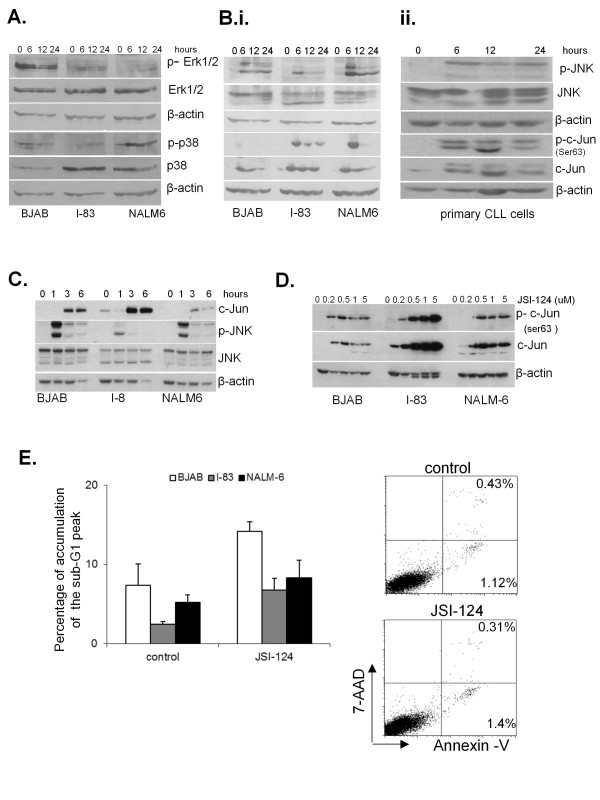
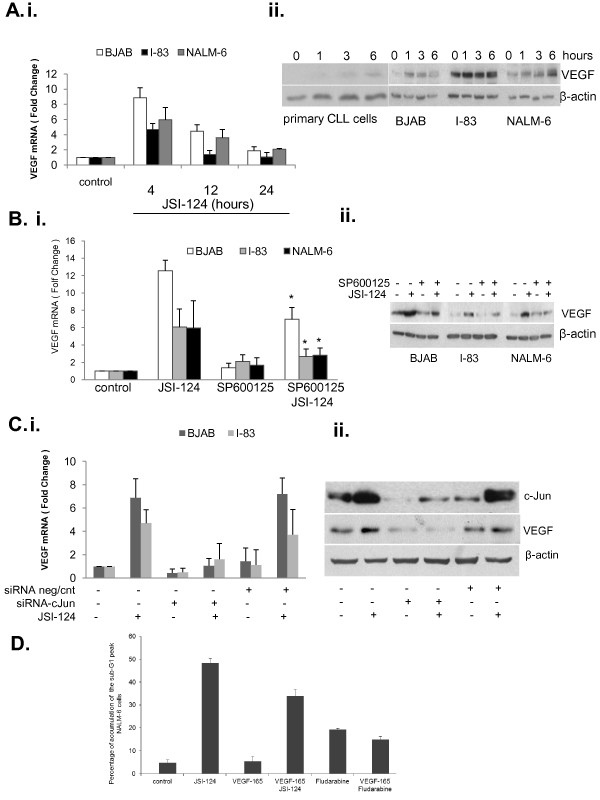
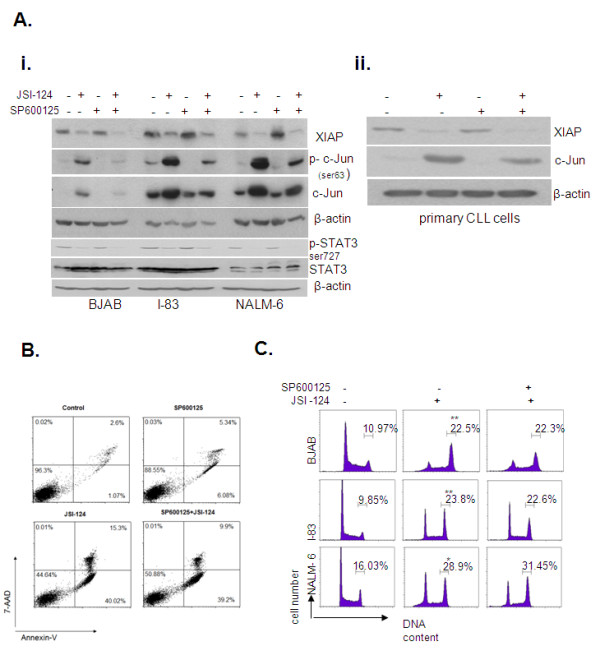
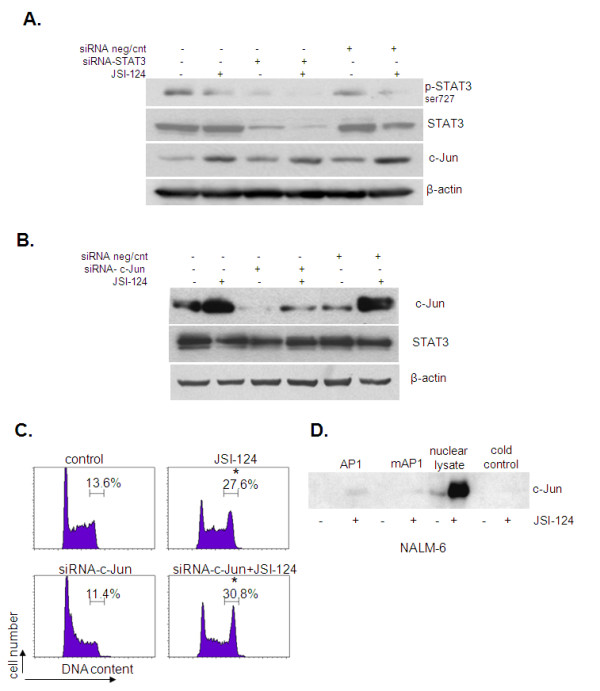
Herein, we show that JSI-124 activates c-Jun N-terminal kinase (JNK) and increases both the expression and serine phosphorylation of c-Jun protein in the B leukemic cell lines BJAB, I-83 and NALM-6. JSI-124 also activated MAPK p38 and MAPK Erk1/2 albeit at lower levels than JNK activation. Inhibition of the JNK signaling pathway failed to effect cell cycle arrest or apoptosis induced by JSI-124 but repressed JSI-124 induced c-Jun expression in these leukemia cells. The JNK pathway activation c-Jun leads to transcriptional activation of many genes. Treatment of BJAB, I-83, and NALM-6 cells with JSI-124 lead to an increase of Vascular Endothelial Growth Factor (VEGF) at both the mRNA and protein level. Knockdown of c-Jun expression and inhibition of JNK activation significantly blocked JSI-124 induced VEGF expression. Pretreatment with recombinant VEGF reduced JSI-124 induced apoptosis.
Taken together, our data demonstrates that JSI-124 activates the JNK signaling pathway independent of apoptosis and cell cycle arrest, leading to increased VEGF expression.
葫芦素 I(JSI-124)是 JAK/STAT3 信号通路的有效抑制剂,在包括 B 细胞白血病在内的多种癌症中具有抗肿瘤活性。然而,除了 JAK/STAT3 通路之外,JSI-124 的其他分子靶点尚未完全了解。
根据指示,用 JSI-124 处理 BJAB、I-83、NALM-6 和原代 CLL 细胞。通过流式细胞术测量亚 G1 期细胞(凋亡标志物)的积累和 Annexin V/PI 染色来测量细胞凋亡。通过 FACS 分析 G1 和 G2 期的细胞周期。通过 Western blot 分析检测 p38、Erk1/2、JNK、c-Jun 和 XIAP 的磷酸化和蛋白表达的变化。使用 siRNA 转染敲除 STAT3 和 c-Jun 基因。通过 RT-PCR 和 Western blot 测定 VEGF 的 mRNA 和蛋白水平来确定 VEGF 的表达。使用链霉亲和素下拉测定法确定 c-Jun 与 AP-1 DNA 结合位点的结合。
本文显示,JSI-124 激活了 c-Jun N 端激酶(JNK),并增加了 B 白血病细胞系 BJAB、I-83 和 NALM-6 中 c-Jun 蛋白的表达和丝氨酸磷酸化。JSI-124 还激活了 MAPK p38 和 MAPK Erk1/2,但激活程度低于 JNK。抑制 JNK 信号通路未能影响 JSI-124 诱导的细胞周期阻滞或凋亡,但抑制了 JSI-124 在这些白血病细胞中诱导的 c-Jun 表达。JNK 通路激活 c-Jun 导致许多基因的转录激活。用 JSI-124 处理 BJAB、I-83 和 NALM-6 细胞可导致 VEGF 的 mRNA 和蛋白水平均增加。c-Jun 表达的敲低和 JNK 激活的抑制显著阻断了 JSI-124 诱导的 VEGF 表达。用重组 VEGF 预处理可降低 JSI-124 诱导的凋亡。
综上所述,我们的数据表明,JSI-124 激活 JNK 信号通路,独立于细胞凋亡和细胞周期阻滞,导致 VEGF 表达增加。