Yasuda Kaoru, Khandare Anupama, Burianovskyy Leonid, Maruyama Shoichi, Zhang Frank, Nasjletti Alberto, Goligorsky Michael S
Department of Medicine, Renal Research Institute, New York Medical College, Valhalla, New York, USA.
Aging (Albany NY). 2011 Jun;3(6):597-608. doi: 10.18632/aging.100341.
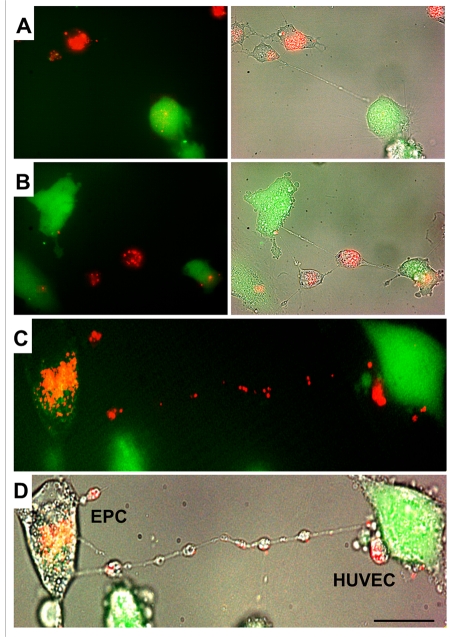
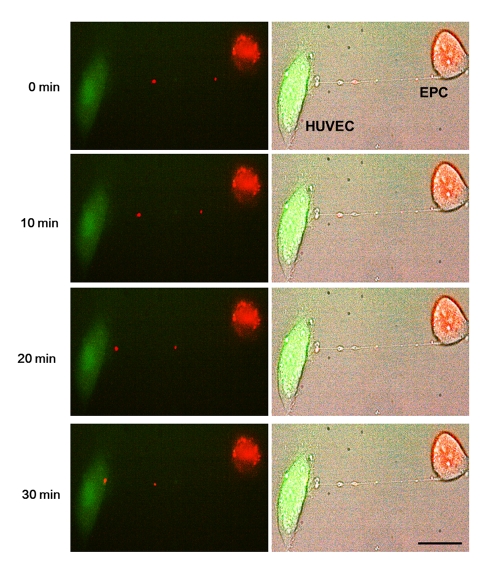
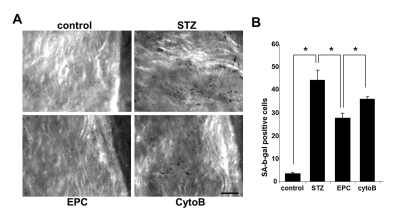
Although therapeutic effect of adoptive transfer of endothelial progenitor cells (EPC) has been well-substantiated, the actual engraftment is relatively low compared to a robust functional improvement of vasculopathy. Cellular mechanisms governing this action remain elusive. A recently discovered cell-cell communication via tunneling nanotube (TNT) formation is capable of transferring mitochondria and lysosomes between the cells - "organellar diakinesis". Based on the previous demonstration of lysosomal dysfunction in endothelial cells exposed to AGE-modified collagen I, we inquired whether TNT mechanism may be involved in EPC-mediated repair of stressed endothelial cells. Here we demonstrate that EPC selectively and multiplicatively establish TNT communication with stressed endothelia. The guidance cues for the selectivity are provided by exofacially exposed phosphatidylserine moieties. Lysosomal transfer is associated with the preservation of lysosomal pH gradient, functionally reconstituting lysosomal pool of stressed cells and improving endothelial cell viability, reducing premature senescence and apoptosis. In vivo, adoptive transfer of EPC to streptozotocin-diabetic mice results in a TNT-dependent reduction of senescent endothelial cells and correction of endothelium-dependent vasorelaxation. Collectively, these data establish a selective multiplicative effect of TNT between EPC and stressed endothelia, reconstitution of the lysosomal pool, and improved viability and function of stressed endothelia.
尽管内皮祖细胞(EPC)的过继转移治疗效果已得到充分证实,但与血管病变的显著功能改善相比,实际的植入率相对较低。控制这一作用的细胞机制仍然难以捉摸。最近发现的通过隧道纳米管(TNT)形成的细胞间通讯能够在细胞之间转移线粒体和溶酶体——“细胞器成熟分裂”。基于先前在暴露于晚期糖基化终末产物修饰的I型胶原的内皮细胞中溶酶体功能障碍的证明,我们探究了TNT机制是否可能参与EPC介导的应激内皮细胞修复。在这里,我们证明EPC选择性地并大量地与应激内皮细胞建立TNT通讯。选择性的引导线索由外表面暴露的磷脂酰丝氨酸部分提供。溶酶体转移与溶酶体pH梯度的维持相关,在功能上重建应激细胞的溶酶体库并提高内皮细胞活力,减少过早衰老和凋亡。在体内,将EPC过继转移给链脲佐菌素诱导的糖尿病小鼠会导致衰老内皮细胞的TNT依赖性减少以及内皮依赖性血管舒张的纠正。总体而言,这些数据证实了TNT在EPC和应激内皮细胞之间的选择性增殖作用、溶酶体库的重建以及应激内皮细胞活力和功能的改善。