• 文献检索
  • 文档翻译
  • 深度研究
  • 学术资讯
  • Suppr Zotero 插件Zotero 插件
  • 邀请有礼
  • 套餐&价格
  • 历史记录
应用&插件
Suppr Zotero 插件Zotero 插件浏览器插件Mac 客户端Windows 客户端微信小程序
定价
高级版会员购买积分包购买API积分包
服务
文献检索文档翻译深度研究API 文档MCP 服务
关于我们
关于 Suppr公司介绍联系我们用户协议隐私条款
关注我们

Suppr 超能文献

核心技术专利:CN118964589B侵权必究
粤ICP备2023148730 号-1Suppr @ 2026

文献检索

告别复杂PubMed语法,用中文像聊天一样搜索,搜遍4000万医学文献。AI智能推荐,让科研检索更轻松。

立即免费搜索

文件翻译

保留排版,准确专业,支持PDF/Word/PPT等文件格式,支持 12+语言互译。

免费翻译文档

深度研究

AI帮你快速写综述,25分钟生成高质量综述,智能提取关键信息,辅助科研写作。

立即免费体验

“我的苯丙酮尿症”:提高苯丙酮尿症患者的自我管理能力。一项随机对照试验。

"MY PKU": increasing self-management in patients with phenylketonuria. A randomized controlled trial.

机构信息

Department of Pediatrics, Academic Medical Center (AMC), University of Amsterdam, AZ Amsterdam, The Netherlands.

出版信息

Orphanet J Rare Dis. 2011 Jun 27;6:48. doi: 10.1186/1750-1172-6-48.

DOI:10.1186/1750-1172-6-48
PMID:21708003
原文链接:https://pmc.ncbi.nlm.nih.gov/articles/PMC3133536/
Abstract

BACKGROUND

Phenylketonuria (PKU) is an autosomal recessive disorder of phenylalanine metabolism. The inability to convert phenylalanine (Phe) into tyrosine causes Phe to accumulate in the body. Adherence to a protein restricted diet, resulting in reduced Phe levels, is essential to prevent cognitive decline. Frequent evaluation of plasma Phe levels and, if necessary, adjustment of the diet are the mainstay of treatment. We aimed to assess whether increased self-management of PKU patients and/or their parents is feasible and safe, by providing direct online access to blood Phe values without immediate professional guidance.

METHODS

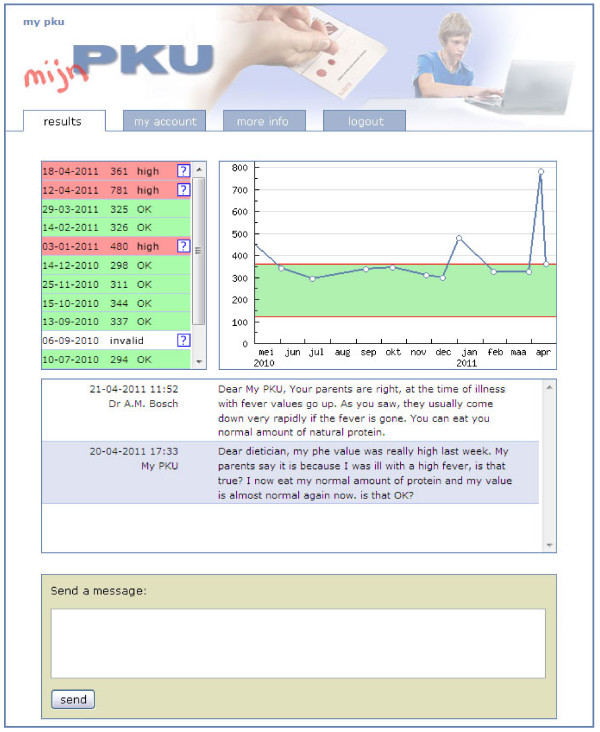
Thirty-eight patients aged ≥ 1 year participated in a 10 month randomized controlled trial. Patients were randomized into a study group (1) or a control group (2). Group 2 continued the usual procedure: a phone call or e-mail by a dietician in case of a deviant Phe value. Group 1 was given a personal "My PKU" web page with a graph of their recent and previous Phe values, online general information about the dietary treatment and the Dutch PKU follow-up guidelines, and a message-box to contact their dietician if necessary. Phe values were provided on "My PKU" without advice. Outcome measures were: differences in mean Phe value, percentage of values above the recommended range and Phe sample frequency, between a 10-month pre-study period and the study period in each group, and between the groups in both periods. Furthermore we assessed satisfaction of patients and/or parents with the 'My PKU' procedure of online availability.

RESULTS

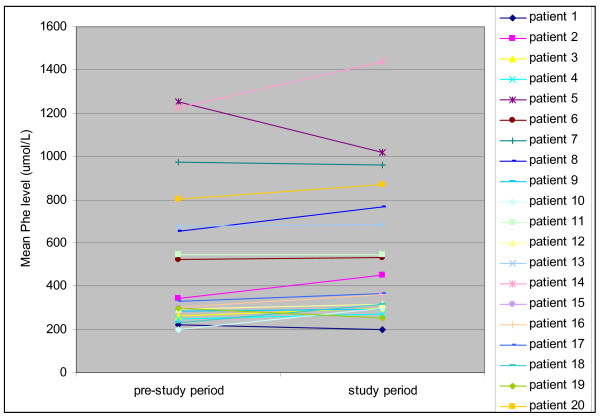
There were no significant differences in mean Phe value, percentage of values above recommended range or in frequency of blood spot sampling for Phe determination between the pre-study period and the study period in each group, nor between the 2 groups during the periods. All patients and/or parents expressed a high level of satisfaction with the new way of disease management.

CONCLUSIONS

Increased self-management in PKU by providing patients and/or parents their Phe values without advice is feasible and safe and is highly appreciated.

TRIAL REGISTRATION

The trial was registered with The Netherlands National Trial Register (NTR #1171) before recruitment of patients.

摘要

背景

苯丙酮尿症(PKU)是一种常染色体隐性遗传的苯丙氨酸代谢障碍。由于无法将苯丙氨酸(Phe)转化为酪氨酸,导致 Phe 在体内积聚。为了防止认知能力下降,必须坚持限制蛋白质的饮食,从而降低 Phe 水平。频繁评估血浆 Phe 水平,并在必要时调整饮食,是治疗的主要方法。我们旨在评估通过直接在线访问血液 Phe 值而无需即时专业指导,是否可以增加 PKU 患者及其父母的自我管理能力,同时保证其安全性。

方法

38 名年龄≥1 岁的患者参加了一项为期 10 个月的随机对照试验。患者被随机分为研究组(1)或对照组(2)。对照组 2 继续采用常规程序:营养师在出现异常 Phe 值时通过电话或电子邮件联系。研究组 1 则提供了一个个人“我的 PKU”网页,其中包含他们最近和以前的 Phe 值图表、有关饮食治疗和荷兰 PKU 随访指南的在线一般信息,以及一个留言框,以便在必要时与营养师联系。在“我的 PKU”上提供了 Phe 值,但没有提供建议。主要观察指标是:两组在研究前 10 个月和研究期间的平均 Phe 值、超过推荐范围的 Phe 值百分比和 Phe 值样本频率之间的差异,以及两个时期之间的差异。此外,我们评估了患者及其父母对在线获取“我的 PKU”的满意度。

结果

两组在研究前 10 个月和研究期间,以及两个时期之间,平均 Phe 值、超过推荐范围的 Phe 值百分比或 Phe 值样本采集频率均无显著差异。所有患者及其父母均对这种新的疾病管理方式表示高度满意。

结论

通过提供患者及其父母 Phe 值而不提供建议,来增加 PKU 的自我管理是可行且安全的,并且受到高度赞赏。

试验注册

在招募患者之前,该试验已在荷兰国家试验注册处(NTR #1171)进行了注册。
https://cdn.ncbi.nlm.nih.gov/pmc/blobs/0634/3133536/99cfc437364b/1750-1172-6-48-2.jpg
https://cdn.ncbi.nlm.nih.gov/pmc/blobs/0634/3133536/778aab7e96e4/1750-1172-6-48-1.jpg
https://cdn.ncbi.nlm.nih.gov/pmc/blobs/0634/3133536/99cfc437364b/1750-1172-6-48-2.jpg
https://cdn.ncbi.nlm.nih.gov/pmc/blobs/0634/3133536/778aab7e96e4/1750-1172-6-48-1.jpg
https://cdn.ncbi.nlm.nih.gov/pmc/blobs/0634/3133536/99cfc437364b/1750-1172-6-48-2.jpg

相似文献

1
"MY PKU": increasing self-management in patients with phenylketonuria. A randomized controlled trial.“我的苯丙酮尿症”:提高苯丙酮尿症患者的自我管理能力。一项随机对照试验。
Orphanet J Rare Dis. 2011 Jun 27;6:48. doi: 10.1186/1750-1172-6-48.
2
5-year retrospective analysis of patients with phenylketonuria (PKU) and hyperphenylalaninemia treated at two specialized clinics.5 年回顾性分析在两家专业诊所治疗的苯丙酮尿症(PKU)和高苯丙氨酸血症患者。
Mol Genet Metab. 2020 Mar;129(3):177-185. doi: 10.1016/j.ymgme.2019.12.007. Epub 2019 Dec 10.
3
Blood Phenylalanine Levels in Patients with Phenylketonuria from Europe between 2012 and 2018: Is It a Changing Landscape?2012 年至 2018 年期间欧洲苯丙酮尿症患者的血苯丙氨酸水平:是否正在发生变化?
Nutrients. 2024 Jun 28;16(13):2064. doi: 10.3390/nu16132064.
4
Introduction of sapropterin dihydrochloride as standard of care in patients with phenylketonuria.盐酸沙丙蝶呤在苯丙酮尿症患者中的标准治疗介绍。
Mol Genet Metab. 2010 Jul;100(3):229-33. doi: 10.1016/j.ymgme.2010.03.022. Epub 2010 Apr 3.
5
Adherence to clinic recommendations among patients with phenylketonuria in the United States.美国苯丙酮尿症患者对临床建议的依从性。
Mol Genet Metab. 2017 Mar;120(3):190-197. doi: 10.1016/j.ymgme.2017.01.001. Epub 2017 Jan 6.
6
Over Restriction of Dietary Protein Allowance: The Importance of Ongoing Reassessment of Natural Protein Tolerance in Phenylketonuria.过度限制饮食蛋白质摄入量:苯丙酮尿症中持续重新评估天然蛋白质耐受性的重要性。
Nutrients. 2019 Apr 30;11(5):995. doi: 10.3390/nu11050995.
7
Impact of phenylalanine on cognitive, cerebral, and neurometabolic parameters in adult patients with phenylketonuria (the PICO study): a randomized, placebo-controlled, crossover, noninferiority trial.苯丙氨酸对成年苯丙酮尿症患者认知、大脑和神经代谢参数的影响(PICO 研究):一项随机、安慰剂对照、交叉、非劣效性试验。
Trials. 2020 Feb 13;21(1):178. doi: 10.1186/s13063-019-4022-z.
8
Metabolomics for improved treatment monitoring of phenylketonuria: urinary biomarkers for non-invasive assessment of dietary adherence and nutritional deficiencies.代谢组学在苯丙酮尿症治疗监测中的应用:用于非侵入性评估饮食依从性和营养缺乏的尿生物标志物。
Analyst. 2019 Nov 4;144(22):6595-6608. doi: 10.1039/c9an01642b.
9
Metabolic Control of Patients with Phenylketonuria in a Portuguese Metabolic Centre Comparing Three Different Recommendations.葡萄牙代谢中心对苯丙酮尿症患者的代谢控制:三种不同建议的比较。
Nutrients. 2021 Sep 6;13(9):3118. doi: 10.3390/nu13093118.
10
Mental health and social functioning in early treated Phenylketonuria: the PKU-COBESO study.早期治疗苯丙酮尿症患者的心理健康和社会功能:PKU-COBESO 研究。
Mol Genet Metab. 2013;110 Suppl:S57-61. doi: 10.1016/j.ymgme.2013.10.011. Epub 2013 Oct 22.

引用本文的文献

1
A method for phenylalanine self-monitoring using phenylalanine ammonia-lyase and a pre-existing portable ammonia detection system.一种使用苯丙氨酸解氨酶和现有的便携式氨检测系统进行苯丙氨酸自我监测的方法。
Mol Genet Metab Rep. 2023 Mar 21;35:100970. doi: 10.1016/j.ymgmr.2023.100970. eCollection 2023 Jun.
2
A holistic approach to the patients/ Families with inborn errors of metabolism.对先天性代谢缺陷患者/家庭采取整体方法。
J Mother Child. 2020 Oct 2;24(2):65-72. doi: 10.34763/jmotherandchild.20202402si.2004.000010.
3
Micronutrients, Essential Fatty Acids and Bone Health in Phenylketonuria.

本文引用的文献

1
Does self-management of oral anticoagulation therapy improve quality of life and anxiety?自我管理口服抗凝治疗是否能提高生活质量和降低焦虑?
Fam Pract. 2011 Apr;28(2):134-40. doi: 10.1093/fampra/cmq089. Epub 2010 Nov 10.
2
Phenylketonuria.苯丙酮尿症。
Lancet. 2010 Oct 23;376(9750):1417-27. doi: 10.1016/S0140-6736(10)60961-0.
3
Does self-monitoring reduce blood pressure? Meta-analysis with meta-regression of randomized controlled trials.自我监测能否降低血压?随机对照试验的荟萃分析与荟萃回归。
苯丙酮尿症中的微量营养素、必需脂肪酸与骨骼健康
Ann Nutr Metab. 2017;70(2):111-121. doi: 10.1159/000465529. Epub 2017 Mar 24.
4
Development of Metabolic Phenotype in Phenylketonuria: Evaluation of the Blaskovics Protein Loading Test at 5 Years of Age.苯丙酮尿症代谢表型的发展:5岁时布拉斯科维茨蛋白负荷试验的评估
JIMD Rep. 2016;29:77-84. doi: 10.1007/8904_2015_508. Epub 2015 Dec 19.
5
Requirements for a minimum standard of care for phenylketonuria: the patients' perspective.苯丙酮尿症最低护理标准要求:患者视角。
Orphanet J Rare Dis. 2013 Dec 17;8:191. doi: 10.1186/1750-1172-8-191.
Ann Med. 2010 Jul;42(5):371-86. doi: 10.3109/07853890.2010.489567.
4
The reality of dietary compliance in the management of phenylketonuria.苯丙酮尿症管理中饮食依从性的现实情况。
J Inherit Metab Dis. 2010 Dec;33(6):665-70. doi: 10.1007/s10545-010-9073-y. Epub 2010 Apr 7.
5
Management of phenylketonuria in Europe: survey results from 19 countries.欧洲苯丙酮尿症管理:来自 19 个国家的调查结果。
Mol Genet Metab. 2010 Feb;99(2):109-15. doi: 10.1016/j.ymgme.2009.09.005. Epub 2009 Sep 13.
6
Meta-analysis of quality of life outcomes following diabetes self-management training.糖尿病自我管理培训后生活质量结果的荟萃分析。
Diabetes Educ. 2008 Sep-Oct;34(5):815-23. doi: 10.1177/0145721708323640.
7
Self-management of anticoagulation.抗凝的自我管理。
Expert Rev Cardiovasc Ther. 2008 Aug;6(7):979-85. doi: 10.1586/14779072.6.7.979.
8
Does patient blood glucose monitoring improve diabetes control? A systematic review of the literature.患者血糖监测能否改善糖尿病控制?一项文献系统综述。
Diabetes Educ. 2007 Nov-Dec;33(6):991-1011; discussion 1012-3. doi: 10.1177/0145721707309807.
9
Phenylalanine blood levels and clinical outcomes in phenylketonuria: a systematic literature review and meta-analysis.苯丙酮尿症患者的苯丙氨酸血药浓度与临床结局:一项系统文献综述与荟萃分析
Mol Genet Metab. 2007 Sep-Oct;92(1-2):63-70. doi: 10.1016/j.ymgme.2007.05.006. Epub 2007 Jun 25.
10
Plasma phenylalanine in patients with phenylketonuria self-managing their diet.苯丙酮尿症患者自行管理饮食时的血浆苯丙氨酸水平。
Arch Dis Child. 2005 Feb;90(2):163-4. doi: 10.1136/adc.2003.040451.