Centro de Genética Médica, Centro Hospitalar Universitário do Porto (CHUPorto), 4099-028 Porto, Portugal.
Centro de Referência na Área de Doenças Hereditárias do Metabolismo, Centro Hospitalar Universitário do Porto-CHUPorto, 4099-001 Porto, Portugal.
Nutrients. 2021 Sep 6;13(9):3118. doi: 10.3390/nu13093118.
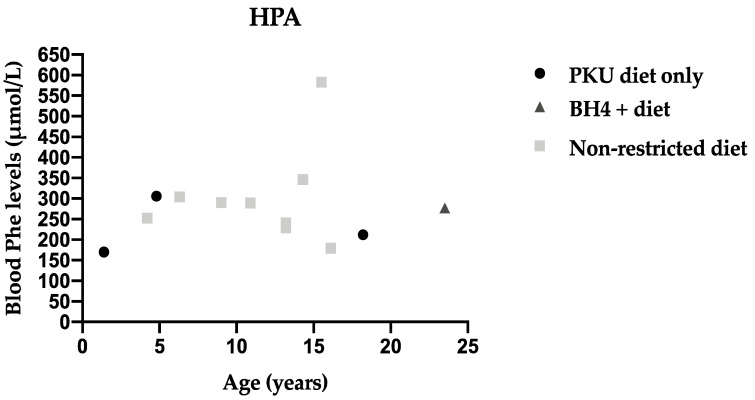
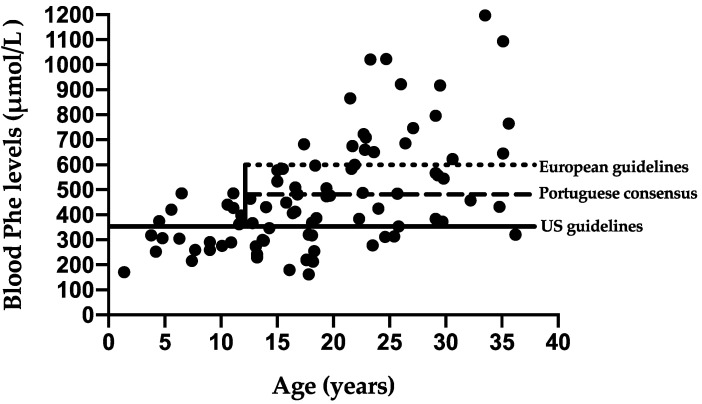
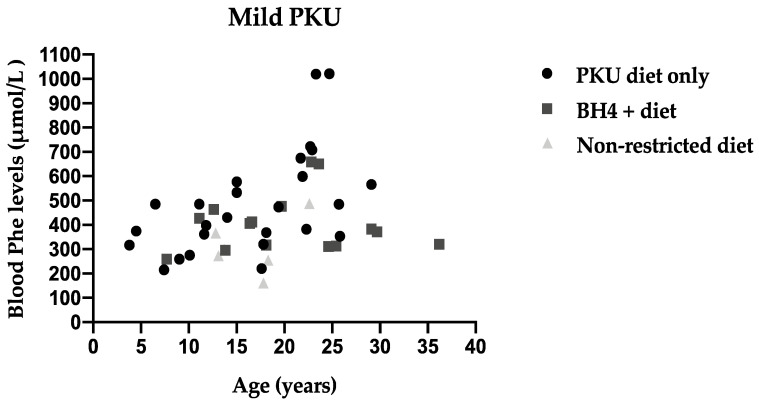
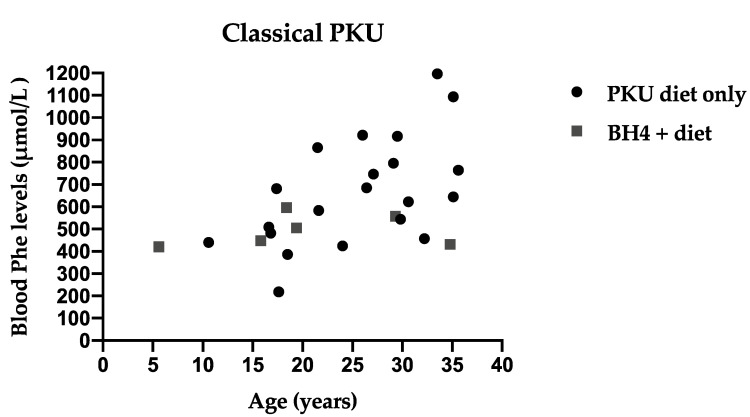
Blood phenylalanine (Phe) is used as the primary marker to evaluate metabolic control. Our study aimed to describe the metabolic control of patients with phenylketonuria (PKU) comparing three different treatment recommendations (European guidelines/US guidelines/Portuguese consensus). This was a retrospective, observational, single centre study in patients with PKU collecting data on blood Phe levels from 2017. Nutritional intake data and sapropterin (BH4) prescription were collected at the last appointment of 2017. The final sample studied included 87 patients (48% females) [13 hyperphenylalaninemia; 47 mild PKU; 27 classical PKU] with a median age of 18 y (range: 1-36 y). The median number of blood Phe measurements for patients was 21 (range: 6-89). In patients aged < 12 y, the median blood Phe level was 300 μmol/L (range 168-480) and 474 μmol/L (range 156-1194) for patients ≥ 12 y. Overall, a median of 83% of blood Phe levels were within the European PKU guidelines target range. In patients aged ≥ 12 years, there was a higher median % of blood Phe levels within the European PKU guidelines target range (≥12 y: 84% vs. <12 y: 56%). In children < 12 y with classical PKU ( 2), only 34% of blood Phe levels were within target range for all 3 guidelines and 49% with mild PKU ( 11). Girls had better control than boys (89% vs. 66% median Phe levels within European Guidelines). Although it is clear that 50% or more patients were unable to achieve acceptable metabolic control on current treatment options, a globally agreed upper Phe target associated with optimal outcomes for age groups is necessary. More studies need to examine how clinics with dissimilar resources, different therapeutic Phe targets and frequency of monitoring relate to metabolic control.
血液苯丙氨酸(Phe)被用作评估代谢控制的主要标志物。我们的研究旨在比较三种不同治疗建议(欧洲指南/美国指南/葡萄牙共识),描述苯丙酮尿症(PKU)患者的代谢控制情况。这是一项回顾性、观察性、单中心研究,在 PKU 患者中收集 2017 年的血液 Phe 水平数据。营养摄入数据和 sapropterin(BH4)处方在 2017 年的最后一次就诊时收集。最终研究样本包括 87 名患者(48%为女性)[13 例高苯丙氨酸血症;47 例轻度 PKU;27 例经典 PKU],中位年龄为 18 岁(范围:1-36 岁)。患者的血液 Phe 测量中位数为 21 次(范围:6-89 次)。在年龄<12 岁的患者中,血液 Phe 水平中位数为 300μmol/L(范围 168-480),年龄≥12 岁的患者为 474μmol/L(范围 156-1194)。总体而言,中位 83%的血液 Phe 水平在欧洲 PKU 指南的目标范围内。在年龄≥12 岁的患者中,有更高比例的血液 Phe 水平在欧洲 PKU 指南的目标范围内(≥12 岁:84%;<12 岁:56%)。在年龄<12 岁的经典 PKU(≥2)患儿中,只有 34%的血液 Phe 水平在所有 3 种指南的目标范围内,轻度 PKU(≥11)患儿中为 49%。女孩的控制情况优于男孩(女孩:89%的血液 Phe 水平在欧洲指南范围内;男孩:66%)。尽管很明显,目前的治疗方案有 50%或更多的患者无法达到可接受的代谢控制,但需要制定一个与年龄组最佳结果相关的、全球统一的、较高的 Phe 目标。需要更多的研究来检查不同资源、不同治疗性 Phe 目标和监测频率的诊所与代谢控制的关系。