Physical Activity and Health Research Laboratory, Department of Human Movement Sciences, University of Wisconsin-Milwaukee, Enderis Hall Room 453, PO Box 413, Milwaukee, WI 53201-0413, USA.
Int J Behav Nutr Phys Act. 2011 Jun 27;8:69. doi: 10.1186/1479-5868-8-69.
Advances in technology, social influences and environmental attributes have resulted in substantial portions of the day spent in sedentary pursuits. Sedentary behavior may be a cause of many chronic diseases including obesity, insulin resistance, type 2 diabetes and the metabolic syndrome. Research demonstrated that breaking up sedentary time was beneficially associated with markers of body composition, cardiovascular health and type 2 diabetes. Therefore, the purpose of this study was to quantify the total energy expenditure of three different durations of physical activity within a 30-minute sedentary period and to examine the potential benefits of interrupting sedentary behavior with physical activity for weight control.
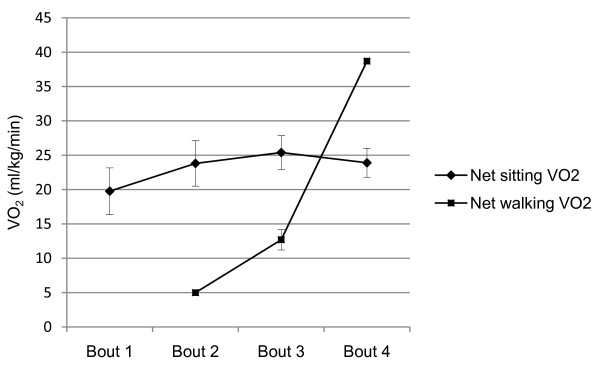
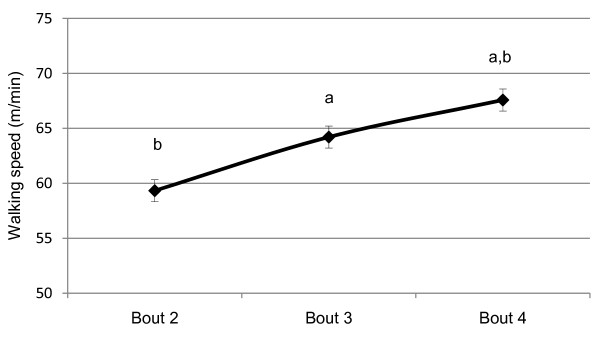
Participants completed four consecutive 30-minute bouts of sedentary behavior (reading, working on the computer, or doing other desk activities) with and without interruptions of walking at a self-selected pace. Bout one contained no walking interruptions. Bout two contained a 1-minute walking period. Bout three contained a 2-minute walking period. Bout four contained a 5-minute walking period. Body composition and resting metabolic rate were assessed.
Twenty males and females (18-39 years) completed this study. Results of the repeated measures analysis of variance with post-hoc testing showed that significantly more energy was expended during each 30 minute sedentary bout with a walking break than in the 30 minute sedentary bout (p < 0.05 for all comparisons). On average, participants expended an additional 3.0, 7.4, and 16.5 additional net or activity kilocalories during bouts 2, 3, and 4, respectively compared with bout 1. When extrapolated for a full eight-hour working day, this data shows that an individual would theoretically expend an additional 24, 59 or 132 kilocalories per day, if they stood up and walked at a normal, self selected pace for one, two or five minutes every hour, respectively, compared with sitting for the 8-hour period.
This study demonstrated that making small changes, such as taking a five minute walking break every hour could yield beneficial weight control or weight loss results. Therefore, taking breaks from sedentary time is a potential outlet to prevent obesity and the rise of obesity in developed countries.
技术进步、社会影响和环境因素导致人们一天中有很大一部分时间都在久坐不动。久坐行为可能是许多慢性疾病的病因,包括肥胖、胰岛素抵抗、2 型糖尿病和代谢综合征。研究表明,打破久坐时间与身体成分、心血管健康和 2 型糖尿病的标志物呈有益关联。因此,本研究的目的是量化在 30 分钟久坐期间进行三种不同时间长度的身体活动所消耗的总能量,并探讨用身体活动打断久坐行为对体重控制的潜在益处。
参与者连续完成四组 30 分钟的久坐行为(阅读、使用电脑或进行其他桌面活动),并在不打断和打断的情况下以自选速度行走。第一组没有步行中断,第二组有 1 分钟的步行时间,第三组有 2 分钟的步行时间,第四组有 5 分钟的步行时间。评估身体成分和静息代谢率。
共有 20 名男性和女性(18-39 岁)完成了这项研究。重复测量方差分析的结果显示,与 30 分钟的单纯静坐相比,每次有步行休息的 30 分钟静坐期间消耗的能量明显更多(所有比较均为 p<0.05)。平均而言,与第 1 组相比,第 2、3 和 4 组在各次 30 分钟静坐期间分别额外消耗了 3.0、7.4 和 16.5 个净或活动千卡。如果按照每天 8 小时的工作时间进行推断,这一数据表明,如果一个人在每天 8 小时的工作时间内,每隔 1 小时站起来以正常、自选的速度走 1、2 或 5 分钟,与连续坐 8 小时相比,理论上每天会额外消耗 24、59 或 132 千卡。
本研究表明,进行一些小的改变,例如每小时进行 5 分钟的步行休息,就可以带来有益的体重控制或减肥效果。因此,打破久坐时间的习惯是预防肥胖和发达国家肥胖率上升的一种潜在方法。