Department of Conservative Dentistry and Fixed Prosthodontics, Faculty of Dentistry, Mansoura University, Mansoura, Egypt.
J Appl Oral Sci. 2011 Aug;19(4):388-95. doi: 10.1590/s1678-77572011005000015. Epub 2011 Jul 1.
This in vitro study aimed to evaluate the influence of different surface treatments, 3 luting agents and thermocycling on microtensile bond strength (µTBS) to zirconia ceramic.
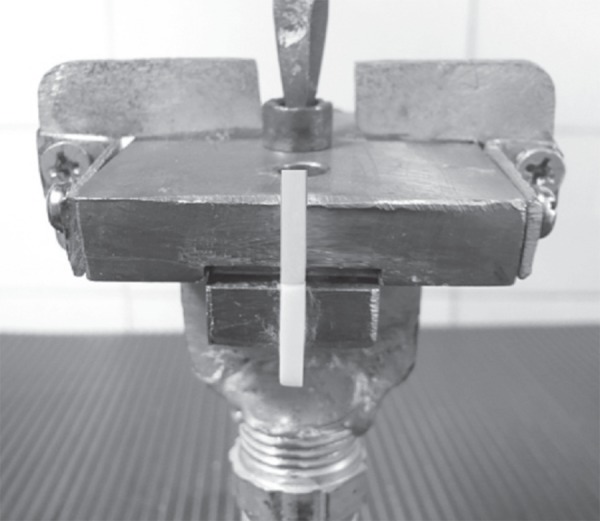
A total of 18 blocks (5x5x4 mm) were fabricated from zirconia ceramic (ICE Zirkonia) and duplicated into composite blocks (Alphadent). Ceramic blocks were divided into 3 groups (n=6) according to the following surface treatments: airborne-particle abrasion (AA), silica-coating, (SC) (CoJet) and silica coating followed by silane application (SCSI) (ESPE Sil). Each group was divided into 3 subgroups (n=2) according to the 3 luting agents used. Resin-modified glass-ionomer cement (RMGIC, Ketac Cem Plus), self-adhesive resin cement (UN, RelyX Unicem) and adhesive resin cement (ML, MultiLink Automix) were used for bonding composite and zirconia blocks. Each bonding assembly was cut into microbars (10 mm long and 1±0.1 mm²). Seven specimens of each subgroup were stored in water bath at 37ºC for 1 week. The other 7 specimens were stored in water bath at 37ºC for 30 days then thermocycled (TC) for 7,500 cycles. µTBS values were recorded for each specimen using a universal testing machine. Statistical analyses were performed using a 3-way ANOVA model followed by serial 1-way ANOVAs. Comparison of means was performed with Tukey's HSD test at (α=0.05).
µTBS ranged from 16.8 to 31.8 MPa after 1 week and from 7.3 to 16.4 MPa after 30 days of storage in water and thermocycling. Artificial aging significantly decreased µTBS (p<0.05). Considering surface treatment, SCSI significantly increased µTBS (p<0.05) compared to SC and AA. Resin cements (UN and ML) demonstrated significantly higher µTBS (p<0.05) compared to RMGIC cement.
Silica coating followed by silane application together with adhesive resin cements significantly increased µTBS, while thermocycling significantly decreased µTBS.
本体外研究旨在评估不同表面处理、3 种水门汀和热循环对氧化锆陶瓷微拉伸粘结强度(µTBS)的影响。
共制备 18 个氧化锆陶瓷块(5x5x4mm)(ICE Zirkonia)并复制为复合块(Alphadent)。陶瓷块根据以下表面处理分为 3 组(n=6):喷砂(AA)、硅涂层(SC)(CoJet)和硅涂层后硅烷处理(SCSI)(ESPE Sil)。每组根据 3 种水门汀分为 3 个亚组(n=2):树脂改良型玻璃离子水门汀(RMGIC,Ketac Cem Plus)、自粘结树脂水门汀(UN,RelyX Unicem)和粘结树脂水门汀(ML,MultiLink Automix)用于粘结复合和氧化锆块。每个粘结组件被切割成微棒(10mm 长,1±0.1mm²)。每组的 7 个样本在 37°C 水浴中储存 1 周,另外 7 个样本在 37°C 水浴中储存 30 天后进行热循环(TC)7500 次。使用万能试验机记录每个样本的微拉伸粘结强度(µTBS)值。采用三因素方差分析模型(3-way ANOVA model)进行统计分析,然后进行一系列单向方差分析(1-way ANOVA)。使用 Tukey 的 HSD 检验(α=0.05)进行均值比较。
在 1 周的储存和热循环后,µTBS 值范围为 16.8 至 31.8MPa。人工老化显著降低了 µTBS(p<0.05)。考虑表面处理,与 SC 和 AA 相比,SCSI 显著增加了 µTBS(p<0.05)。树脂水门汀(UN 和 ML)与 RMGIC 水门汀相比,µTBS 显著更高(p<0.05)。
硅涂层后硅烷处理联合使用粘结树脂水门汀可显著提高 µTBS,而热循环显著降低 µTBS。