Bajwa Sukhminder Jit Singh, Bajwa Sukhwinder Kaur, Kaur Jasbir, Singh Gurpreet, Arora Vikramjit, Gupta Sachin, Kulshrestha Ashish, Singh Amarjit, Parmar Ss, Singh Anita, Goraya Sps
Department of Anaesthesiology and Intensive Care, Gian Sagar Medical College & Hospital, Banur, Punjab, India.
Indian J Anaesth. 2011 Mar;55(2):116-21. doi: 10.4103/0019-5049.79883.
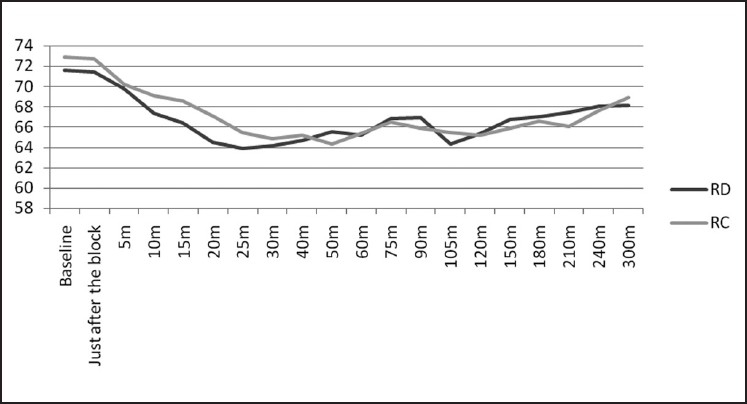
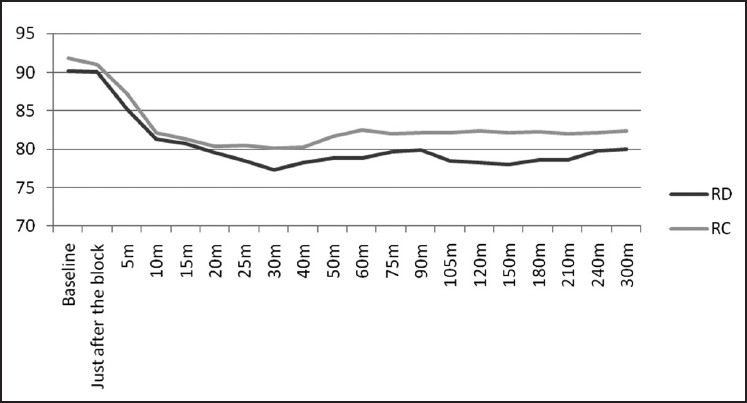
Efforts to find a better adjuvant in regional anaesthesia are underway since long. Aims and objectives are to compare the efficacy and clinical profile of two α-2 adrenergic agonists, dexmedetomidine and clonidine, in epidural anaesthesia with special emphasis on their sedative properties and an ability to provide smooth intra-operative and post-operative analgesia. A prospective randomized study was carried out which included 50 adult female patients between the ages of 44 and 65 years of (American Society of Anaesthesiologists) ASAI/II grade who underwent vaginal hysterectomies. The patients were randomly allocated into two groups; ropivacaine + dexmedetomidine (RD) and ropivacaine + clonidine (RC), comprising of 25 patients each. Group RD was administered 17 ml of 0.75% epidural ropivacaine and 1.5 μg/kg of dexmedetomidine, while group RC received admixture of 17 ml of 0.75% ropivacaine and 2 μg/kg of clonidine. Onset of analgesia, sensory and motor block levels, sedation, duration of analgesia and side effects were observed. The data obtained was subjected to statistical computation with analysis of variance and chi-square test using statistical package for social science (SPSS) version 10.0 for windows and value of P < 0.05 was considered significant and P < 0.0001 as highly significant. The demographic profile, initial and post-operative block characteristics and cardio-respiratory parameters were comparable and statistically non-significant in both the groups. However, sedation scores with dexmedetomidine were better than clonidine and turned out to be statistically significant (P < 0.05). The side effect profile was also comparable with a little higher incidence of nausea and dry mouth in both the groups which was again a non-significant entity (P > 0.05). Dexmedetomidine is a better neuraxial adjuvant compared to clonidine for providing early onset of sensory analgesia, adequate sedation and a prolonged post-operative analgesia.
长期以来,人们一直在努力寻找区域麻醉中更好的辅助药物。目的是比较两种α-2肾上腺素能激动剂右美托咪定和可乐定在硬膜外麻醉中的疗效和临床特征,特别强调它们的镇静特性以及提供平稳术中及术后镇痛的能力。进行了一项前瞻性随机研究,纳入了50例年龄在44至65岁之间的成年女性患者(美国麻醉医师协会ASA I/II级),她们接受了阴道子宫切除术。患者被随机分为两组;罗哌卡因+右美托咪定(RD)组和罗哌卡因+可乐定(RC)组,每组各25例。RD组给予17毫升0.75%的硬膜外罗哌卡因和1.5微克/千克的右美托咪定,而RC组接受17毫升0.75%罗哌卡因与2微克/千克可乐定的混合液。观察镇痛起效时间、感觉和运动阻滞平面、镇静情况、镇痛持续时间及副作用。所获数据使用社会科学统计软件包(SPSS)10.0版进行方差分析和卡方检验的统计计算,Windows系统下P值<0.05被认为具有统计学意义,P值<0.0001为高度显著。两组的人口统计学特征、初始及术后阻滞特征和心肺参数具有可比性且在统计学上无显著差异。然而,右美托咪定的镇静评分优于可乐定,且具有统计学意义(P<0.05)。副作用情况也具有可比性,两组恶心和口干的发生率略高,但同样无统计学意义(P>0.05)。与可乐定相比,右美托咪定是一种更好的神经轴辅助药物,可提供早期感觉镇痛、充分镇静和延长的术后镇痛。