Johnson Jeffrey S, Sutterer David W, Acheson Daniel J, Lewis-Peacock Jarrod A, Postle Bradley R
Department of Psychiatry, University of Wisconsin-Madison Madison, WI, USA.
Front Psychol. 2011 Jun 10;2:128. doi: 10.3389/fpsyg.2011.00128. eCollection 2011.
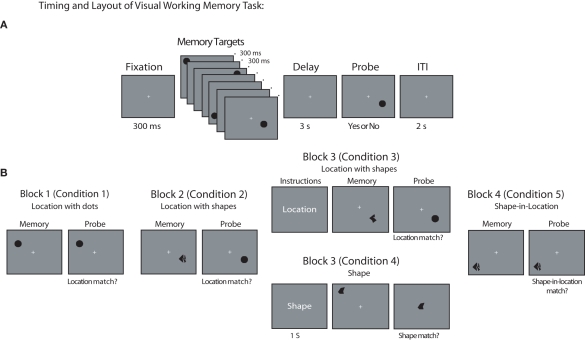
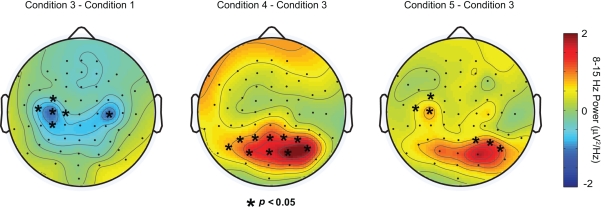
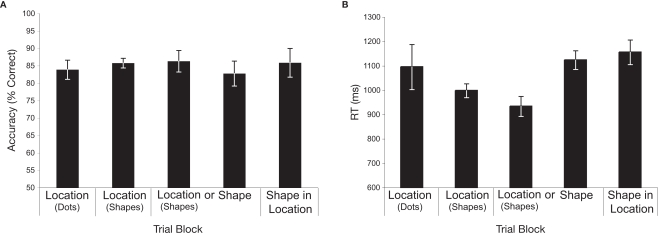
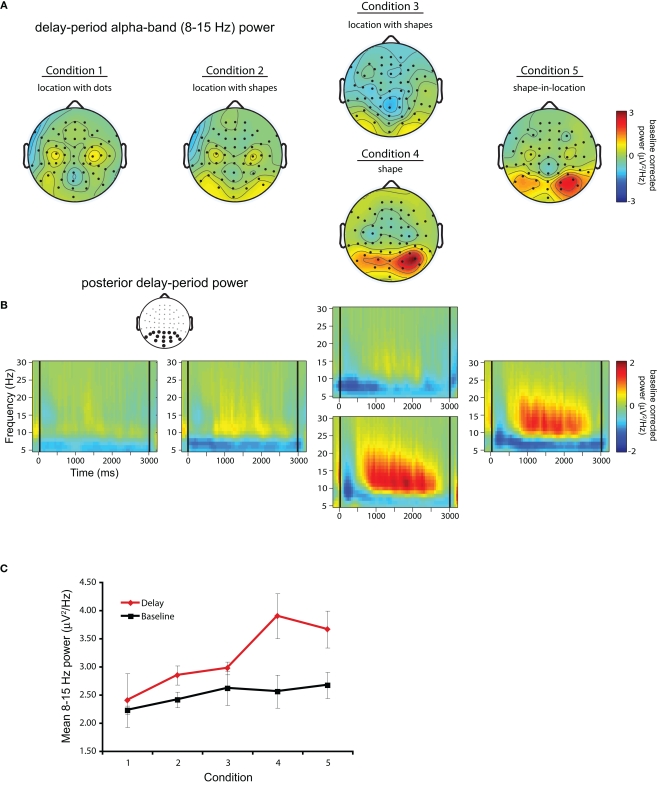
Studies exploring the role of neural oscillations in cognition have revealed sustained increases in alpha-band (~8-14 Hz) power during the delay period of delayed-recognition short-term memory tasks. These increases have been proposed to reflect the inhibition, for example, of cortical areas representing task-irrelevant information, or of potentially interfering representations from previous trials. Another possibility, however, is that elevated delay-period alpha-band power (DPABP) reflects the selection and maintenance of information, rather than, or in addition to, the inhibition of task-irrelevant information. In the present study, we explored these possibilities using a delayed-recognition paradigm in which the presence and task relevance of shape information was systematically manipulated across trial blocks and electroencephalographic was used to measure alpha-band power. In the first trial block, participants remembered locations marked by identical black circles. The second block featured the same instructions, but locations were marked by unique shapes. The third block featured the same stimulus presentation as the second, but with pretrial instructions indicating, on a trial-by-trial basis, whether memory for shape or location was required, the other dimension being irrelevant. In the final block, participants remembered the unique pairing of shape and location for each stimulus. Results revealed minimal DPABP in each of the location-memory conditions, whether locations were marked with identical circles or with unique task-irrelevant shapes. In contrast, alpha-band power increases were observed in both the shape-memory condition, in which location was task irrelevant, and in the critical final condition, in which both shape and location were task relevant. These results provide support for the proposal that alpha-band oscillations reflect the retention of shape information and/or shape-location associations in short-term memory.
探索神经振荡在认知中作用的研究表明,在延迟识别短期记忆任务的延迟期,阿尔法波段(约8 - 14赫兹)功率持续增加。有人提出,这些增加反映了对例如代表任务无关信息的皮质区域的抑制,或对先前试验中潜在干扰表征的抑制。然而,另一种可能性是,延迟期阿尔法波段功率升高(DPABP)反映了信息的选择和维持,而不是对任务无关信息的抑制,或者是除抑制之外还反映了信息的选择和维持。在本研究中,我们使用一种延迟识别范式来探索这些可能性,在该范式中,形状信息的存在和任务相关性在不同试验块中被系统地操纵,并使用脑电图来测量阿尔法波段功率。在第一个试验块中,参与者记住由相同黑色圆圈标记的位置。第二个块有相同的指示,但位置由独特形状标记。第三个块的刺激呈现与第二个相同,但有审前指示,逐次试验地表明是需要记忆形状还是位置,另一个维度是无关的。在最后一个块中,参与者记住每个刺激的形状和位置的独特配对。结果显示,在每个位置记忆条件下,无论位置是用相同圆圈还是用独特的任务无关形状标记,DPABP都最小。相比之下,在形状记忆条件(其中位置是任务无关的)和关键的最后条件(其中形状和位置都是任务相关的)中都观察到了阿尔法波段功率增加。这些结果为阿尔法波段振荡反映短期记忆中形状信息和/或形状 - 位置关联的保留这一观点提供了支持。