Southeast Poultry Research Laboratory, Agricultural Research Service, United States Department of Agriculture, 934 College Station Road, Athens, GA 30605, USA.
Virol J. 2011 Jun 29;8:331. doi: 10.1186/1743-422X-8-331.
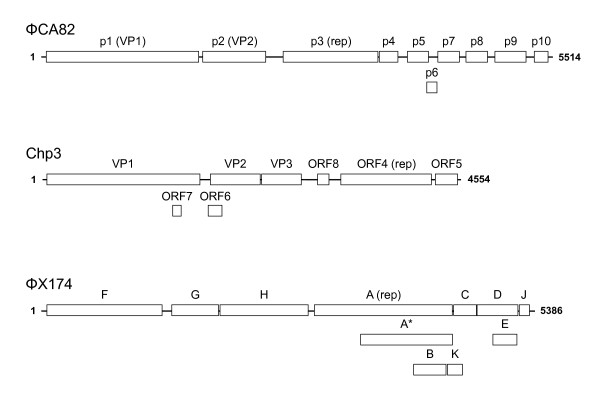
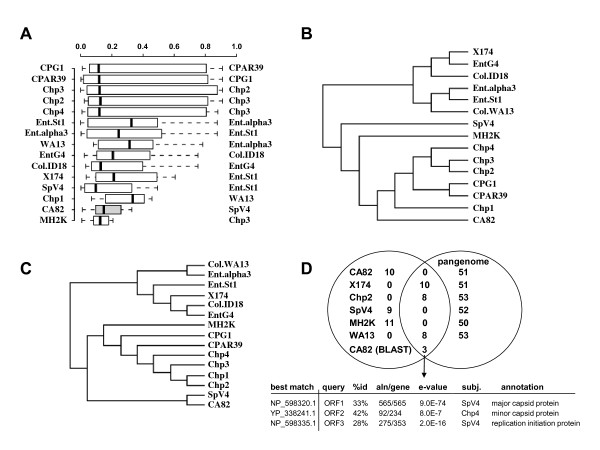
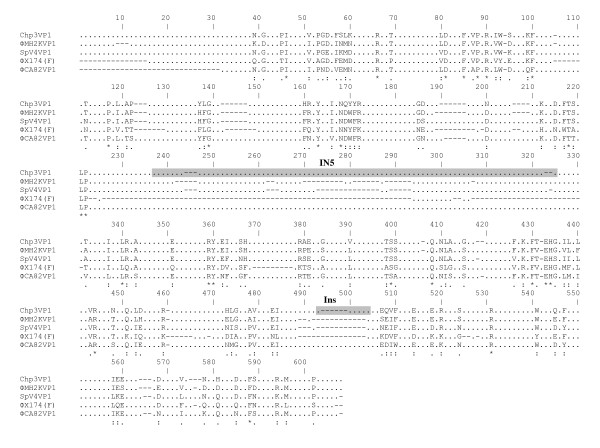
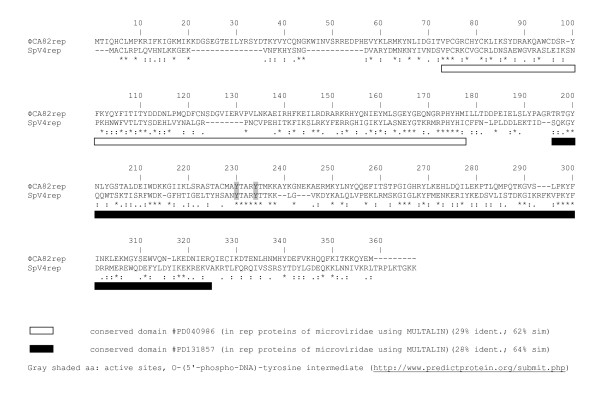
The genomic DNA sequence of a novel enteric uncultured microphage, ΦCA82 from a turkey gastrointestinal system was determined utilizing metagenomics techniques. The entire circular, single-stranded nucleotide sequence of the genome was 5,514 nucleotides. The ΦCA82 genome is quite different from other microviruses as indicated by comparisons of nucleotide similarity, predicted protein similarity, and functional classifications. Only three genes showed significant similarity to microviral proteins as determined by local alignments using BLAST analysis. ORF1 encoded a predicted phage F capsid protein that was phylogenetically most similar to the Microviridae ΦMH2K member's major coat protein. The ΦCA82 genome also encoded a predicted minor capsid protein (ORF2) and putative replication initiation protein (ORF3) most similar to the microviral bacteriophage SpV4. The distant evolutionary relationship of ΦCA82 suggests that the divergence of this novel turkey microvirus from other microviruses may reflect unique evolutionary pressures encountered within the turkey gastrointestinal system.
利用宏基因组学技术,测定了一种新型肠道未培养噬菌体ΦCA82 的基因组 DNA 序列。该基因组为全长 5514 个核苷酸的单链环状 DNA。与其他微病毒相比,ΦCA82 基因组具有很大的差异,这可以从核苷酸相似性、预测蛋白相似性和功能分类的比较中看出。通过 BLAST 分析的局部比对,只有三个基因与微病毒蛋白显示出显著的相似性。ORF1 编码一种预测的噬菌体 F 衣壳蛋白,该蛋白与 Microviridae ΦMH2K 成员的主要衣壳蛋白在系统发育上最为相似。ΦCA82 基因组还编码了一种预测的次要衣壳蛋白(ORF2)和假定的复制起始蛋白(ORF3),与微病毒噬菌体 SpV4 最为相似。ΦCA82 的遥远进化关系表明,这种新型火鸡微病毒与其他微病毒的分化可能反映了火鸡胃肠道中遇到的独特进化压力。