Centre for International Health, University of Bergen, Bergen, Norway.
J Int AIDS Soc. 2011 Jun 30;14:34. doi: 10.1186/1758-2652-14-34.
The aim of this survey was to determine the prevalence of and factors associated with Helicobacter pylori (H. pylori) colonization in HIV-infected, highly active antiretroviral therapy-naïve Ugandan children aged 0-12 years.
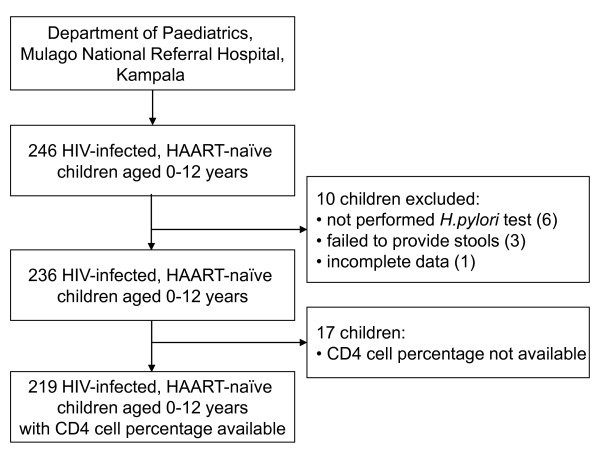
In a hospital-based survey, 236 HIV-infected children were tested for H. pylori colonization using a faecal antigen test. A standardized interview with socio-demographic information and medical history was used to assess risk factors. A cluster of differentiation 4 (CD4) cell percentage was prevalent in most children.
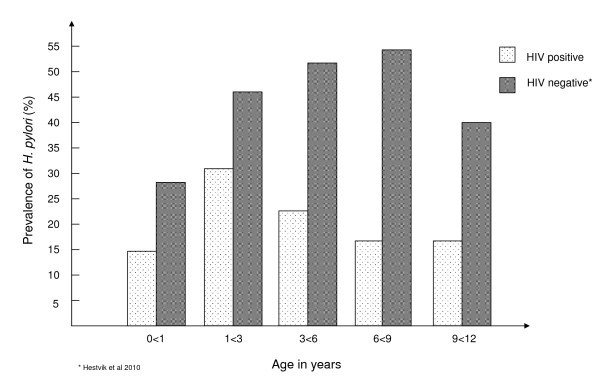
The overall prevalence of H. pylori in the HIV-infected children was 22.5%. Age-specific prevalence was as follows: up to one year, 14.7%; 1-3 years, 30.9%; and 3-12 years, 20.7%. HIV-infected children who were more seriously affected by their disease (low CD4 cell percentage or WHO clinical stage II-IV) were less likely to be colonized with H. pylori. There was a trend for a lower prevalence of H. pylori in children who had taken antibiotics for the preceding two weeks (21.6%) than in those who had not taken antibiotics (35.7%). There was no statistically significant difference in prevalence by gender, housing, congested living, education of the female caretaker, drinking water or toilet facilities.
HIV-infected, HAART-naïve Ugandan children had a lower prevalence of H. pylori colonization compared with apparently healthy Ugandan children (44.3%). Children with a low CD4 cell percentage and an advanced clinical stage of HIV had an even lower risk of H. pylori colonization. Treatment with antibiotics due to co-morbidity with infectious diseases is a possible explanation for the relatively low prevalence.
本调查旨在确定在感染人类免疫缺陷病毒(HIV)、未经高效抗逆转录病毒治疗(HAART)的乌干达 0-12 岁儿童中,幽门螺杆菌(H. pylori)定植的流行率及其相关因素。
在一项基于医院的调查中,使用粪便抗原检测对 236 名 HIV 感染儿童进行 H. pylori 定植检测。采用标准化的访谈,获取社会人口统计学信息和病史,以评估危险因素。大多数儿童的 CD4 细胞百分比均存在簇分化 4(CD4)。
HIV 感染儿童中 H. pylori 的总体流行率为 22.5%。各年龄段的流行率如下:1 岁以下为 14.7%;1-3 岁为 30.9%;3-12 岁为 20.7%。疾病严重程度更高的 HIV 感染儿童(CD4 细胞百分比低或世界卫生组织临床分期 II-IV),H. pylori 定植的可能性较低。与未使用抗生素的儿童(35.7%)相比,在过去两周内使用过抗生素的儿童(21.6%)中 H. pylori 的流行率呈下降趋势。儿童的性别、住房、拥挤的生活环境、女性照顾者的受教育程度、饮用水或厕所设施等因素与 H. pylori 的流行率无统计学显著差异。
与明显健康的乌干达儿童(44.3%)相比,HIV 感染、未经 HAART 的乌干达儿童的 H. pylori 定植率较低。CD4 细胞百分比低和 HIV 临床分期较晚的儿童发生 H. pylori 定植的风险更低。由于合并传染病而使用抗生素治疗可能是导致相对低流行率的原因之一。