Department of Psychiatry, UNC Neuroscience Center, University of North Carolina at Chapel Hill, Chapel Hill, North Carolina 27599, USA.
Nature. 2011 Jun 29;475(7356):377-80. doi: 10.1038/nature10194.
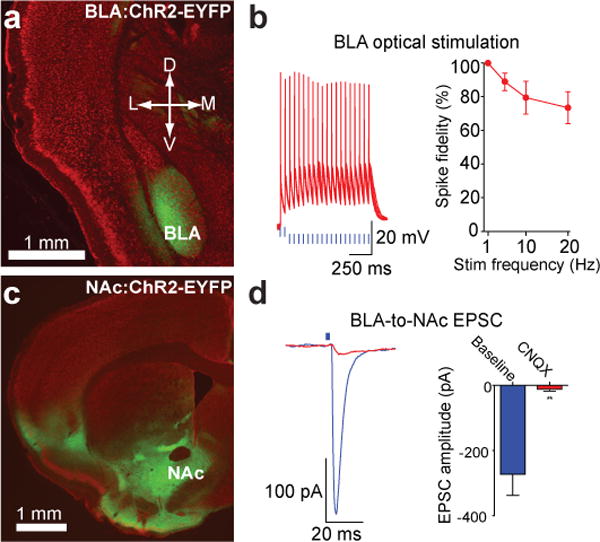
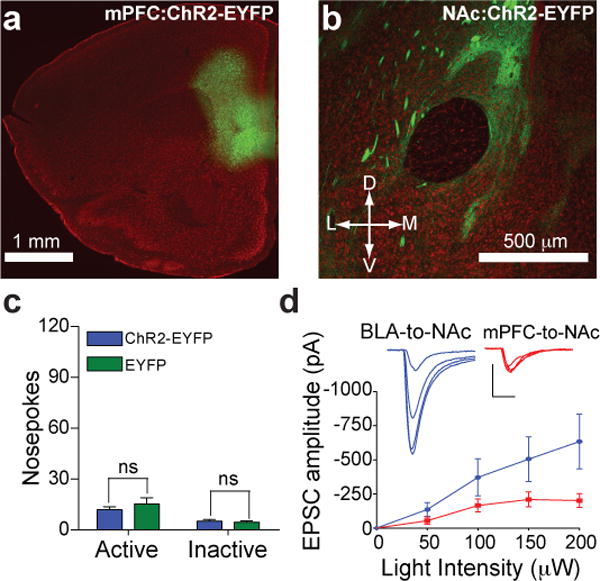
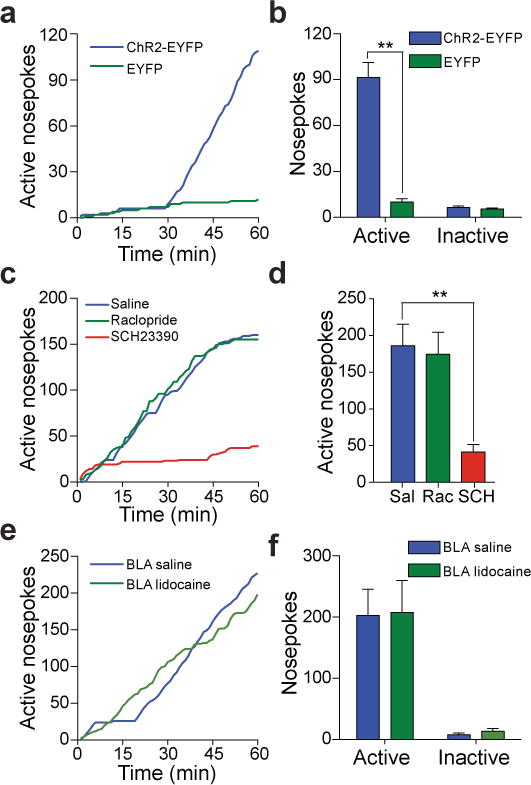
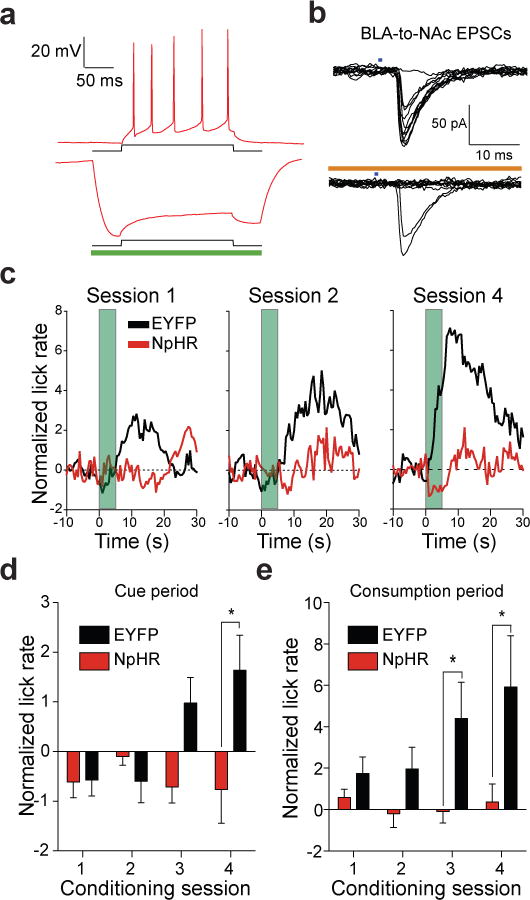
The basolateral amygdala (BLA) has a crucial role in emotional learning irrespective of valence. The BLA projection to the nucleus accumbens (NAc) is thought to modulate cue-triggered motivated behaviours, but our understanding of the interaction between these two brain regions has been limited by the inability to manipulate neural-circuit elements of this pathway selectively during behaviour. To circumvent this limitation, we used in vivo optogenetic stimulation or inhibition of glutamatergic fibres from the BLA to the NAc, coupled with intracranial pharmacology and ex vivo electrophysiology. Here we show that optical stimulation of the pathway from the BLA to the NAc in mice reinforces behavioural responding to earn additional optical stimulation of these synaptic inputs. Optical stimulation of these glutamatergic fibres required intra-NAc dopamine D1-type receptor signalling, but not D2-type receptor signalling. Brief optical inhibition of fibres from the BLA to the NAc reduced cue-evoked intake of sucrose, demonstrating an important role of this specific pathway in controlling naturally occurring reward-related behaviour. Moreover, although optical stimulation of glutamatergic fibres from the medial prefrontal cortex to the NAc also elicited reliable excitatory synaptic responses, optical self-stimulation behaviour was not observed by activation of this pathway. These data indicate that whereas the BLA is important for processing both positive and negative affect, the glutamatergic pathway from the BLA to the NAc, in conjunction with dopamine signalling in the NAc, promotes motivated behavioural responding. Thus, optogenetic manipulation of anatomically distinct synaptic inputs to the NAc reveals functionally distinct properties of these inputs in controlling reward-seeking behaviours.
外侧杏仁核(BLA)在情绪学习中起着至关重要的作用,而与情绪效价无关。BLA 投射到伏隔核(NAc)被认为调节线索触发的动机行为,但由于无法在行为过程中选择性地操纵该途径的神经回路元件,我们对这两个脑区之间的相互作用的理解受到了限制。为了克服这一限制,我们使用体内光遗传学刺激或抑制 BLA 到 NAc 的谷氨酸能纤维,结合颅内药理学和离体电生理学。在这里,我们展示了在小鼠中刺激 BLA 到 NAc 的通路可以增强对额外的这些突触输入进行光刺激的行为反应。刺激这些谷氨酸能纤维需要 NAc 内多巴胺 D1 型受体信号,但不需要 D2 型受体信号。短暂光抑制 BLA 到 NAc 的纤维减少了线索诱发的蔗糖摄入,表明该特定途径在控制自然发生的与奖励相关的行为方面起着重要作用。此外,尽管刺激 BLA 到 NAc 的谷氨酸能纤维的光遗传学也引发了可靠的兴奋性突触反应,但通过激活该途径没有观察到光自我刺激行为。这些数据表明,虽然 BLA 对处理正性和负性情绪都很重要,但 BLA 到 NAc 的谷氨酸能途径与 NAc 中的多巴胺信号一起,促进了动机行为反应。因此,对 NAc 中解剖上不同的突触输入进行光遗传学操纵揭示了这些输入在控制寻求奖励行为方面的功能上的不同特性。