Marrzoq Lamia F Abu, Sharif Fadel A, Abed Abdalla A
Medical Department, College of Science and Technology, Khan Younis, Islamic University of Gaza, Palestine, Biology Departement, Islamic University of Gaza, Palestine.
J Cardiovasc Dis Res. 2011 Jan;2(1):29-35. doi: 10.4103/0975-3583.78584.
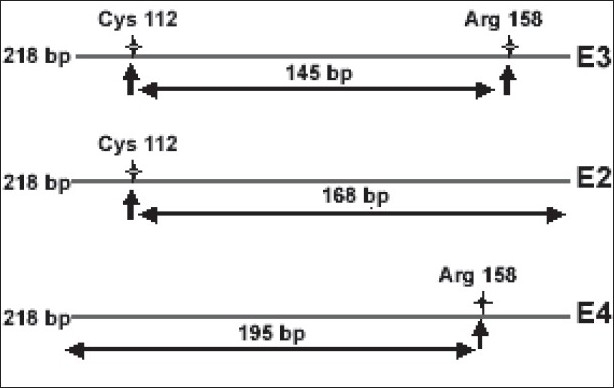
Apolipoprotein E (ApoE) plays a role in the regulation of lipid metabolism in humans. ApoE, a 229-amino-acid polypeptide, is classified into three major isoforms (E2, E3, and E4) according to the differences in amino acids at positions 112 and 158. In the normal population, ApoE3 isoform is the most prevalent, and ApoE2 or E4 is frequently associated with hyperlipoproteinemia. The objective of this work was to investigate the relationship between ApoE gene polymorphism and coronary heart disease (CHD) in Gaza Strip and investigate the association between serum lipid levels and CHD.
The study population consisted of 137 subjects including 69 CHD cases (45 male, 24 female) and 68 healthy subjects (33 male and 35 female).
The ApoE3/E3 genotype was the most common in the control and the CHD groups. ApoE2/E3 and ApoE3/E4 were the next most common genotypes. The frequencies of ApoE alleles in the CHD subjects were 0.826 for E3, 0.137 for E4, and 0.0362 for E2. These frequencies are comparable to those found in the control group which were 0.875 for the E3, 0.073 for E4, and 0.0515 for E2. No statistically significant differences in ApoE genotypes were found between the patients and the control groups. Moreover, there was no significant difference between the mean of triglyceride (TG) and HDL levels among different ApoE genotypes. However, there was a significant difference in the mean of LDL and ApoE genotypes where the mean of LDL was 218.17 mg/dl in ApoE4, 149.67 mg/dl in ApoE2, and 184.52 mg/dl in ApoE3. A significant difference was also evident between the mean of LDL levels in the CHD and the control group where the mean of LDL was 126 mg/dl in CHD and 111.47 mg/dl in the control group. Our study indicated that there was no significant difference between the mean of cholesterol and TG levels of the CHD and the control groups.
To our knowledge, this is the first study in Gaza Strip investigating the relation between ApoE genotypes and CHD. Further investigations are needed to link other genetic factors to CHD.
载脂蛋白E(ApoE)在人体脂质代谢调节中发挥作用。ApoE是一种由229个氨基酸组成的多肽,根据第112位和158位氨基酸的差异分为三种主要异构体(E2、E3和E4)。在正常人群中,ApoE3异构体最为常见,而ApoE2或E4常与高脂蛋白血症相关。本研究的目的是调查加沙地带ApoE基因多态性与冠心病(CHD)之间的关系,并研究血脂水平与CHD之间的关联。
研究人群包括137名受试者,其中69例CHD患者(45例男性,24例女性)和68名健康受试者(33例男性和35例女性)。
ApoE3/E3基因型在对照组和CHD组中最为常见。ApoE2/E3和ApoE3/E4是次常见的基因型。CHD受试者中ApoE等位基因的频率分别为:E3为0.826,E4为0.137,E2为0.0362。这些频率与对照组中的频率相当,对照组中E3为0.875,E4为0.073,E2为0.0515。患者组和对照组之间ApoE基因型无统计学显著差异。此外,不同ApoE基因型之间甘油三酯(TG)和高密度脂蛋白(HDL)水平的平均值无显著差异。然而,低密度脂蛋白(LDL)平均值与ApoE基因型之间存在显著差异,其中ApoE4中LDL平均值为218.17mg/dl,ApoE2中为149.67mg/dl,ApoE3中为184.52mg/dl。CHD组和对照组之间LDL水平的平均值也存在显著差异,CHD组中LDL平均值为126mg/dl,对照组中为111.47mg/dl。我们的研究表明,CHD组和对照组之间胆固醇和TG水平的平均值无显著差异。
据我们所知,这是加沙地带第一项研究ApoE基因型与CHD关系的研究。需要进一步研究将其他遗传因素与CHD联系起来。