Kestle John R W, Riva-Cambrin Jay, Wellons John C, Kulkarni Abhaya V, Whitehead William E, Walker Marion L, Oakes W Jerry, Drake James M, Luerssen Thomas G, Simon Tamara D, Holubkov Richard
Primary Children's Medical Center, University of Utah, Salt Lake City, Utah, USA.
J Neurosurg Pediatr. 2011 Jul;8(1):22-9. doi: 10.3171/2011.4.PEDS10551.
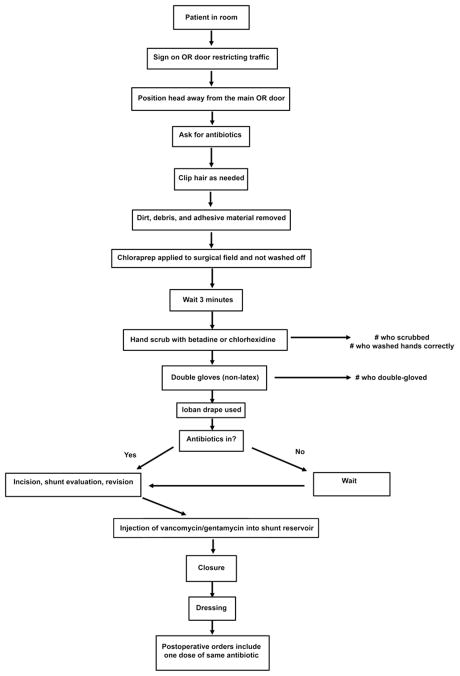
Quality improvement techniques are being implemented in many areas of medicine. In an effort to reduce the ventriculoperitoneal shunt infection rate, a standardized protocol was developed and implemented at 4 centers of the Hydrocephalus Clinical Research Network (HCRN).
The protocol was developed sequentially by HCRN members using the current literature and prior institutional experience until consensus was obtained. The protocol was prospectively applied at each HCRN center to all children undergoing a shunt insertion or revision procedure. Infections were defined on the basis of CSF, wound, or pseudocyst cultures; wound breakdown; abdominal pseudocyst; or positive blood cultures in the presence of a ventriculoatrial shunt. Procedures and infections were measured before and after protocol implementation.
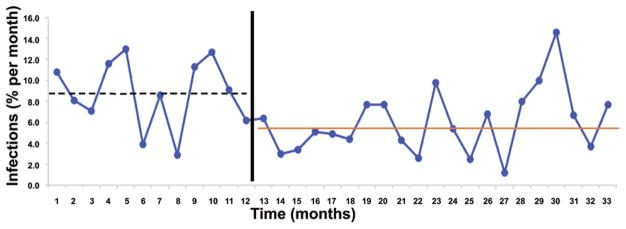
Twenty-one surgeons at 4 centers performed 1571 procedures between June 1, 2007, and February 28, 2009. The minimum follow-up was 6 months. The Network infection rate decreased from 8.8% prior to the protocol to 5.7% while using the protocol (p = 0.0028, absolute risk reduction 3.15%, relative risk reduction 36%). Three of 4 centers lowered their infection rate. Shunt surgery after external ventricular drainage (with or without prior infection) had the highest infection rate. Overall protocol compliance was 74.5% and improved over the course of the observation period. Based on logistic regression analysis, the use of BioGlide catheters (odds ratio [OR] 1.91, 95% CI 1.19-3.05; p = 0.007) and the use of antiseptic cream by any members of the surgical team (instead of a formal surgical scrub by all members of the surgical team; OR 4.53, 95% CI 1.43-14.41; p = 0.01) were associated with an increased risk of infection.
The standardized protocol for shunt surgery significantly reduced shunt infection across the HCRN. Overall protocol compliance was good. The protocol has established a common baseline within the Network, which will facilitate assessment of new treatments. Identification of factors associated with infection will allow further protocol refinement in the future.
质量改进技术正在医学的许多领域得到应用。为降低脑室腹腔分流术感染率,脑积水临床研究网络(HCRN)的4个中心制定并实施了一项标准化方案。
HCRN成员根据当前文献和既往机构经验逐步制定该方案,直至达成共识。该方案前瞻性地应用于HCRN各中心所有接受分流管置入或翻修手术的儿童。感染根据脑脊液、伤口或假囊肿培养结果、伤口裂开、腹部假囊肿或存在脑室心房分流时血培养阳性来定义。在方案实施前后对手术和感染情况进行测量。
2007年6月1日至2009年2月28日期间,4个中心的21名外科医生实施了1571例手术。最短随访时间为6个月。网络感染率从方案实施前的8.8%降至使用方案期间的5.7%(p = 0.0028,绝对风险降低3.15%,相对风险降低36%)。4个中心中有3个中心降低了感染率。脑室外引流后(无论有无既往感染)进行的分流手术感染率最高。总体方案依从性为74.5%,且在观察期内有所提高。基于逻辑回归分析,使用BioGlide导管(比值比[OR] 1.91,95%可信区间1.19 - 3.05;p = 0.007)以及手术团队任何成员使用抗菌乳膏(而非手术团队所有成员进行正规外科刷手;OR 4.53,95%可信区间1.43 - 14.41;p = 0.01)与感染风险增加相关。
分流手术标准化方案显著降低了HCRN内的分流感染率。总体方案依从性良好。该方案在网络内建立了共同基线,这将有助于评估新的治疗方法。识别与感染相关的因素将有助于未来进一步完善方案。