Gurleyik Emin
Department of Surgery, Duzce University, Medical Faculty, Duzce, Turkey.
J Med Case Rep. 2011 Jul 1;5:266. doi: 10.1186/1752-1947-5-266.
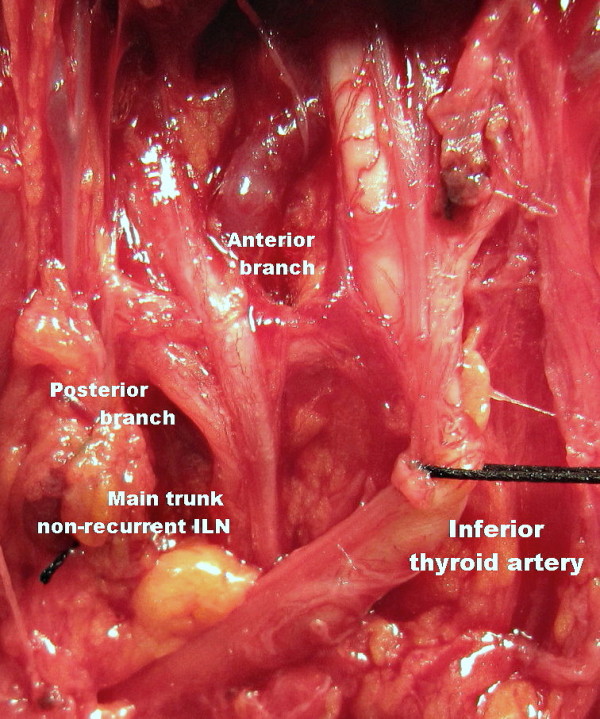
A non-recurrent course is a rare anatomic variation of the inferior laryngeal nerve (ILN). Bilateral extra-laryngeal bifurcation of the ILN seldom occurs before its laryngeal entry. Anastomosis between the ILN and cervical sympathetic chain is another rare anatomic feature. The prevalence of extra-laryngeal branching of the non-recurrent nerve is unknown. We present an example of triple anatomic variations of ILNs in the same patient, and also two anatomic variations in the same nerve.
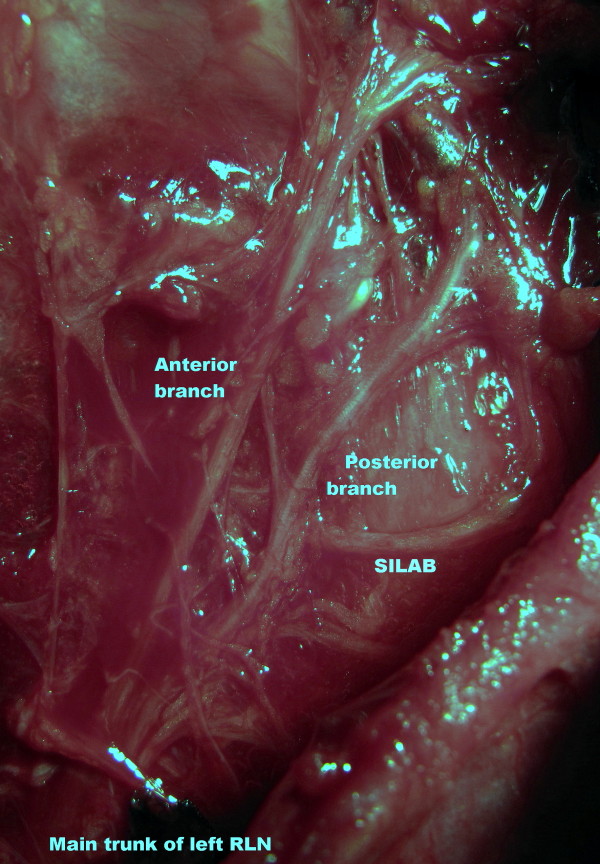
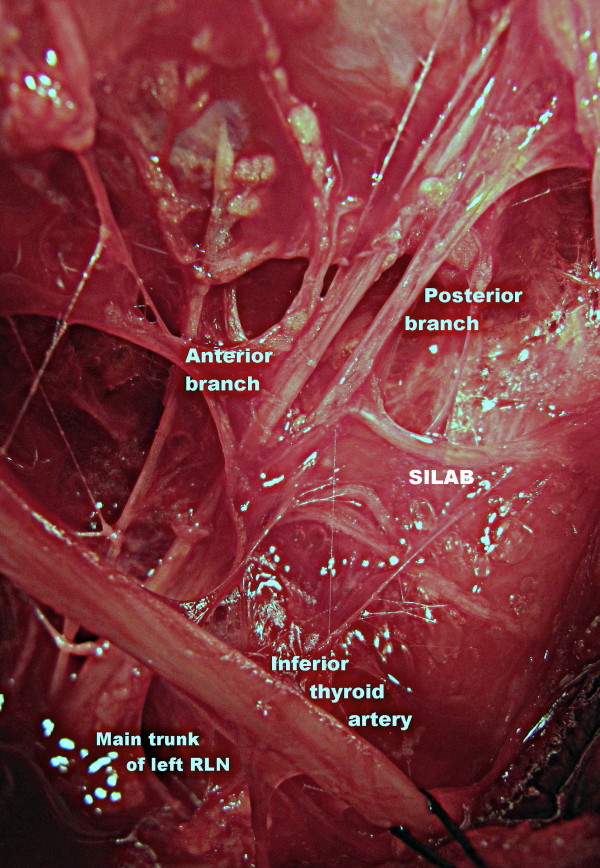
A 56-year-old Caucasian man with a large toxic multi-nodular goiter was surgically treated with total thyroidectomy. Both his right and left ILNs were identified, fully exposed and preserved along their cervical courses. We discovered many variations during bilateral exploration of the two ILNs. His right ILN was non-recurrent. This non-recurrent ILN showed a terminal division before laryngeal entry. The left nerve had a usual course as a recurrent laryngeal nerve (RLN) at his tracheaesophageal groove. We also discovered bifurcation of his RLN beginning at a neurovascular (RLN and inferior thyroid artery) crossing point. Anterior and posterior branches of both nerves entered his larynx separately. The sympathetic inferior laryngeal anastomotic branch (SILAB) between the posterior branch of his left ILN and the cervical sympathetic chain was established in the distal part of the nerve before laryngeal entry.
A non-recurrent nerve and extra-laryngeal branching of the ILN are two different variations. The coincidence of a right non-recurrent ILN and bilateral bifurcation of both nerves is a very interesting feature. SILAB is a rare additional finding as a third anatomic variation in the same patient. Extra-laryngeal terminal division of a non-recurrent ILN is an extremely unusual anatomic finding. Two anatomic variations have occurred in the same nerve, like "the variation of the variation".
非返喉神经走行是喉下神经(ILN)一种罕见的解剖变异。喉下神经在入喉前很少出现双侧喉外分支。喉下神经与颈交感神经链之间的吻合是另一种罕见的解剖特征。非返神经喉外分支的发生率尚不清楚。我们展示了同一患者喉下神经的三种解剖变异实例,以及同一神经的两种解剖变异。
一名56岁患有巨大毒性多结节性甲状腺肿的白种男性接受了甲状腺全切除术。术中识别出双侧喉下神经,在其颈部走行全程充分暴露并予以保留。在双侧探查两条喉下神经的过程中,我们发现了许多变异情况。其右侧喉下神经为非返神经。这条非返喉下神经在入喉前出现终末分支。左侧神经走行正常,为经气管食管沟的喉返神经(RLN)。我们还发现其喉返神经在神经血管(喉返神经和甲状腺下动脉)交叉点处开始分支。两条神经的前后分支分别进入喉部。左侧喉下神经后支与颈交感神经链之间的交感喉下吻合支(SILAB)在神经入喉前的远端形成。
非返神经和喉下神经的喉外分支是两种不同的变异。右侧非返喉下神经与双侧神经分支同时存在是一个非常有趣的特征。交感喉下吻合支作为同一患者的第三种解剖变异是一个罕见的额外发现。非返喉下神经的喉外终末分支是一种极其不寻常的解剖发现。同一条神经出现两种解剖变异,可谓“变异之中的变异”。