Gurleyik Emin
Department of Surgery, Duzce University, Medical Faculty, 81650 Duzce, Turkey.
J Thyroid Res. 2013;2013:731250. doi: 10.1155/2013/731250. Epub 2013 May 30.
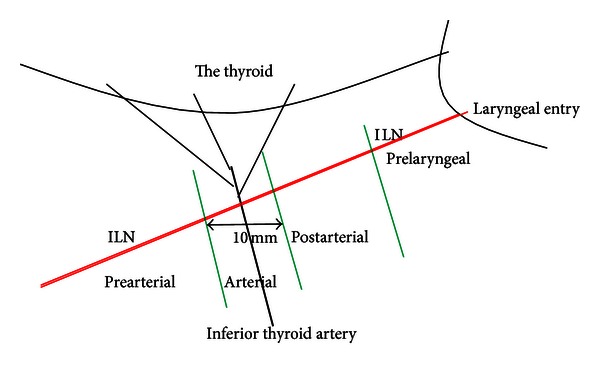
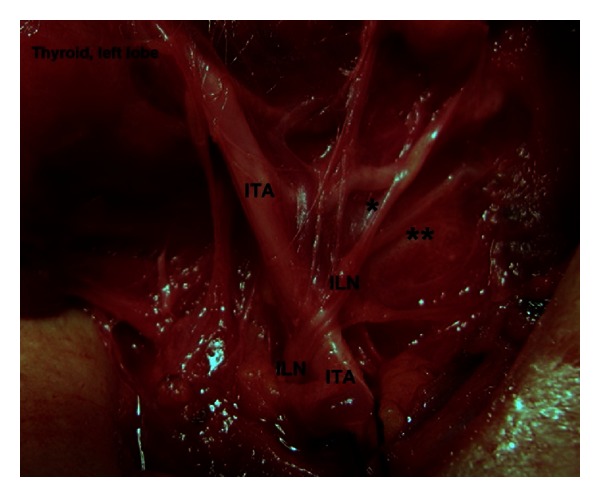
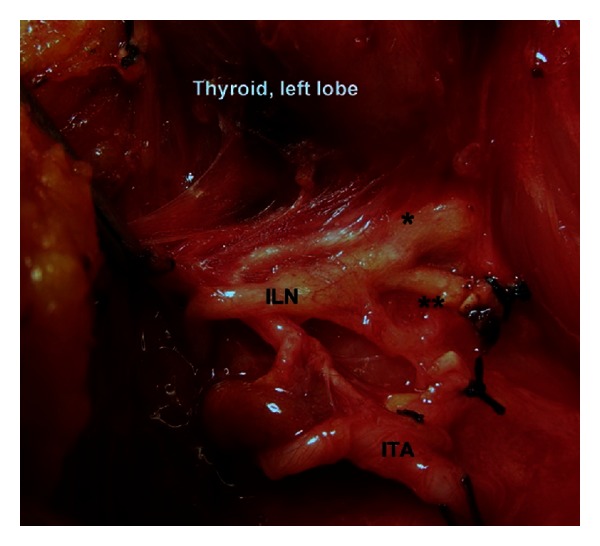
Background. Complete anatomic knowledge including all variations of the inferior laryngeal nerve (ILN) is mandatory for thyroid surgeon. Extralaryngeal terminal division (ETD) of the ILN has significant importance for the safety of thyroidectomy. Material and Methods. Surgical dissection of 200 ILNs was performed on 100 cases. The presence of ETD of the nerve was determined intraoperatively. We propose by a surgical point of view a regional (segmental) classification of ETD of the ILN along its cervical course. Results. ETD has been observed in 54/200 nerves (27%). Great majority are bifurcated nerves (trifurcation 2%). Four types of ETD are classified. In type 1 (arterial; 46.3%), ETD has occurred near inferior thyroid artery (ITA). In type 2 (postarterial; 31.5%), division has been found on postarterial segment. In type 3 (prelaryngeal; 11%), division has been located very close to laryngeal entry point. In type 4 (prearterial; 11%), ETD has occurred before the nerve crossing the ITA. Conclusions. ETD of the ILN is a common anatomical variation. The bifurcation occurs in the ILN at various distances from laryngeal entry point. The classification increasing surgeons' awareness may help to simplify identification and exposure of terminal branches. Preservation of both extralaryngeal terminal branches of the ILN has paramount importance for the safety of thyroid operations.
背景。对于甲状腺外科医生而言,掌握包括喉返神经(ILN)所有变异情况在内的完整解剖知识是必不可少的。喉返神经的喉外终末分支(ETD)对甲状腺切除术的安全性具有重要意义。材料与方法。对100例患者的200条喉返神经进行手术解剖。术中确定神经喉外终末分支的存在情况。我们从手术角度提出了喉返神经喉外终末分支沿其颈部走行的区域(节段)分类法。结果。在200条神经中有54条(27%)观察到喉外终末分支。绝大多数为分叉神经(三叉分支占2%)。将喉外终末分支分为四种类型。在1型(动脉旁型;46.3%)中,喉外终末分支出现在甲状腺下动脉(ITA)附近。在2型(动脉后型;31.5%)中,分支位于动脉后段。在3型(喉前型;11%)中,分支位于非常靠近喉入口处。在4型(动脉前型;11%)中,喉外终末分支出现在神经穿过甲状腺下动脉之前。结论。喉返神经的喉外终末分支是一种常见的解剖变异。喉返神经的分叉发生在距喉入口点不同距离处。这种分类法提高外科医生的认识,可能有助于简化终末分支的识别和暴露。保留喉返神经的两条喉外终末分支对甲状腺手术的安全性至关重要。