International Centre for Allied Health Evidence, University of South Australia, Adelaide, South Australia.
BMC Health Serv Res. 2011 Jul 6;11:161. doi: 10.1186/1472-6963-11-161.
Evidence-based care should improve acute stroke outcomes with the same magnitude of effect for stroke patients of all ages. However, there is evidence to suggest that, in some instances, older stroke patients may receive poorer quality care than younger patients.Our aim was to systematically review evidence of the quality of care provided to patients with acute stroke related to their age. Quality of care was determined by compliance with recommended care processes.
We systematically searched MEDLINE, CINAHL, ISI Web of Knowledge, Ageline and the Cochrane Library databases to identify publications (1995-2009) that reported data on acute stroke care process indicators by patient age. Data extracted included patient demographics and process indicator compliance. Included publications were critically appraised by two independent reviewers using the Critical Appraisal Skills Programme tool, and a comparison was made of the risk of bias according to studies' findings. The evidence base for reported process indicators was determined, and meta-analysis was undertaken for studies with sufficient similarity.
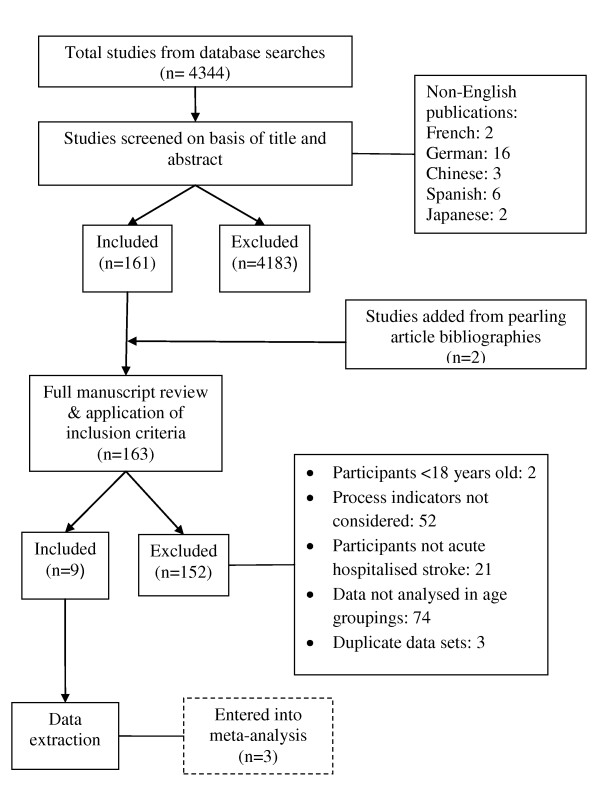
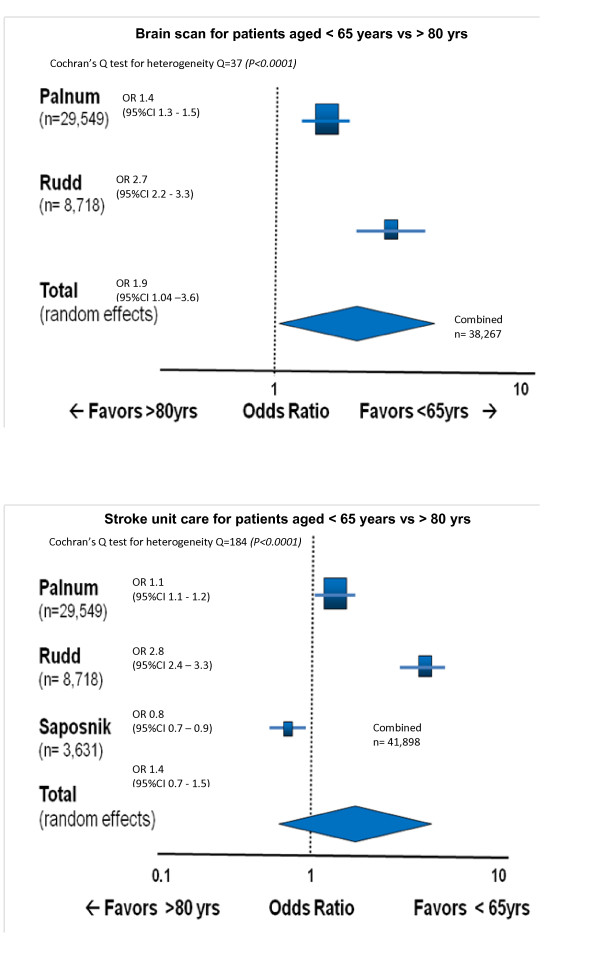
Nine from 163 potential studies met the inclusion criteria. Of the 56 process indicators reported, eleven indicators were evidence-based. Seven of these indicators (64%) showed significantly poorer care for older patients compared to younger ones, while younger patients received comparatively inferior care for only antihypertensive therapy at discharge. Our findings are limited by the variable methodological quality of included studies.
Patients' age may be a factor in the care they receive after an acute stroke. However, the possible influence of patients' age on clinicians' decision-making must be considered in terms of the many complex issues that surround the provision of optimal care for older patients with acute stroke.
循证护理应该改善所有年龄段卒中患者的急性卒中性结果,其影响程度也应该相同。然而,有证据表明,在某些情况下,老年卒中患者可能比年轻患者接受的护理质量更差。我们的目的是系统地评价与年龄相关的急性卒中患者的护理质量证据。通过评估推荐的护理流程的遵守情况来确定护理质量。
我们系统地检索了 MEDLINE、CINAHL、ISI Web of Knowledge、Ageline 和 Cochrane Library 数据库,以确定 1995-2009 年间发表的报告了急性卒中护理流程指标的患者年龄数据的出版物。提取的数据包括患者人口统计学和流程指标的依从性。纳入的出版物由两名独立的评审员使用关键评估技能计划工具进行严格评估,并根据研究结果比较了偏倚风险。根据报告的流程指标的证据基础,对具有足够相似性的研究进行了荟萃分析。
在 163 篇潜在研究中,有 9 篇符合纳入标准。在报告的 56 个流程指标中,有 11 个是基于证据的。这 11 个指标中有 7 个(64%)显示老年患者的护理明显差于年轻患者,而年轻患者仅在出院时接受降压治疗的护理相对较差。由于纳入研究的方法学质量存在差异,我们的研究结果受到限制。
患者的年龄可能是他们在急性卒中后接受护理的一个因素。然而,必须考虑患者年龄对临床医生决策的可能影响,因为围绕为急性卒中老年患者提供最佳护理存在许多复杂问题。