Laboratory of Infectious Diseases, National Institute of Allergy and Infectious Diseases, National Institutes of Health, Bethesda, Maryland, United States of America.
PLoS Pathog. 2011 Jun;7(6):e1002105. doi: 10.1371/journal.ppat.1002105. Epub 2011 Jun 23.
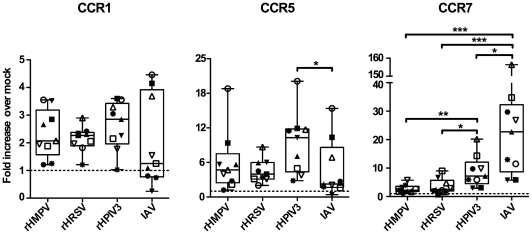
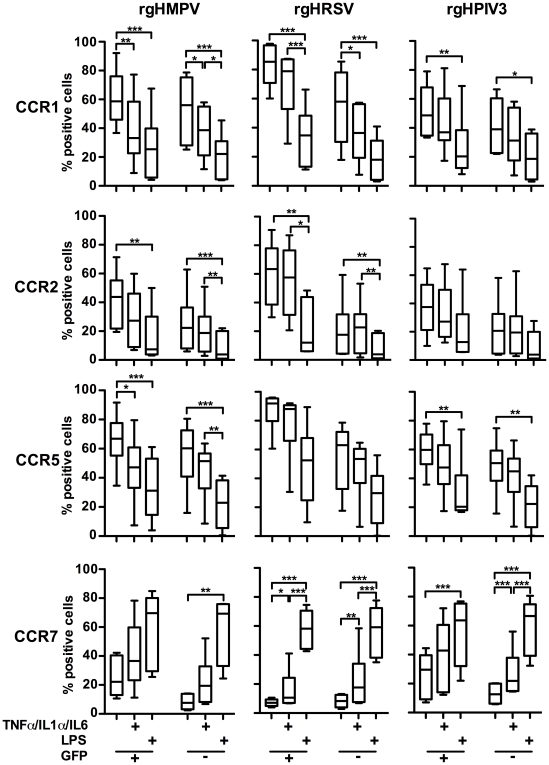
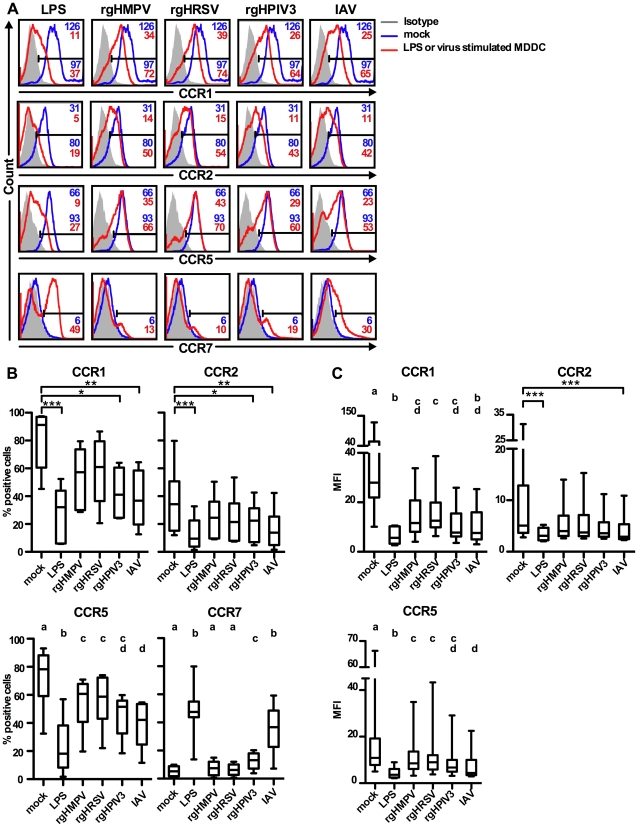
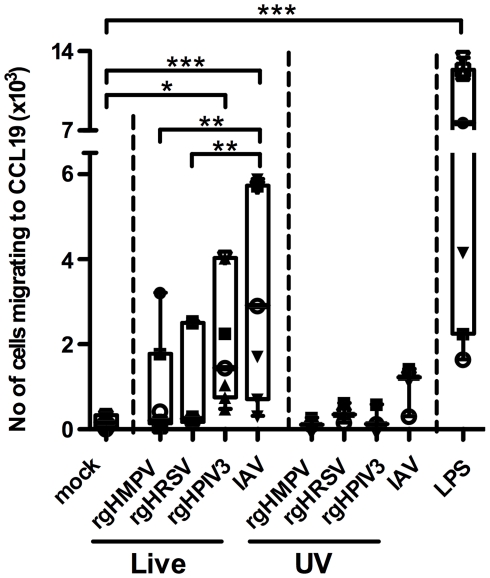
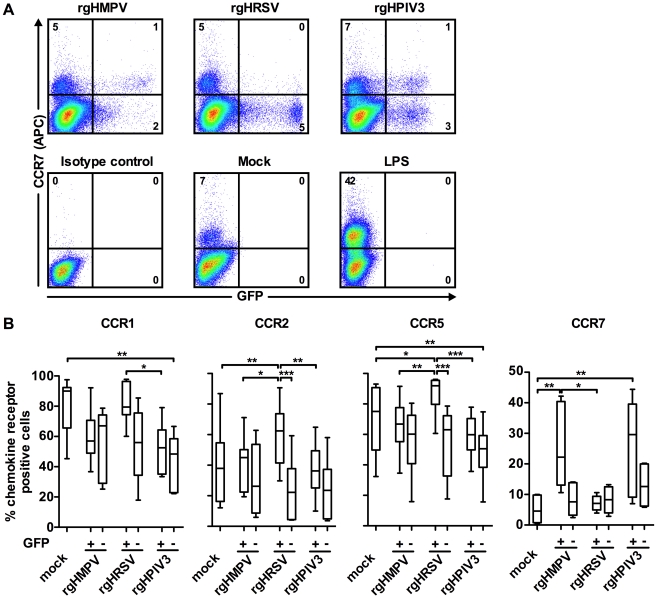
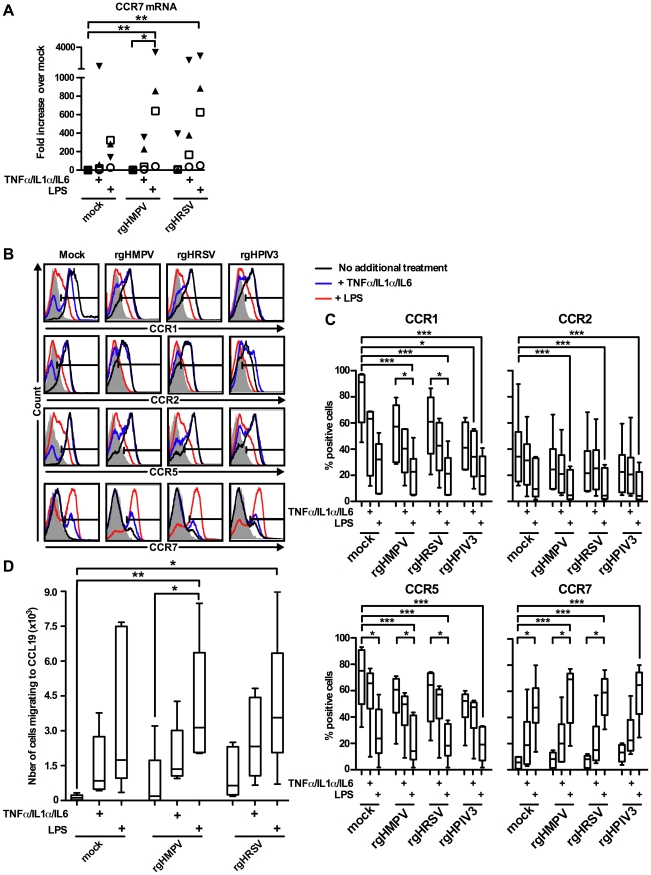
Human respiratory syncytial virus (HRSV) and, to a lesser extent, human metapneumovirus (HMPV) and human parainfluenza virus type 3 (HPIV3), can re-infect symptomatically throughout life without significant antigenic change, suggestive of incomplete or short-lived immunity. In contrast, re-infection by influenza A virus (IAV) largely depends on antigenic change, suggestive of more complete immunity. Antigen presentation by dendritic cells (DC) is critical in initiating the adaptive immune response. Antigen uptake by DC induces maturational changes that include decreased expression of the chemokine receptors CCR1, CCR2, and CCR5 that maintain DC residence in peripheral tissues, and increased expression of CCR7 that mediates the migration of antigen-bearing DC to lymphatic tissue. We stimulated human monocyte-derived DC (MDDC) with virus and found that, in contrast to HPIV3 and IAV, HMPV and HRSV did not efficiently decrease CCR1, 2, and 5 expression, and did not efficiently increase CCR7 expression. Consistent with the differences in CCR7 mRNA and protein expression, MDDC stimulated with HRSV or HMPV migrated less efficiently to the CCR7 ligand CCL19 than did IAV-stimulated MDDC. Using GFP-expressing recombinant virus, we showed that the subpopulation of MDDC that was robustly infected with HRSV was particularly inefficient in chemokine receptor modulation. HMPV- or HRSV-stimulated MDDC responded to secondary stimulation with bacterial lipopolysaccharide or with a cocktail of proinflammatory cytokines by increasing CCR7 and decreasing CCR1, 2 and 5 expression, and by more efficient migration to CCL19, suggesting that HMPV and HRSV suboptimally stimulate rather than irreversibly inhibit MDDC migration. This also suggests that the low concentration of proinflammatory cytokines released from HRSV- and HMPV-stimulated MDDC is partly responsible for the low CCR7-mediated migration. We propose that inefficient migration of HRSV- and HMPV-stimulated DC to lymphatic tissue contributes to reduced adaptive responses to these viruses.
人类呼吸道合胞病毒(HRSV),在较小程度上还有人类偏肺病毒(HMPV)和人类副流感病毒 3 型(HPIV3),在没有明显抗原变化的情况下,会在整个生命过程中再次出现症状,提示不完全或短暂的免疫。相比之下,甲型流感病毒(IAV)的再感染在很大程度上取决于抗原变化,提示更完全的免疫。树突状细胞(DC)的抗原呈递对于启动适应性免疫反应至关重要。DC 摄取抗原会诱导成熟变化,包括降低维持 DC 在外周组织中居留的趋化因子受体 CCR1、CCR2 和 CCR5 的表达,以及增加介导携带抗原的 DC 迁移到淋巴组织的 CCR7 的表达。我们用病毒刺激人单核细胞来源的 DC(MDDC),发现与 HPIV3 和 IAV 相反,HMPV 和 HRSV 不能有效地降低 CCR1、2 和 5 的表达,也不能有效地增加 CCR7 的表达。与 CCR7 mRNA 和蛋白表达的差异一致,用 HRSV 或 HMPV 刺激的 MDDC向 CCR7 配体 CCL19 的迁移效率低于 IAV 刺激的 MDDC。使用表达 GFP 的重组病毒,我们表明,被 HRSV 强烈感染的 MDDC 亚群在趋化因子受体调节方面特别低效。HMPV 或 HRSV 刺激的 MDDC 对细菌脂多糖或促炎细胞因子混合物的二次刺激的反应是增加 CCR7 和降低 CCR1、2 和 5 的表达,以及更有效地向 CCL19 迁移,这表明 HMPV 和 HRSV 亚最佳地刺激而不是不可逆地抑制 MDDC 迁移。这也表明,从 HRSV 和 HMPV 刺激的 MDDC 释放的低浓度促炎细胞因子部分导致低 CCR7 介导的迁移。我们提出,HRSV 和 HMPV 刺激的 DC 向淋巴组织的迁移效率低下,导致对这些病毒的适应性反应降低。