Dipartimento di Neuroscienze, Sezione di Fisiologia, Università di Parma, Istituto Italiano di Tecnologia, (IIT; Unità di Parma) Parma, Italy.
Front Neuroanat. 2011 Jun 22;5:35. doi: 10.3389/fnana.2011.00035. eCollection 2011.
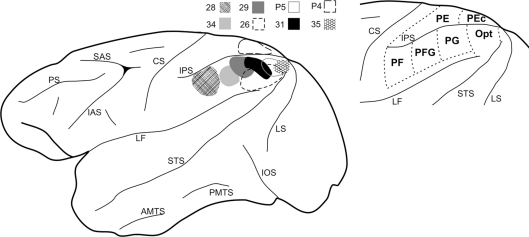
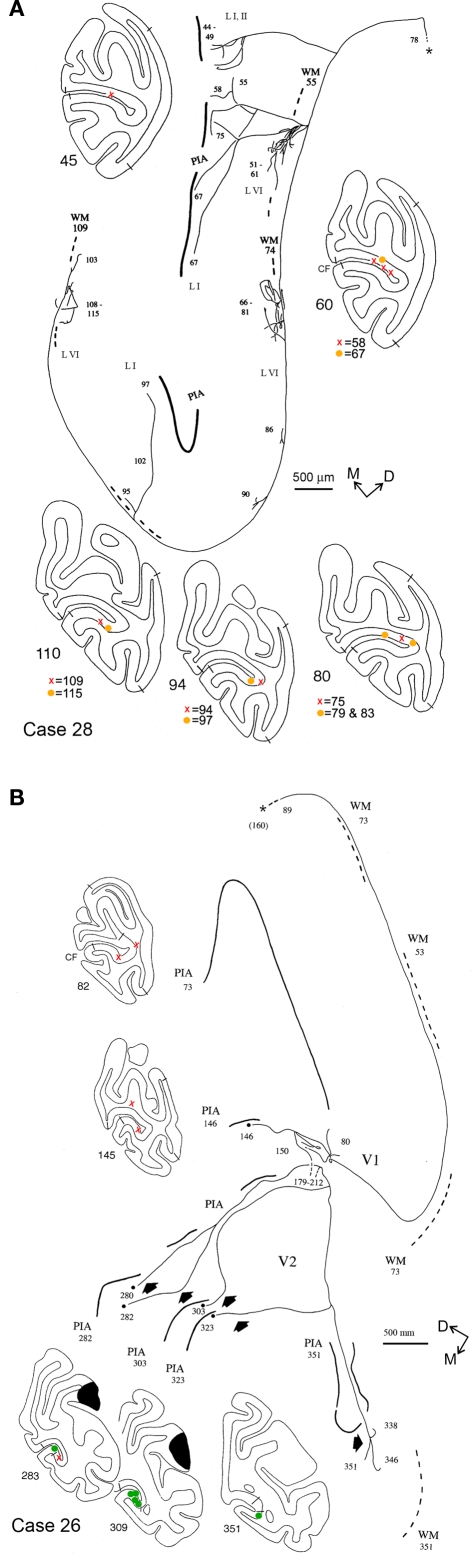
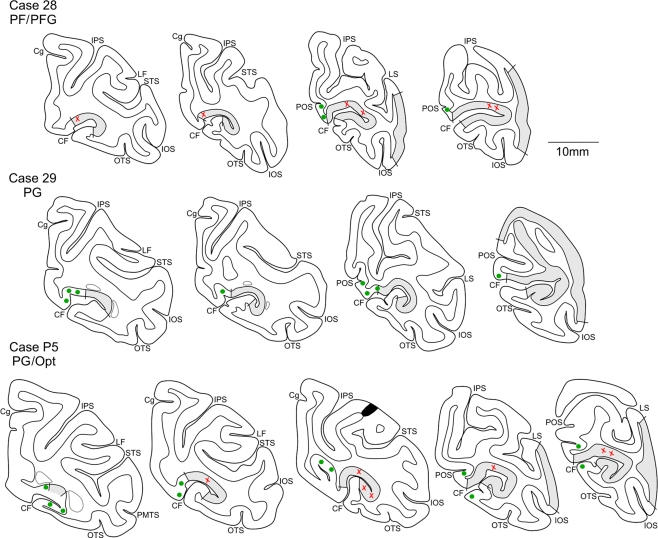
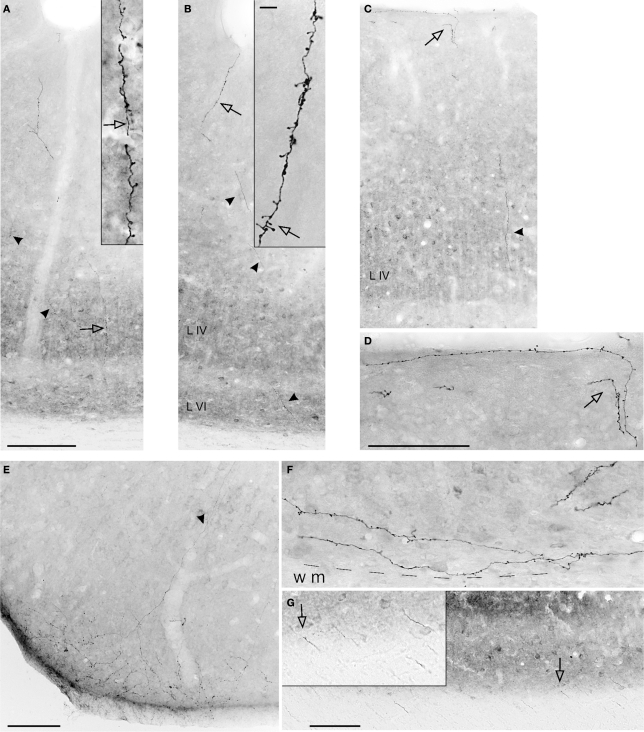
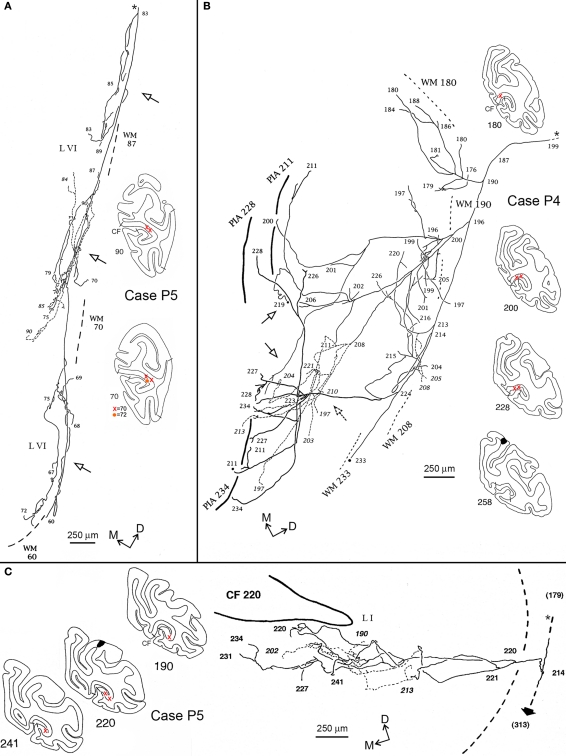
Non-extrastriate projections to area V1 in monkeys, now demonstrated by several anatomical studies, are potential substrates of physiologically documented multisensory effects in primary sensory areas. The full network of projections among association and primary areas, however, is likely to be complex and is still only partially understood. In the present report, we used the anterograde tracer biotinylated dextran amine to investigate projections to areas V1 and V2 from subdivisions of the parietal association cortex in macaque. Parietal cortex was chosen to allow comparisons between projections from this higher association area and from other previously reported areas. In addition, we were interested in further elucidating pathways to areas V1 and V2 from parietal areas, as potentially contributing to attention and active vision. Of eight cases, three brains had projections only to area V2, and the five others projected to both areas V1 and V2. Terminations in area V1 were sparse. These were located in supragranular layers I, II, upper III; occasionally in IVB; and in layer VI. Terminations in V2 were denser, and slightly more prevalent in the supragranular layers. For both areas, terminations were in the calcarine region, corresponding to the representation of the peripheral visual field. By reconstructions of single axons, we demonstrated that four of nine axons had collaterals, either to V1 and V2 (n = 1) or to area V1 and a ventral area likely to be TEO (n = 3). In area V1, axons extended divergently in layer VI as well as layer I. Overall, these and previous results suggest a nested connectivity architecture, consisting of multiple direct and indirect recurrent projections from association areas to area V1. Terminations in area V1 are not abundant, but could be potentiated by the network of indirect connections.
猴脑中向 V1 区的非外纹状投射,现在已被几项解剖学研究证明,是初级感觉区中生理记录到的多感觉效应的潜在基质。然而,联络区和初级区之间的完整投射网络可能很复杂,目前仍只是部分理解。在本报告中,我们使用顺行示踪剂生物素化葡聚糖胺,研究了猕猴顶叶联络皮质各亚区向 V1 和 V2 区的投射。选择顶叶皮质是为了能够将来自这个高级联络区的投射与来自其他先前报道的区域的投射进行比较。此外,我们还对来自顶叶区到 V1 和 V2 区的潜在有助于注意力和主动视觉的投射途径感兴趣。在 8 个案例中,有 3 个大脑只有向 V2 区的投射,而另外 5 个则向 V1 和 V2 区投射。在 V1 区的终止部位稀疏。这些终止部位位于颗粒层 I、II、上 III;偶尔在 IVB;以及在 VI 层。在 V2 区的终止部位更密集,在颗粒层稍占优势。对于这两个区域,终止部位都在楔回区,对应于外周视野的代表区域。通过对单个轴突的重建,我们证明了 9 个轴突中的 4 个有分支,要么到 V1 和 V2(n=1),要么到 V1 和一个可能是 TEO 的腹侧区域(n=3)。在 V1 区,轴突在 VI 层和 I 层都呈发散状延伸。总的来说,这些结果和以前的结果表明,存在一种嵌套的连接结构,由来自联络区的多个直接和间接的反复投射组成,投射到 V1 区。V1 区的终止部位不丰富,但可能通过间接连接网络得到增强。