The Cognitive Neurophysiology Laboratory, Nathan S. Kline Institute for Psychiatric Research Orangeburg, New York, NY, USA.
Front Integr Neurosci. 2011 Jun 22;5:23. doi: 10.3389/fnint.2011.00023. eCollection 2011.
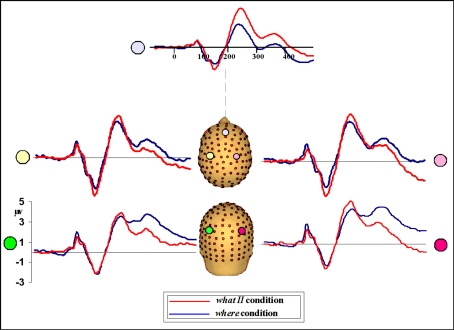
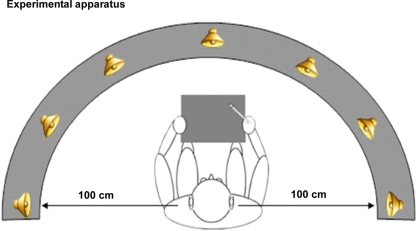
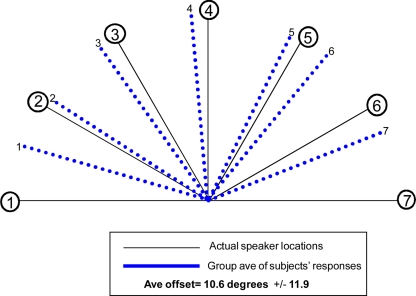
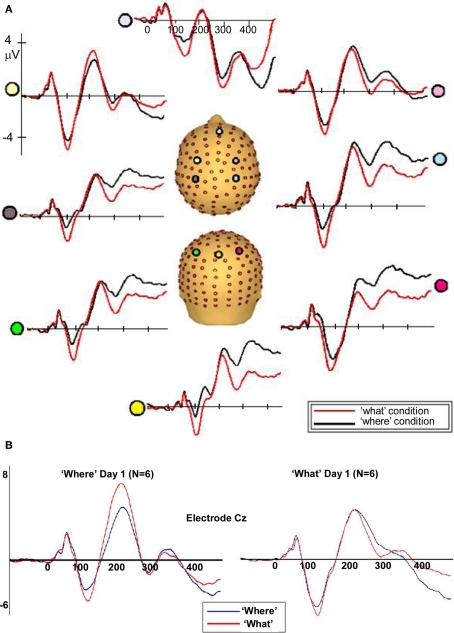
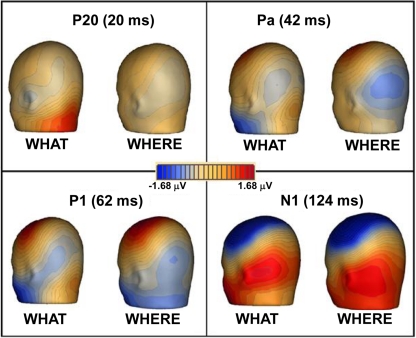
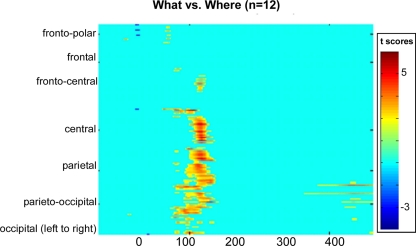
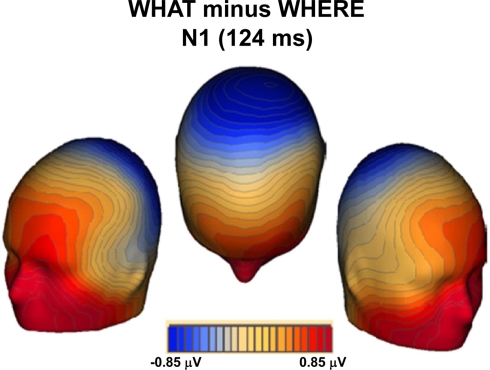
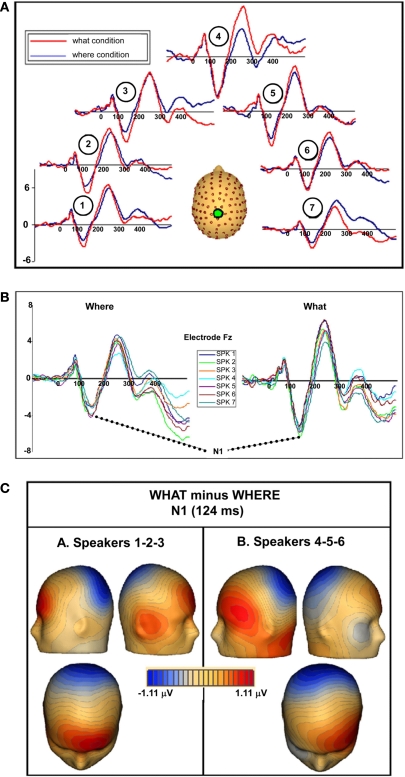
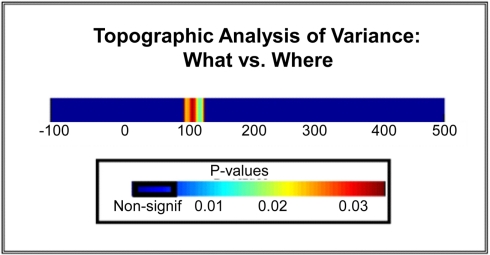
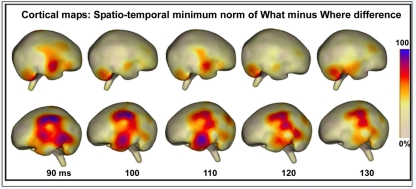
Functionally distinct dorsal and ventral auditory pathways for sound localization (WHERE) and sound object recognition (WHAT) have been described in non-human primates. A handful of studies have explored differential processing within these streams in humans, with highly inconsistent findings. Stimuli employed have included simple tones, noise bursts, and speech sounds, with simulated left-right spatial manipulations, and in some cases participants were not required to actively discriminate the stimuli. Our contention is that these paradigms were not well suited to dissociating processing within the two streams. Our aim here was to determine how early in processing we could find evidence for dissociable pathways using better titrated WHAT and WHERE task conditions. The use of more compelling tasks should allow us to amplify differential processing within the dorsal and ventral pathways. We employed high-density electrical mapping using a relatively large and environmentally realistic stimulus set (seven animal calls) delivered from seven free-field spatial locations; with stimulus configuration identical across the "WHERE" and "WHAT" tasks. Topographic analysis revealed distinct dorsal and ventral auditory processing networks during the WHERE and WHAT tasks with the earliest point of divergence seen during the N1 component of the auditory evoked response, beginning at approximately 100 ms. While this difference occurred during the N1 timeframe, it was not a simple modulation of N1 amplitude as it displayed a wholly different topographic distribution to that of the N1. Global dissimilarity measures using topographic modulation analysis confirmed that this difference between tasks was driven by a shift in the underlying generator configuration. Minimum-norm source reconstruction revealed distinct activations that corresponded well with activity within putative dorsal and ventral auditory structures.
在非人类灵长类动物中,已经描述了用于声音定位(WHERE)和声音对象识别(WHAT)的功能上不同的背侧和腹侧听觉通路。少数研究探索了人类在这些流中的差异处理,结果高度不一致。所使用的刺激包括简单的音调、噪声爆发和语音,具有模拟的左右空间操作,并且在某些情况下,参与者不需要主动区分刺激。我们认为,这些范式不太适合分离两个流中的处理。我们的目的是确定使用更好的 WHAT 和 WHERE 任务条件,我们是否能够在早期处理中找到可分离途径的证据。使用更有说服力的任务应该使我们能够放大背侧和腹侧通路内的差异处理。我们使用高密度电映射,使用相对较大且具有实际环境的刺激集(七种动物叫声),从七个自由场空间位置传递;在“WHERE”和“WHAT”任务中,刺激配置完全相同。地形分析显示,在 WHERE 和 WHAT 任务期间存在明显的背侧和腹侧听觉处理网络,最早的分歧点出现在听觉诱发反应的 N1 成分中,大约在 100ms 时开始。虽然这种差异发生在 N1 时间范围内,但它不是 N1 幅度的简单调制,因为它显示出与 N1 完全不同的地形分布。使用地形调制分析的全局不相似性度量证实,任务之间的这种差异是由基础发生器配置的变化驱动的。最小范数源重建显示出与假定的背侧和腹侧听觉结构内的活动相对应的明显激活。