Akirav Irit
Department of Psychology, University of Haifa Haifa, Israel.
Front Behav Neurosci. 2011 Jun 23;5:34. doi: 10.3389/fnbeh.2011.00034. eCollection 2011.
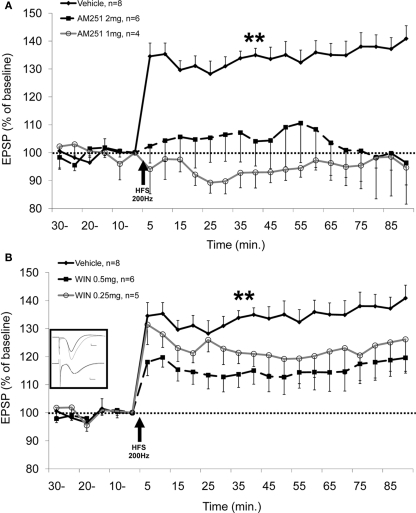
Cannabinoid agonists generally have a disruptive effect on memory, learning, and operant behavior that is considered to be hippocampus-dependent. Nevertheless, under certain conditions, cannabinoid receptor activation may facilitate neuronal learning processes. For example, CB(1) receptors are essential for the extinction of conditioned fear associations, indicating an important role for this receptor in neuronal emotional learning and memory. This review examines the diverse effects of cannabinoids on hippocampal memory and plasticity. It shows how the effects of cannabinoid receptor activation may vary depending on the route of administration, the nature of the task (aversive or not), and whether it involves emotional memory formation (e.g., conditioned fear and extinction learning) or non-emotional memory formation (e.g., spatial learning). It also examines the memory stage under investigation (acquisition, consolidation, retrieval, extinction), and the brain areas involved. Differences between the effects of exogenous and endogenous agonists are also discussed. The apparently biphasic effects of cannabinoids on anxiety is noted as this implies that the effects of cannabinoid receptor agonists on hippocampal learning and memory may be attributable to a general modulation of anxiety or stress levels and not to memory per se. The review concludes that cannabinoids have diverse effects on hippocampal memory and plasticity that cannot be categorized simply into an impairing or an enhancing effect. A better understanding of the involvement of cannabinoids in memory processes will help determine whether the benefits of the clinical use of cannabinoids outweigh the risks of possible memory impairments.
大麻素激动剂通常对记忆、学习和操作性行为具有破坏作用,这种作用被认为依赖于海马体。然而,在某些情况下,大麻素受体激活可能会促进神经元学习过程。例如,CB(1)受体对于条件性恐惧关联的消退至关重要,这表明该受体在神经元情绪学习和记忆中发挥着重要作用。本综述探讨了大麻素对海马体记忆和可塑性的多种影响。它展示了大麻素受体激活的效果如何因给药途径、任务性质(是否具有厌恶性质)以及它是否涉及情绪记忆形成(例如条件性恐惧和消退学习)或非情绪记忆形成(例如空间学习)而有所不同。它还研究了所调查的记忆阶段(获取、巩固、检索、消退)以及涉及的脑区。同时也讨论了外源性和内源性激动剂作用的差异。注意到大麻素对焦虑的明显双相作用,因为这意味着大麻素受体激动剂对海马体学习和记忆的影响可能归因于焦虑或应激水平的一般调节,而不是记忆本身。综述得出结论,大麻素对海马体记忆和可塑性具有多种影响,不能简单地归类为损害或增强作用。更好地理解大麻素在记忆过程中的参与情况将有助于确定大麻素临床使用的益处是否超过可能的记忆损害风险。