Hamzeh F M, Lietman P S, Gibson W, Hayward G S
Division of Clinical Pharmacology, Johns Hopkins School of Medicine, Baltimore, Maryland 21205.
J Virol. 1990 Dec;64(12):6184-95. doi: 10.1128/JVI.64.12.6184-6195.1990.
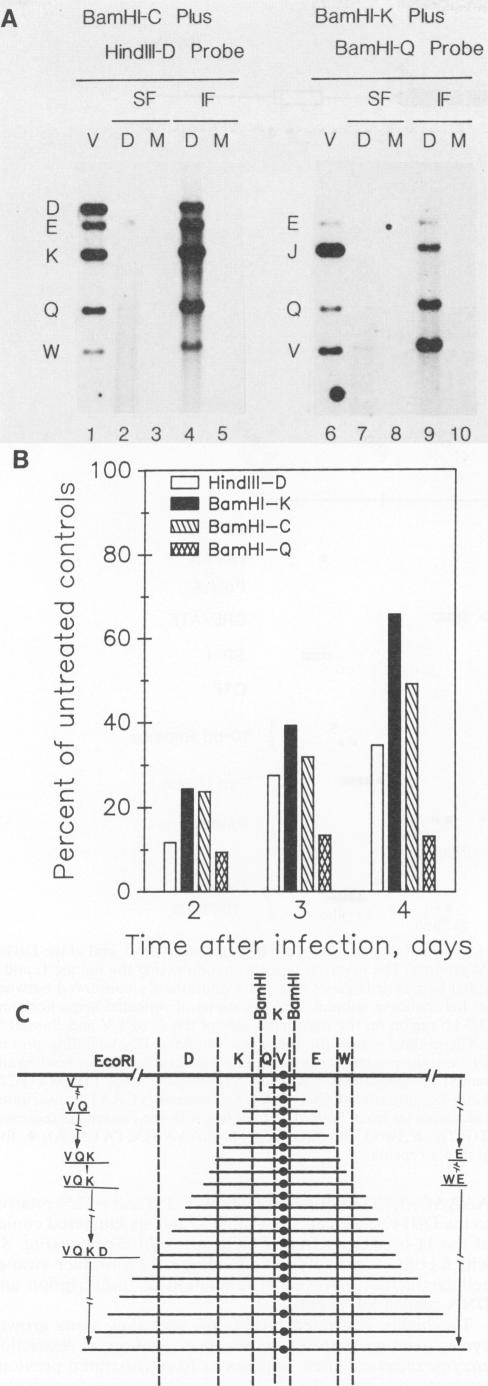
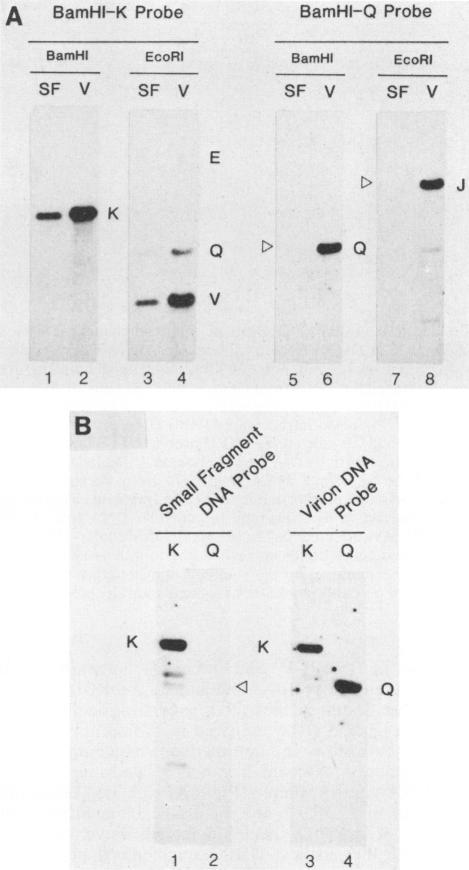
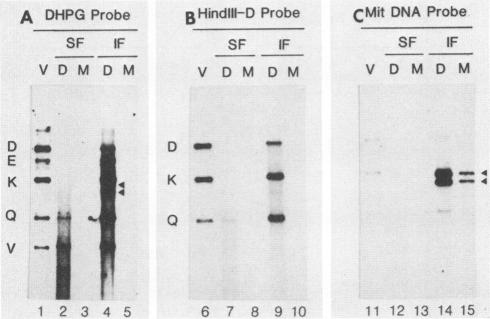
Infection with human cytomegalovirus in the presence of the antiviral nucleotide analog ganciclovir results in continuing low-level viral DNA synthesis and the accumulation of relatively small fragments of double-stranded progency DNA. These fragments consistently proved to represent amplification of sequences from only one small section of the viral genome (EcoRI-V) lying near the center of the unique L segment. Further mapping revealed that the viral sequences represented in these fragments occurred in gradients of abundance that decreased in both directions from a point near 0.35 to 0.4 map unit. The proportion of amplified sequences increased with both time after infection and dosage of ganciclovir used. We conclude that the primary lytic cycle replication origin of human cytomegalovirus lies within a 3- to 4-kb region immediately upstream and to the right of the promoter for the single-stranded DNA-binding protein (DB140). The amplified origin-containing DNA molecules appeared to arise by continuing rounds of bidirectional initiation on truncated fragments of the genome that were generated as a result of chain termination effects induced by the incorporation of ganciclovir into the viral DNA. Inspection of the DNA sequence in the vicinity of ori-Lyt revealed a large complex upstream region that may be a noncoding intergenic domain and that bears no homology to any previously described herpesvirus origin. This 2.5-kb region includes many duplicated and inverted sequences, together with consensus CRE/ATF and other transcription factor-binding sites, and an interesting set of 23 copies of an interspersed decamer consensus element AAAACACCGT that is also conserved at the equivalent locus in simian cytomegalovirus. This work represents the first identification of an origin domain in a cytomegalovirus genome and is the first demonstration of a bidirectional mechanism for any herpesvirus lytic cycle origin.
在抗病毒核苷酸类似物更昔洛韦存在的情况下,人巨细胞病毒感染会导致持续的低水平病毒DNA合成以及双链子代DNA相对小片段的积累。这些片段一直被证明仅代表来自病毒基因组唯一L区段中心附近一个小区域(EcoRI-V)的序列扩增。进一步的图谱分析表明,这些片段中所代表的病毒序列以丰度梯度出现,从靠近0.35至0.4图单位的一点向两个方向递减。扩增序列的比例随感染后的时间以及所用更昔洛韦的剂量增加而增加。我们得出结论,人巨细胞病毒的主要裂解周期复制起点位于单链DNA结合蛋白(DB140)启动子上游紧邻且右侧的3至4kb区域内。含有扩增起点的DNA分子似乎是由于更昔洛韦掺入病毒DNA诱导的链终止效应所产生的基因组截短片段上持续进行的双向起始轮次而产生的。对ori-Lyt附近的DNA序列检查揭示了一个大的复杂上游区域,该区域可能是一个非编码基因间结构域,且与任何先前描述的疱疹病毒起点均无同源性。这个2.5kb区域包括许多重复和反向序列,以及共有CRE/ATF和其他转录因子结合位点,还有一组有趣的23个散布的十聚体共有元件AAAACACCGT的拷贝,该元件在猴巨细胞病毒的等效位点也保守。这项工作代表了在巨细胞病毒基因组中首次鉴定出一个起点结构域,并且是首次证明任何疱疹病毒裂解周期起点的双向机制。