Höss A, Moarefi I F, Fanning E, Arthur A K
Institut für Biochemie, Munich, Federal Republic of Germany.
J Virol. 1990 Dec;64(12):6291-6. doi: 10.1128/JVI.64.12.6291-6296.1990.
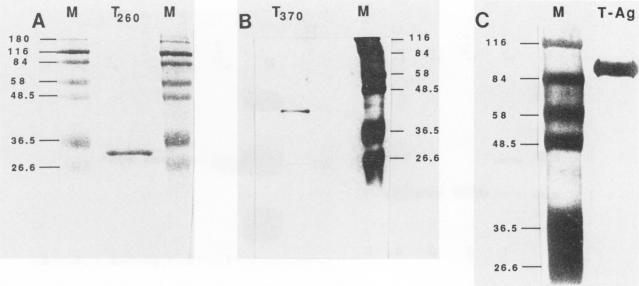
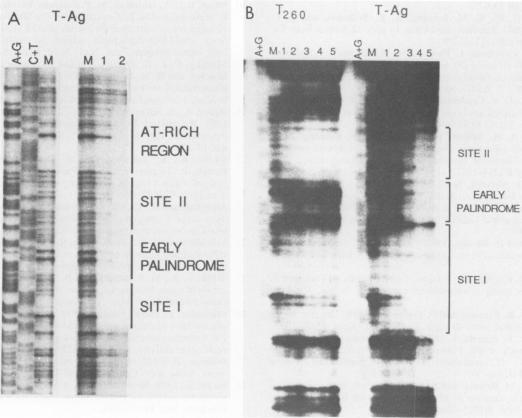
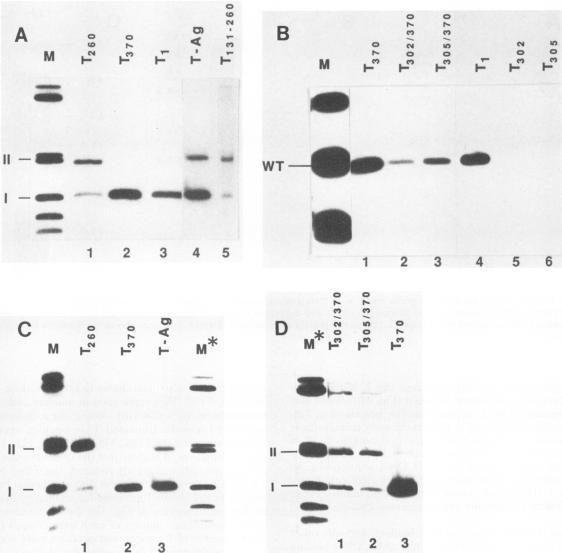
The specificity and regulation of protein-DNA interactions play a crucial role in all aspects of communication between genotype and phenotype in a cell. The large T antigen of simian virus 40 binds to identical, yet quite differently arranged, pentanucleotide motifs in the simian virus 40 control region, sites I and II. Wild-type T antigen preferentially binds site I. We demonstrate that a bacterial peptide encoding residues 1 to 259 (T260) includes the essential amino acids required for binding to both DNA sites but predominantly binds site II. However, a longer peptide (residues 1 to 369; T370) binds almost exclusively to site I. Thus, the addition of amino acids 260 to 369 to the T260 peptide results in the loss of site II binding. This region includes a single putative metal-binding region, and mutation of T370 at either conserved cysteine of the finger results in equal but inefficient binding to both sites. While no metal binding has been shown to be directly associated with this sequence, these results suggest a novel, perhaps structural, function for such a finger motif, since this domain of T antigen appears to play a crucial role in modulating the DNA-binding behavior of T-antigen peptides.
蛋白质与DNA相互作用的特异性和调控在细胞内基因型与表型之间的所有通讯环节中都起着关键作用。猴病毒40的大T抗原与猴病毒40控制区中相同但排列方式迥异的五核苷酸基序结合,即位点I和位点II。野生型T抗原优先结合位点I。我们证明,编码1至259位残基的细菌肽(T260)包含与两个DNA位点结合所需的必需氨基酸,但主要结合位点II。然而,更长的肽(1至369位残基;T370)几乎只结合位点I。因此,在T260肽上添加260至369位氨基酸会导致其失去与位点II的结合能力。该区域包含一个单一的假定金属结合区,T370在该指状结构的任何一个保守半胱氨酸处发生突变,都会导致其与两个位点的结合能力相等但效率低下。虽然尚未证明金属结合与该序列直接相关,但这些结果表明了这种指状基序具有一种新的、可能是结构性的功能,因为T抗原的这一结构域似乎在调节T抗原肽的DNA结合行为中起着关键作用。