Loeber G, Parsons R, Tegtmeyer P
Department of Microbiology, State University of New York, Stony Brook 11794.
J Virol. 1989 Jan;63(1):94-100. doi: 10.1128/JVI.63.1.94-100.1989.
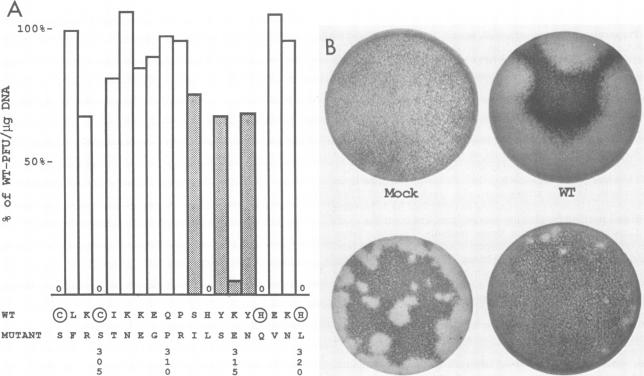
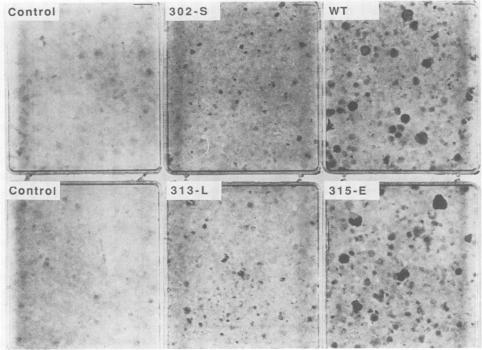
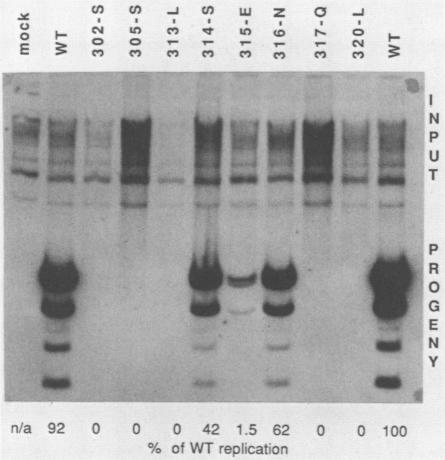
Simian virus 40 large T antigen contains a single sequence element with an arrangement of cysteines and histidines that is characteristic of a zinc finger motif. The finger region maps from amino acids 302 through 320 and has the sequence Cys-302LeuLysCys-305IleLysLysGluGlnProSerHisTyrLysTyrHis- 317GluLysHis-320. In a conventional representation, the binding of zinc to the cysteines and histidines at positions 302, 305, 317, and 320 would form two minor loops and one major loop from the intervening amino acids. We made single amino acid substitutions at every position in the finger to identify possible functional elements within the putative metal-binding domain. Amino acids in the zinc finger could be divided into three classes characterized by distinct roles in DNA replication and transformation. Class 1 consisted of amino acids in the two minor loops of the finger and in the amino-terminal part of the major loop. Mutations here did not affect either replication or transformation. Class 2 consisted of the SerHisTyrLysTyr amino acids located in the carboxy terminus of the major loop of the finger. Mutations in this contiguous region reduced replication of the mutant viruses to different degrees. This clustering suggested that the region is an active site important for a specific function in DNA replication. With the exception of a mutation in the histidine at position 313, these mutations had no effect on transformation. Class 3 consisted of the proposed zinc-binding amino acids at positions 302, 305, 317, and 320 and the histidine at position 313 in the major loop of the finger. Mutations in these amino acids abolished the viability of the virus completely and had a distinctive effect on the transforming functions of the protein. Thus, the five cysteines and histidines of class 3 may play an important role in determining the overall structure of the protein. The histidine at position 313 may function both in the active site where it is located and in cooperation with the proposed zinc-binding ligands.
猴病毒40大T抗原含有一个单一的序列元件,其半胱氨酸和组氨酸的排列具有锌指基序的特征。该锌指区域位于氨基酸302至320之间,序列为Cys-302LeuLysCys-305IleLysLysGluGlnProSerHisTyrLysTyrHis-317GluLysHis-320。按照传统表示法,锌与302、305、317和320位的半胱氨酸和组氨酸结合,会从中间的氨基酸形成两个小环和一个大环。我们在锌指的每个位置进行了单氨基酸替换,以确定假定的金属结合域内可能的功能元件。锌指中的氨基酸可分为三类,它们在DNA复制和转化中具有不同的作用。第1类由锌指的两个小环以及大环氨基末端部分的氨基酸组成。此处的突变既不影响复制也不影响转化。第2类由位于锌指大环羧基末端的SerHisTyrLysTyr氨基酸组成。该连续区域的突变使突变病毒的复制程度不同程度降低。这种聚集表明该区域是DNA复制中特定功能的重要活性位点。除了313位组氨酸的突变外,这些突变对转化没有影响。第3类由302、305、317和320位提议的锌结合氨基酸以及锌指大环中313位的组氨酸组成。这些氨基酸的突变完全消除了病毒的活力,并对蛋白质的转化功能产生独特影响。因此,第3类的五个半胱氨酸和组氨酸可能在决定蛋白质的整体结构中起重要作用。313位的组氨酸可能在其所在的活性位点发挥作用,并与提议的锌结合配体协同作用。