Department of Bioengineering, University of Pennsylvania, Philadelphia, Pennsylvania, United States of America.
PLoS Comput Biol. 2011 Jun;7(6):e1002106. doi: 10.1371/journal.pcbi.1002106. Epub 2011 Jun 30.
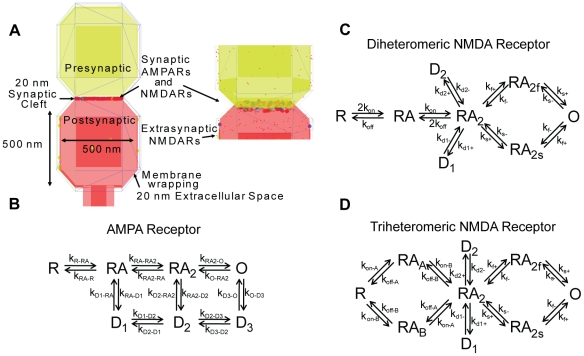
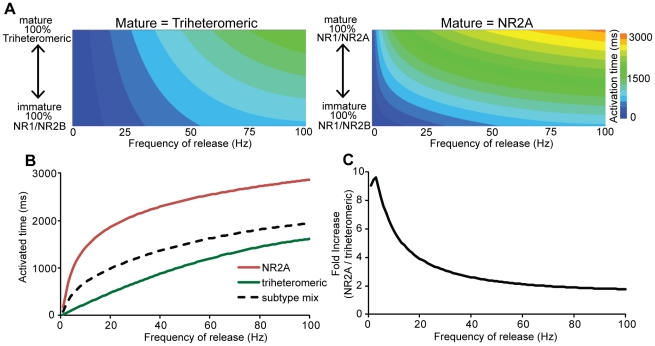
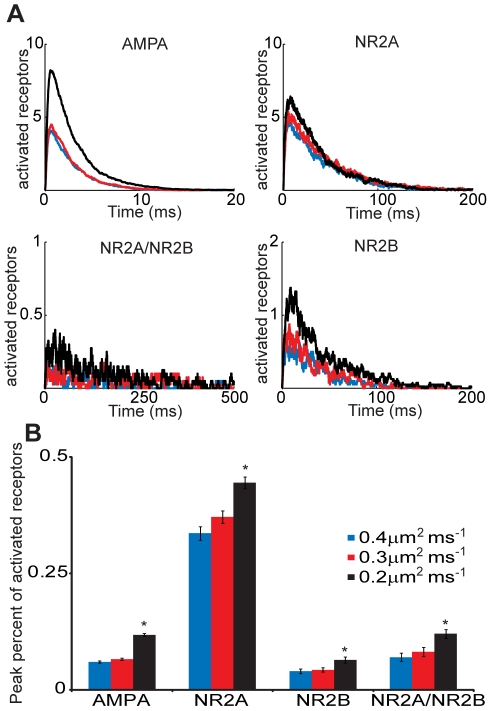
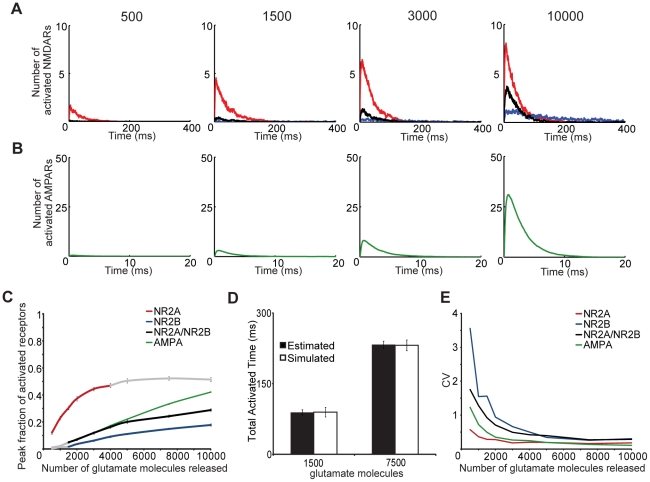
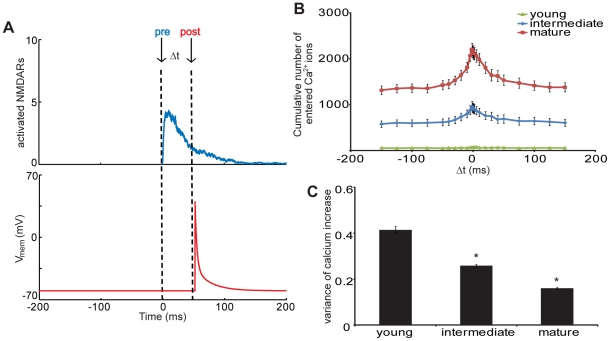
NMDA receptors (NMDARs) are the major mediator of the postsynaptic response during synaptic neurotransmission. The diversity of roles for NMDARs in influencing synaptic plasticity and neuronal survival is often linked to selective activation of multiple NMDAR subtypes (NR1/NR2A-NMDARs, NR1/NR2B-NMDARs, and triheteromeric NR1/NR2A/NR2B-NMDARs). However, the lack of available pharmacological tools to block specific NMDAR populations leads to debates on the potential role for each NMDAR subtype in physiological signaling, including different models of synaptic plasticity. Here, we developed a computational model of glutamatergic signaling at a prototypical dendritic spine to examine the patterns of NMDAR subtype activation at temporal and spatial resolutions that are difficult to obtain experimentally. We demonstrate that NMDAR subtypes have different dynamic ranges of activation, with NR1/NR2A-NMDAR activation sensitive at univesicular glutamate release conditions, and NR2B containing NMDARs contributing at conditions of multivesicular release. We further show that NR1/NR2A-NMDAR signaling dominates in conditions simulating long-term depression (LTD), while the contribution of NR2B containing NMDAR significantly increases for stimulation frequencies that approximate long-term potentiation (LTP). Finally, we show that NR1/NR2A-NMDAR content significantly enhances response magnitude and fidelity at single synapses during chemical LTP and spike timed dependent plasticity induction, pointing out an important developmental switch in synaptic maturation. Together, our model suggests that NMDAR subtypes are differentially activated during different types of physiological glutamatergic signaling, enhancing the ability for individual spines to produce unique responses to these different inputs.
N-甲基-D-天冬氨酸受体(NMDARs)是突触神经传递过程中突触后反应的主要介质。NMDAR 以多种方式影响突触可塑性和神经元存活,其功能多样性通常与多种 NMDAR 亚型(NR1/NR2A-NMDARs、NR1/NR2B-NMDARs 和三聚体 NR1/NR2A/NR2B-NMDARs)的选择性激活有关。然而,缺乏可用的药理学工具来阻断特定的 NMDAR 群体,导致人们对每种 NMDAR 亚型在生理信号传递中的潜在作用存在争议,包括不同的突触可塑性模型。在这里,我们开发了一个典型树突棘的谷氨酸能信号转导的计算模型,以检查在难以通过实验获得的时间和空间分辨率下 NMDAR 亚型的激活模式。我们证明了 NMDAR 亚型具有不同的激活动态范围,NR1/NR2A-NMDAR 的激活对单囊泡谷氨酸释放条件敏感,而含有 NR2B 的 NMDAR 则在多囊泡释放条件下发挥作用。我们进一步表明,NR1/NR2A-NMDAR 信号在模拟长时程抑制(LTD)的条件下占主导地位,而在近似长时程增强(LTP)的刺激频率下,含有 NR2B 的 NMDAR 的贡献显著增加。最后,我们表明,在化学 LTP 和尖峰时间依赖可塑性诱导期间,单个突触的 NR1/NR2A-NMDAR 含量显著增强了反应幅度和保真度,指出了突触成熟过程中的一个重要发育开关。总之,我们的模型表明,在不同类型的生理谷氨酸能信号传递过程中,NMDAR 亚型以不同的方式被激活,增强了单个棘突对这些不同输入产生独特反应的能力。