Max Planck Institute for Plant Breeding Research, Cologne, Germany.
PLoS One. 2011;6(6):e20886. doi: 10.1371/journal.pone.0020886. Epub 2011 Jun 30.
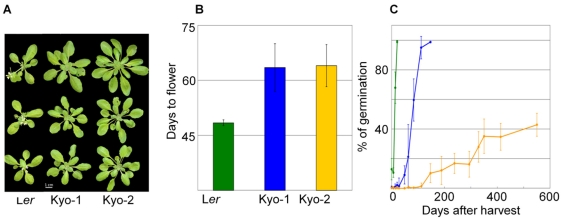
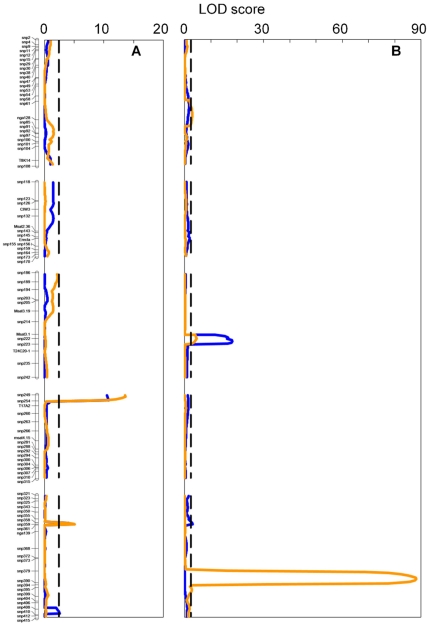
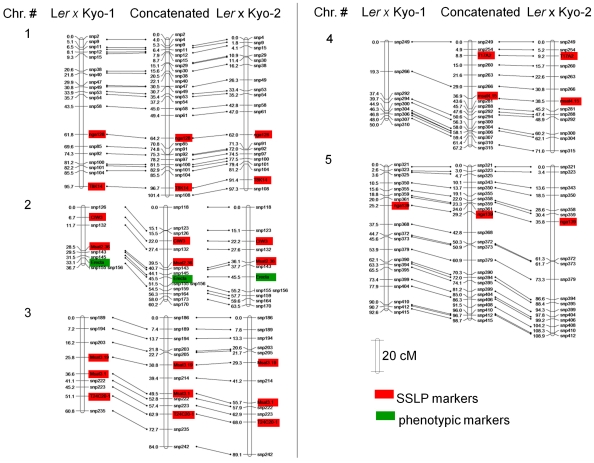
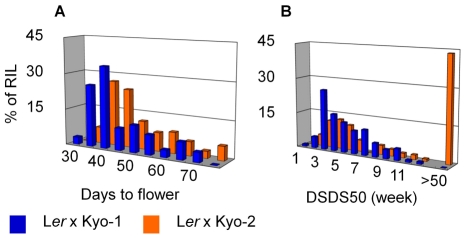
A Quantitative Trait Locus (QTL) analysis was performed using two novel Recombinant Inbred Line (RIL) populations, derived from the progeny between two Arabidopsis thaliana genotypes collected at the same site in Kyoto (Japan) crossed with the reference laboratory strain Landsberg erecta (Ler). We used these two RIL populations to determine the genetic basis of seed dormancy and flowering time, which are assumed to be the main traits controlling life history variation in Arabidopsis. The analysis revealed quantitative variation for seed dormancy that is associated with allelic variation at the seed dormancy QTL DOG1 (for Delay Of Germination 1) in one population and at DOG6 in both. These DOG QTL have been previously identified using mapping populations derived from accessions collected at different sites around the world. Genetic variation within a population may enhance its ability to respond accurately to variation within and between seasons. In contrast, variation for flowering time, which also segregated within each mapping population, is mainly governed by the same QTL.
进行了一项数量性状基因座(QTL)分析,使用了两个来自日本京都同一地点采集的拟南芥基因型与参考实验室品系 Landsberg erecta(Ler)杂交产生的两个新的重组近交系(RIL)群体。我们使用这两个 RIL 群体来确定种子休眠和开花时间的遗传基础,这被认为是控制拟南芥生活史变异的主要特征。分析显示,种子休眠存在数量变异,与一个群体中的种子休眠 QTL DOG1(Delay Of Germination 1 的缩写)的等位基因变异有关,而在另一个群体中则与 DOG6 有关。这些 DOG QTL 之前已经使用来自世界各地不同地点采集的材料衍生的作图群体进行了鉴定。一个群体内的遗传变异可能会增强其对季节内和季节间变异的准确响应能力。相比之下,在每个作图群体内分离的开花时间的变异主要由相同的 QTL 控制。