Department of Entomology, University of Arizona, Tucson, Arizona, United States of America.
PLoS One. 2011;6(6):e21863. doi: 10.1371/journal.pone.0021863. Epub 2011 Jun 30.
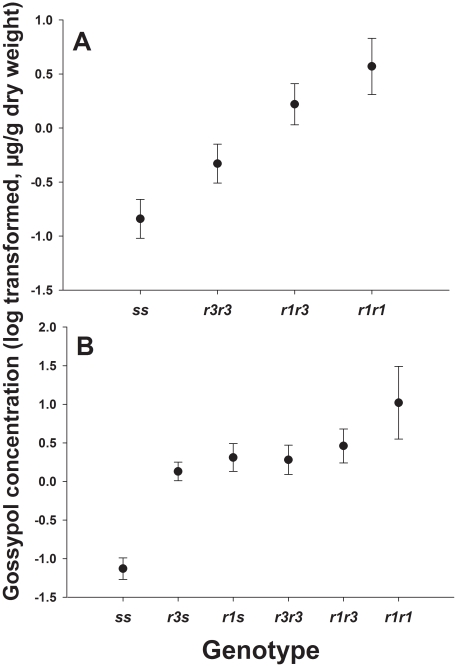
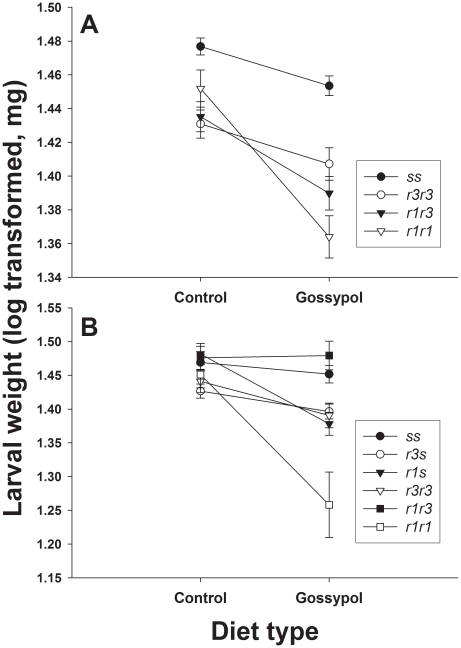
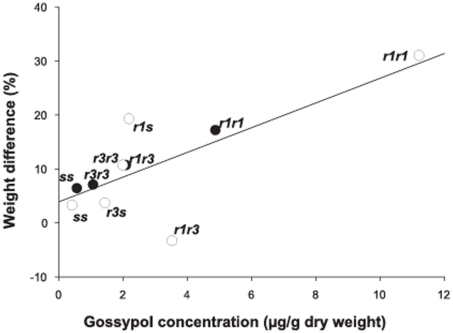
Fitness costs of resistance to Bacillus thuringiensis (Bt) crops occur in the absence of Bt toxins, when individuals with resistance alleles are less fit than individuals without resistance alleles. As costs of Bt resistance are common, refuges of non-Bt host plants can delay resistance not only by providing susceptible individuals to mate with resistant individuals, but also by selecting against resistance. Because costs typically vary across host plants, refuges with host plants that magnify costs or make them less recessive could enhance resistance management. Limited understanding of the physiological mechanisms causing fitness costs, however, hampers attempts to increase costs. In several major cotton pests including pink bollworm (Pectinophora gossypiella), resistance to Cry1Ac cotton is associated with mutations altering cadherin proteins that bind this toxin in susceptible larvae. Here we report that the concentration of gossypol, a cotton defensive chemical, was higher in pink bollworm larvae with cadherin resistance alleles than in larvae lacking such alleles. Adding gossypol to the larval diet decreased larval weight and survival, and increased the fitness cost affecting larval growth, but not survival. Across cadherin genotypes, the cost affecting larval growth increased as the gossypol concentration of larvae increased. These results suggest that increased accumulation of plant defensive chemicals may contribute to fitness costs associated with resistance to Bt toxins.
当具有抗性等位基因的个体比没有抗性等位基因的个体适应性差时,就会出现对苏云金芽孢杆菌(Bt)作物的抗性的适应成本,而这种适应成本的出现与 Bt 毒素无关。由于 Bt 抗性的成本很常见,非 Bt 宿主植物的避难所不仅可以通过提供易感个体与抗性个体交配来延迟抗性的出现,还可以通过选择来对抗抗性。因为成本通常在不同的宿主植物之间有所差异,因此具有能够放大成本或使其不那么隐性的宿主植物的避难所可以增强抗性管理。然而,对导致适应成本的生理机制的理解有限,这阻碍了增加成本的尝试。在包括粉红棉铃虫(Pectinophora gossypiella)在内的几种主要棉花害虫中,对 Cry1Ac 棉花的抗性与改变钙粘蛋白的突变有关,钙粘蛋白是一种在易感幼虫中结合这种毒素的蛋白。在这里,我们报告说,在具有钙粘蛋白抗性等位基因的粉红棉铃虫幼虫中,棉酚的浓度高于缺乏这种等位基因的幼虫。在幼虫的饮食中添加棉酚会降低幼虫的体重和存活率,并增加影响幼虫生长的适应成本,但不影响存活率。在钙粘蛋白基因型中,随着幼虫棉酚浓度的增加,影响幼虫生长的成本也会增加。这些结果表明,植物防御性化学物质的积累增加可能导致与 Bt 毒素抗性相关的适应成本。